Chapter Nine - My last days in the country
At this point I wanted to make a short excursion into Syria, to visit some friends I had made during my trip last May. Back at Beirut's Cola taxi stand, I got out of the bus, and accidentally (?) was exactly at the right spot for service taxi thither. It cost $10 only. Unfortunately I must have been around at the wrong day, at the wrong time, because it took ages to fill up the taxi. I was waiting for over two hours when I asked the driver for the third time how many people he'd gathered. I think to please me he said : "We need only one more..." When that 'one more' hadn't appeared after yet another twenty or so minutes, I decided it was time to pay for the spare seat. As it turned out he had found only one other person, a Palestine girl living in Damascus but studying in Beirut. Clearly he hadn't expected me to pay for that other seat, but he had to leave now, hadn't he ? :-)
Going by taxi was a preferable option to the buses as it didn't include the time-losing stops for refreshments and 'duty free shopping' which you have to take for granted when taking the bus. There was only one brief stop at the Chtaurama Market, the supermarket in Chtaura where all service taxis to and from Damascus seem to make a stop. You can have warm food as well there and everything is cheap enough.
At the border, both the Lebanese and Syrian sides, everything is very relaxed. The only requirement is that you already have a Syrian visa. You get stamped out by a grumpy Lebanese official, and after that you're stamped in by a friendly Syrian custom official. There are of course also customs checks, but these too are very straightforward. At the Lebanese side are some people offering to change Lira to Syrian Pounds. I suggest you do that. There's no catch involved and the moneychangers seem to be very reliable. The going rate will be the black market rate of Syria, which was S£51 to the Dollar at the time I was there. Bringing in more than S£5000 is officially not allowed, but nobody checks. Surely the Syrians know about this, as when you go (back) to Lebanon, there's also a moneychanger on the Syrian side who'll change Pounds to Lira. It's all tolerated though.
Approaching Damascus is always a great sight. Suddenly you see the city, occupying a vast area, lying between the mountains. Travel time had been two hours and 45 minutes, a massive time saving over the bus; I'd seen five hours reported in Lonely Planet's Thorn Tree.
This is a Lebanon travelogue, so I'm not going to say any more about Syria (after all I only went there for a visit), except perhaps that the Alaa Tower Hotel I in Damascus is still as good as it was before, and costs US$ 32, and there's now a direct bus from the capital to Raqqa; it takes approximately seven hours.
The fare to get back from Sham (Damascus) to Beirut was $20, and no bargaining. This is the twice the price I was asked to pay in the other direction ! On top of that, there are self-appointed porters at the taxi stand who'll grab your backpack, even if you don't want it. There was nothing I could do to prevent it; it was more like a small riot, honestly ! Unnecessary to say they expect a tip... The trip in one of the famous big, yellow American cars took over four hours ! This was due to big delays at the Syrian side of the border, where customs officials are very thorough in this direction. Getting stamped out and in was a breeze though, and I saw people obtaining a Lebanese visa in a matter of minutes.
I was back in Beirut. I went to the Embassy Hotel on Rue Makdissi, almost opposite the post office (from where I sent the postcards which never reached their destination). The hotel's a friendly place where a single rooms costs $40 (incl. taxes). It's not too bad but the bathroom's tiny and could do with some attention. The price is too steep for what it is. There's a garden indeed, but it's only a poor representation of what a garden could/should be. Rooms at the back are quiet, considering this is Hamra, and the only noise you'll ever hear, comes from the jets departing from the airport. I got cleaned up a bit and went for a bite. I felt like a 'real' pizza for a change, and dropped in at the Pizza Hut on the corner of Rue Hamra and Rue de Rome. It's what you'd expect it to be. It's quite expensive, but the people serving you are very friendly. Mostly they're students and are interested in making conversations. The ice cream in the Hut is the best I had in Lebanon ! Really, you should try it !
Having nothing to do in particular that afternoon, I walked all the way to one of the south-eastern suburbs to get an impression of the war damage. The suburbs still have most of the visible damage today, I think. It was really a sobering experience !
I had one full day left after that. First thing I did in the morning was changing hotels. I went looking for Hotel Mace, but somehow couldn't find it, and nobody knew it. I suspect the name's been changed. I tried several other places in Hamra, but at the cheaper ones I was told they were full. I ended up at the Mayflower Hotel, which I'd describe as upper-middle class. It's very friendly and welcoming of backpackers. The hotel has some sort of English atmosphere, making it very pleasant to stay. Many of the guests were UN personnel. The price of a single room is US$ 65 plus 16% tax, but if you ask for a deduction you'll get one : $55 plus 5% tax. The rooms are a bit small but still nice and the beds are extremely comfortable. There's A/C, a well-equipped bathroom, international telephone, satellite TV, room service,...
This last day, I decided to make a day trip to Lake Qaraoun and the Litani Dam. First I took a service taxi to the Cola taxi stand. There I changed for a service taxi going to Chtaura. It cost LL 5000 and took only about five minutes to fill up. It had been raining early morning, making the mountain roads very slippery; there was also a dense fog on the summits. In no time I saw twenty, thirty accidents, all of them caused by excessive speed or reckless driving. Luckily my driver was careful and thoughtful !
The only option to get to Qaraoun from Chtaura is by ordinary taxi, and it's no bargain ! Hiring a cab for the whole afternoon, taking in the sights I wanted and with plenty of time for photo stops was $50. Mohammed, the driver, was a very nice fellow, and he knew exactly what I could be interested in.
Lake Qaraoun Lake Qaraoun is a very beautiful place. The Litani Dam was smaller than I expected, but made for an interesting visit nevertheless. Qaraoun is in the deep south of the Bekaa Valley, and is very close to Hezbollah fortified firing positions, which are still occasionally subject to Israeli/SLA (air) attacks; some of the strongholds can be seen from the dam. Strangely enough, there's only little visible military presence around the lake. It's recommended to do a tour around the lake and Litani River. There are several eateries and cafes, and the views are good from everywhere.
We returned to Chtaura where I had some great food in some restaurant, but I forgot the name. There are two identically named places next to each other. It's supposed to be the best eatery in town, serving all kind of 'sandwiches'. It's cheap. Everybody should be able to point it out to you as it's well-known in the vicinity.
I spent my last evening in Beirut, but didn't make it very late, as I had to get up at 4.30 the next morning to be at the airport in time. I went to make a final telephone call home to tell my family everything was all right and I'd be back soon. A convenient place to make a call, is a place near the Tourist Information Office/Ministry of Tourism (which are both apparently permanently closed). It's easy to find. Just go south from the Pizza Hut. It's halfway down an empty gallery on your left after a short walk. I realised that at night this can be a dark, uncomfortable place to some people.
For the next morning I had arranged a taxi to take me to the airport. It cost $15 including 'pick-up fee' and tip. A taxi from any hotel is $25. If you just stop a taxi in the streets, the driver will always quote you a too high a price anyway, usually $20, but will eventually come down to around $10-15. Only occasionally you'll bump into a driver who's honest and will take you for - say - LL 5000.
Check-in, security and customs checks at the airport are all very straightforward. I had kept some Lebanese money to pay for the departure tax, but there wasn't any ! Really ! No departure tax ! I went to the airport bank to change the money back to Dollars, but again - just like when I'd arrived - it was closed. This is really a big drawback. Banks at airports should always be open 24 hours, IMHO.
Otherwise the airport's modern, but still has only limited facilities.
The flight was on time, and four hours and fifteen minutes later I was back in Paris, where I took my connecting flight to Brussels.
End note
My stay in Lebanon has been some sort of revelation to me, seeing the damage of war I had seen so often on TV for real. There are lots of interesting and/or beautiful sights to take in and the people were often overwhelmingly friendly. With a history of being 'attached' to the West so closely, it is hardly surprising that it has lost quite a bit of its Arabic authenticity, unlike - for instance - Syria. Still, it's exactly this partly Westernisation which makes the country quite unique in the region. It's like visiting a mixture between Syria and France. It's an easy country to get around in, as distances are small. However, it's not a cheap place and therefore won't generally be on a shoestring traveller's list. Still, if you have lots of time, a combination of service taxis and walking should get you around quite cheaply, but then there's also the high price of accommodation to take into consideration. Still, if you have the money, give Lebanon a try. You won't be disappointed. I surely wasn't!
Showing posts with label Lebanon. Show all posts
Showing posts with label Lebanon. Show all posts
Wednesday, October 15, 2008

Lebanon: The extreme South
Chapter Eight - The extreme South - An interesting journey
Having arrived at Saida's Sahet en-Nejmeh, the city's main square, I needed to find the only hotel in town, the Nazel esh-Sharq (Hotel d'Orient). I asked around. One man said he knew where it was and offered to drive me there. It wasn't far, but it would have been almost impossible to find, as I don't speak Arabic and the hotel's sign is in Arabic writing only. It's above a shop which sells sanitary products like soap and women's stuff. The guy who'd driven me, showed me the place, but expected a small tip for the ride.
A room in the hotel was $10 for a single, cheap to Lebanese standards. Rooms can be had at various places in the hotel. I chose one upstairs, with a small balcony overlooking the street. Although there's a mosque very nearby, I'd still recommend taking a room there; there's hardly any traffic at night and it avoids the noise from the lounge near the reception.
The rooms were only just acceptable. A toilet and shower were down the hall, but the bathroom was really awful. It took water ten minutes to sip through the dirt in the sink. Still, it's a friendly and relaxed place.
It was after dark when I had arrived at the Hotel d'Orient. I decided to go for a walk to the seafront. It had been a busy (market) day; the street was full of garbage. When cars passed me, I heard a sound as if something snapped. There was an awful stench. When I got into the light, I saw that the cars were running over the carcasses of slaughtered lambs, hence the breaking sound...
Yes, Saida (Sidon) was a pretty dirty city... Pretty gloomy too.
I went looking for the telephone office, which was supposed to be a large white building with a huge antenna on the roof, not far from the Government Rest House. Not so. The office is now to the east of Sahet en-Nejmeh. A friendly local whom I had asked about it, took me to it. It's a busy place, and I had to wait about 45 minutes before I could get on the phone.
Saida port The next day I went to explore the city. From the hotel it's easy to do a walking tour. First, I walked to the Castle of Louis. It's completely fenced off and not accessible. Not a great loss, although with some restoration it could be quite a fascinating place.
Then I walked down the road to the coast and proceeded in the direction of the port, passing by the minaret of the Great Mosque. The port's nice; fishermen are busy with their boats 'n' nets. Opposite the port is the Khan al-Franj, a 17th century caravanserai built by Fakhr ad-Din. It's being restored, but about one half has already been completed and is open to the public. The archaeologists have done a nice job. When I was there, there was an exhibition of modern art. It consisted of collages, involving press-cuttings and photocopies of official documents about the Israeli occupation and the cruelties against the Lebanese people. The work was often beautifully executed, but more important, it gave a lot of food for thought. How is it possible that people do such things to one another ? Really, this exposition called for an hour of silence, not just a minute...
At the Khan I also met the archaeologist in charge of the restorations. He was a friendly guy, only slightly older than me. He had some problems with chemical reactions between certain stones and other substances. I helped him out with that. To show his appreciation, he offered to show me to some of the monuments in town, some of which he had also worked on. Quite interesting. We walked around the fascinating souq area, not as fascinating as that in some of the more famous cities, but worth exploring nevertheless. The people were not exactly welcoming here though, and I even had garbage thrown at my head for taking pictures in the narrow alleys (although they can't have been compromising for anyone; I didn't photograph Muslim women or the likes). I visited an old hammam, a palace of Fakhr ad-Din, an old olive soap factory and finally the Great Mosque. Inside, this is a very, very beautiful place. It's very nicely restored. My new-made friend had worked on it himself. He told me the mosque had been largely destroyed by Israeli bombing. The archaeologists had rebuilt it, but had used the shattered decorations, both to keep the authenticity and as a testimony to what happened to the building.
One shouldn't just barge in here, but ask around if a visit is possible. Forget about it during prayer times. Not only will you be denied entry, but you may even arouse some anger (so I was told) !
Back at the Khan al-Franj we said good-bye, and I continued to the Sea Castle, the highlight of Saida. It's understandable why, when comparing it to the town's other attractions. In essence, this Frankish castle lies off-shore, only connected to the land by a causeway. I bought my ticket at the small booth. It was LL 2000. The guy selling them was a grumpy fella - Yes, you are right when you conclude Saida's not exactly the most friendly town in Lebanon...
View from the Sea Castle Having walked down the causeway, I came to the base of the castle. What I immediately noticed were segments of old columns, incorporated as building material in the walls. Quite odd. There's not much to see inside, but the location is superb and so are the views from the roofs.
I took a taxi to the Temple of Echmoun, only a short ride out of town (they'll hit you for LL 9000 if they notice you don't know how far it is !). There's no charge for entering the site, just a couple of unfriendly soldiers. It's one of those places that are actually only appealing to archaeologists; there's little to see for the 'ordinary' traveller. The mosaics were said to be fine, but I found them only mediocre. I only saw mosaics with patterns, not depicting anything in particular.
The area where the temple is located is quite nice, so I decided to walk back to town (it's not exactly a place to catch a cab anyway). Most of the walk is out in the open, and it was bloody hot. The way back - especially if you came by taxi - is not so obvious, so I asked a guy for directions. After I had continued for a couple of hundred metres, this very guy came after me on his small motorcycle and offered me a ride into town. He didn't expect anything and was just being friendly. I was very thankful.
By the time I arrived back at the hotel it was late afternoon, and I decided I could better move on to Tyre, instead of spending another night in the rather grubby room I had stayed in the night before. At Sahet en-Nejmeh I asked around about service taxis to Tyre (Sour). A man told me there was a minibus as well; he was going in the same direction himself. Once on board of the bus, I asked the man how much the ride cost. He signalled me not to worry about it. He had to get out somewhere along the way, and when he did, I noticed him paying for my ride. Incredible ! A total stranger paying for my ride !...
Distances in Lebanon are never long, but travel can take quite a while if you've got to go through the mountains. Saida and Tyre, however, were both located on the coastal strip, so it didn't take long to get from A to B.
Tyre is Lebanon's southernmost city, and hence it was - and still is - very vulnerable to Israeli raids. Not surprisingly, tourist business is not too much to speak of and there are only three hotels. I chose the cheapest, the Hotel Elyssa, right near the coast where - according to the locals - Israeli gunboats still occasionally blast Lebanese boats to smithereens. A decent single room with A/C was $35. I recommend taking a room at the back. Those have good views of Sour's el-Bass district with nice mountain backdrops. The hotel used to have a restaurant, but due to extremely bad business, it has been closed. So now you can't have breakfast or even a drink. Luckily there's a good Lebanese fast food restaurant only a short distance down the road. It's called the Jawad Food Center. They specialise in juices, and have quite excellent burgers, pizzas, and the usual stuff. They also sell the tasty local honey. For breakfast I recommend a patisserie at the el-Bass end of Rue Abu Dib. Their croissants are lovely and not too expensive. Not a very friendly place though.
Tyre. The sights. There are three sites. One is called the City Ruins (because that's where the centre of the city was located), next to that is a fenced-off site with the remains of a Crusader Cathedral (inaccessible to the public) and finally there's a big, spread-out site at the suburb of el-Bass.
Tyre is a city with an incredibly rich history. It would lead too far to summarise that here (there are more than enough other sources for that). Suffice to say that it was a major Phoenician seaport from about 2000 BC onwards through the Roman period. Today all of tyre is situated on the mainland, but in the old days the headland was an island. Probably the most famous episode in the history of the city was its resistance to the Macedonian conqueror Alexander the Great, whose army took it after a seven-month siege in 332, using floating batteries and building a causeway to gain access to the island. After the defeat of Tyre, 10,000 of its inhabitants were put to death, and another 30,000 were sold as slaves. Alexander's causeway, which was never removed, converted the island into a peninsula. I decided to walk to the City Ruins first. Easy enough from the Elyssa hotel; you just follow the coastal road north-west for a couple of hundred metres. I'd just started off when a teenager crossed the street in front of me. He looked at me and smiled. I said : "Good afternoon". Instead of replying, he just groaned at me, groaned as if he was cummin' during sex. I was rather taken by surprise by that, and just walked on. I hadn't walked further than, say, twenty metres when I heard someone running towards me, behind me. I suspected it was that weird guy. Not paranoid but always at the ready, I prepared myself to give that someone a good kick in the nuts. The running halted. When I looked after me it was that weirdo indeed. He just stared at me. I asked him : "What do you want ?" "Sex. I want sex", he said. "Well, go and find it somewhere else !" I continued. He came walking next to me, eyeballing me, wetting his lips with his tongue and groaning loudly. I was really bothered by that guy, but decided to ignore him rather than starting a fight. After all, he hadn't physically hurt me himself. But he didn't go away. He followed me all the way to the ruins. There I stopped and told him to fuck off and threatened to go to the police. That scared him and he disappeared, luckily not to come back again. Who said that only women are the targets of sexual harassment ? :-)
Tyre's city ruins with el-Bass in the background Anyway, I was at the ruins. But the entrance is not (anymore) at the end of the coastal road. No, you have to turn right at the closed gate and follow the site around a bit. There's the entrance now. It costs LL 5000 to get in.
It's a visually appealing site, although there are hardly any focal points, except perhaps the Palestra Colonnade. The location is superb with the sea, hills and an unparalleled view of the city in the background. The mosaic road leading to the sunken harbour, the baths and the water reservoirs looking like tombs are the main points of interest.
I left the site and was walking towards the Crusader Cathedral when I bumped into a guy selling the typical Lebanese basket-like breads with sesame seeds. His name was Fadi; everybody called him 'Fadi American', because he always greets everybody in English, very unusual for an Arab. The weird thing is that his English is not at all good, but he "loves the sound of it". He's a bit crazy and poor too, but nevertheless a very joyous chap. He took me to a dental lab in the vicinity. There Mohammad and some associates, all Palestinian, produced false teeth. It was kinda strange spending some time there, but they all spoke English and were very friendly and fun to talk to. Fadi left, but said he'd be back later in the afternoon and would take me around town.
The guys at the lab and I talked about the usual things, to make an acquaintance, and about the history of the city, both in ancient times and in more recent days, namely the conflict with Israel, which is still not finished. I asked about the el-Bass site and got out my Lonely Planet guide which contained a city map. Mohammad took it, looked at the map and explained how to get there. When he closed the book, he noticed the regional map on the back. He raved about it ! I asked him why. He said it was because the map shows the Palestinian Territories separately, whereas all Lebanese maps show only Israel. Everybody got excited and it resulted in Ahmad and Ali offering me a ride to Qana. They had some deliveries to make, and I could come along. What a lucky surprise ! I had planned on going to Qana on my own, but this would save me both time and money. Great ! These guys were absolutely friendly.
Qana has a reputation for being the site of a cave where Jesus performed his first miracle. But for me, it was more interesting as the site of the infamous Qana Massacre, which is known all over the country as the culmination of Israeli aggression. In the night of April 18th 1996, during Israel's 'revenge tour' baptised Grapes of Wrath, Jewish planes fired four phosphor rockets at a UN compound where local people, civilians, had sought refuge from the perils of war. 107 were burned alive, among them also UN soldiers. Israeli military sources claimed it was a computer error which was to blame; they had never intended to strike at civilians. What a load of rubbish. Reconnaissance planes had been observed above the area in the days before the attack. Furthermore, when you drive to the village you can clearly still see the craters of the rockets that cut off the roads, the only roads by which medical assistance could arrive. And phosphor rockets ?...
The drive to Qana from Sour only takes a short while. We passed an army checkpoint and Ahmad said : "These are the last Lebanese soldiers. Now we are entering a grey zone." About one kilometre further on, I think it must have been, I saw a destroyed building, painted all white with the big UN letters on it. An African soldier with the typical blue helmet waved us on, no real checks here. Ahmad continued : "This is the UN buffer zone. It is safe now, but Israel sometimes still fires rockets in this security zone." After another ten minutes, I think, we arrived in Qana. It's a quiet, Shiite village. There's nothing going on really. But that this is not your average village speaks from the big concrete banner across the street. It greets you when you enter and says : "Our message to the world, is the blood of our victims." A bit further on, there's a signpost pointing to the site of the Qana Massacre. It's painted brown, just like the signs to a tourist attraction. And actually it is one too, however a morbid one. Personally, I think people visiting Lebanon should be obliged to visit Qana too, as it'll give them a better insight in the cruelties of war. Like I said before, it's impossible to visit Lebanon and not be confronted with the war. I hate to get involved in politics, and I try not to, but in the case of Lebanon it's just impossible. I don't take sides. I condemn all killings, no matter who does them, but it's pretty obvious who's done them in Qana.
We stopped in front of the UN compound and I entered the site. I guarantee you that it feels odd to suddenly see all the tombs of the victims, laid out at your feet. All graves have the pictures of the dead on them. I must confess seeing this brought tears to my eyes. It's really horrible. It's not like visiting a war cemetery. These people are civilians, not soldiers. I'm not at all very religious, but I did say a prayer for the deceased. There's a board with photographs taken after the attack. They show people burnt beyond recognition, torn away limbs, lifeless children and the UN personnel that had to take care of them. A nearby sign puts the thoughts of the people here into words: "The New Holocaust"...
Behind this unusual cemetery, the barracks which were destroyed by the explosion of the rockets can still be seen. After the victims had been removed from the site, a roof was built over it, making this a very vivid reminder of the conflict. Immediately to the right is the present UN base. There's lots of barbed wire and sand-bags, and there are lookout posts. The occupied territory is very nearby !
We drove to al-Dalafeh, a hamlet of Qana. This is the location of the Cave of the Lord Christ. In that cave Christians celebrate Christmas.
An army post overlooking the valley is located at the start of the steep path which descends to the cave. The soldiers here are very careful, and guns are at the ready, but they were never unfriendly and once they had verified that we were OK, one of them even accompanied us to the grotto. On the way to it we passed several rocks which had persons carved into them. There are also several similar rocks further on. One of them shows a central figure surrounded by 12 others. This is thought to be Jesus and the Twelve Apostles.
The cave is only small and not very interesting, but when you're inside you're standing on the ground where Jesus actually slept ! At least, that's what I was told. As with all Biblically-historical sites, it's hard to prove or deny anything.
Ahmad made his deliveries and after that we returned to Tyre, bypassing a monument on the right side of the road, just out of the village. It's supposed to be the tomb of Hiram, a Phoenician king who ruled Tyre. It's a bit odd, nowadays, to find his grave right there... After all he was a king who maintained friendly relations with Israel...
Back at the dental lab, it didn't take long before Fadi arrived. He had sold all his breads and was now ready to take me on a "city tour"... We walked to el-Bass first, to visit that part of Tyre's ruins. We dropped into several shops on the way. It's a really long walk from the headland to the site, especially since the gate you pass first, namely the one at the end of Rue Abu Dib, is not open. You can climb over the fence if you like, but I don't recommend it. We walked all the way 'round the fence to the eastern entrance, which is the only one open. There's a lonely ticket booth, where you pay the LL 5000 entrance fee. They also have a fair guide book available for LL 3000.
Again this is a site with few distinct landmarks. It's very extensive but except for the Monumental Gate there's little in terms of focal points, making it less appealing. I looked at the funeral complex, the mosaics, the Apollo shrine, the Roman chariot road, the aqueduct and finally arrived at the Hippodrome, which - being 480 metres in length and 120 metres wide - occupies a large part of the site. It had a capacity of about 30,000 spectators. Unfortunately, only a small part has been restored. Still it's supposed to be the best preserved in existence. Under the Hippodrome shops were located.
It was an extremely windy day that day, and at times my eyes were full of the fine sand of which there is in abundance at the site. I decided not to take longer than absolutely necessary. The archaeological remains in Tyre are extensive and historically interesting, but they're only mildly interesting for the more casual visitor, I think.
We headed back downtown. It was late afternoon. Fadi showed me several interesting shops in the old souqs. In the evening we went to eat some great pizzas, and dropped by a games hall. Games halls are slightly different here than at home : it's a house's converted living room, stocked with PCs. You just choose a game and a guy will boot up the CD-ROM for ya'. The PCs performed poorly so it wasn't great fun, but Fadi loved it - he was doing his utmost to please me. And you know what ? Poor Fadi paid it for all expenses that day ! All the money he had earned that day was spent on me ! Unbelievable ! I tried to tell him one time that I'd pay the next time, but I had to use all my humour after that to let him believe I'd been joking... Hospitality is not taken lightly by Arabs ! Truly, it's unbelievable the friendship one encounters in the Arab world. It's unparalleled.
I needed to make an international phone call. There's of course the telephone office at the Western end of the harbour, but there's a closer one not far from Hotel Elyssa. It's back on Rue Abu Dib, a couple of houses to the left across the street (when coming from the hotel).
Late at night, we met Ali (from the dental lab) again. Together we went to visit the bakery where Fadi buys his bread. It's a centuries-old bakery located somewhere in the souqs, still functioning in the traditional way. The freshly-made bread is truly delicious ! After that, we went to Fadi's house, a poor man's residence amidst the dark souqs. I was welcomed by his mother and sister, very nice people. I only stayed for a short while because it was getting rather late and I didn't want to disturb these nice folks for too long. Ali drove me back to my hotel where I said good-bye to him and Fadi. It was the end of an extremely interesting and friendly day. I have good memories of Tyre, especially because of the people I met there. If you make it there, just ask anyone for Fadi American, everybody knows him. Don't take advantage of him, that's only too easy, but send him the best regards of his Belgian friend Patrick, the guy he went to play games with. We'd both highly appreciate that ! Thanks.
After my two nights stay in the Elyssa, I checked out and left for Beirut. I flagged down a passing minibus on the main road. The trip cost LL 5000.
Lebanon: The Chouf Mountains - Home of the Druze
Chapter Seven - The Chouf Mountains - Home of the Druze
The next day I left the Palmyra Hotel in Baalbek. I took a minibus to Chtaura (LL 3000; to Zahlé is strangely enough only LL 1000). I wanted to go to Beiteddine directly (I really hated having to go via Beirut), so had to take a taxi. I asked several taxi drivers but not one wanted to negotiate the 30 bucks they wanted for the ride. They didn't come down one penny !
The ride through the Chouf mountains was extremely nice. The Chouf are a region with lots of water and hence lots of green. They're also the home of the Druze, that odd offspring of the Muslim religion. The Druze were involved in fierce fighting for the mountains during the war. They were outnumbered, but being the dedicated partisans they are, they were victorious regardless.
 The village of Beiteddine is situated in the Chouf. It's famous for the extensive palace complex, built by a Lebanese emir. I first saw the palace from the other side of the valley it overlooks. The Lonely Planet guide says : "The palace almost looks like a vision from a fairy tale." I think that's highly exaggerated. I found it rather plain on the outside from a distance; I almost didn't notice it. I passed a barber's and enquired on how to get there. The guy there promptly gave me a lift.
I paid the LL 5000 entrance tax to the rather unfriendly guys at the reception and entered the Outer Courtyard, a vast empty area flanked by buildings on three sides. I visited the Joumblatt Memorial Exhibition and the Ethnographic Museum, but found neither of them too interesting. I then climbed the main staircase and entered the Central Courtyard. This is extremely beautiful, and so are most of the buildings surrounding it, also on the inside. There's a nice fountain, the views over the valley are good and the colours used in the construction of the quarters are warm and make things very cosy. I had to descend to the lower terraces and the rest of the complex by another, but plain, staircase. The entrance to the Third Court was closed, and I also couldn't visit the extensive kitchens, bathhouse and Tomb of Sitt Chams. Luckily the lovely gardens and the views from them make up for a lot of that loss. There's a mosaic museum in the former stables, but although the atmosphere inside is good (especially because of the good choice of light), I found the collection only very average.
A visit to the Palace of Beiteddine can take quite a while, especially if you want to be thorough. Personally, I found the palace nice but nothing to rave about. The complex's exterior is beautiful and so are some of the interiors (it is forbidden to take photographs inside of those). Unfortunately, most interiors are very plain, and filling the empty space with just some average museum really doesn't make up for that. The palace was occupied by the Israelis during the war, and allegedly they've stolen a lot of its treasures, so it's fortunate that we can still visit it at all.
I grabbed my backpack which I'd left at the palace's entrance and walked the five kilometre down the road around the valley to Deir al-Qamar. The first thing in Deir I came across was Castle Moussa, a very artificial looking building. And artificial it is. It's the product of the mind of a certain Mister Moussa. He wanted to realise his dream of life by building this castle and filling it with wax figures showing traditional Lebanese life the way he saw it.
Entrance is LL 5000. The displays are IMHO pretty crappy, and the whole thing is nothing but a tourist trap of no real interest. At the end of the 'tour', there's an unfriendly souvenir shop and a guy who - if you show enough interest - will serve you a cup of coffee; he grinds the beans in a traditional grinder, making music in the process. Would be nice if it wasn't so 'plastic'; a tip is also expected.
This castle really looks as if it comes out of a fairytale book, contrary to Beiteddine Palace, so it's hard to resist going inside. However, I'd be tempted to recommend to do just that, were it not for the fact that this Mr Moussa built everything with his own bare hands !
Further down the road, I walked into Deir al-Qamar centre. The village is situated more or less 'round a central square with a fountain, a lovely place. Most of the beautiful buildings I saw upon arriving, were definitely old and I understood why all of Deir is rightfully preserved as a national monument. I had to get rid of my backpack. I had a couple of tasty (and cheap enough) hamburgers at Snack Antoun's. The place is located at the corner of the main street, just behind the mosque and is run by Georges Antoun Bassem. He's a really nice guy, and didn't mind at all that I left my pack there until I had finished my visit.
Dominating the square was the Musée Marie Baz, housed in the former palace of Emir Fakhr ad-Dine. Since 1925 it's the property of Baz family, and in 1995 Samir Baz decided to open it to the public and turned it into a wax museum depicting in Lebanese history since 1512. The museum was inaugurated in July 97.
The museum is only small (actually the restaurant inside is bigger than the exposition), but the staff are extremely friendly and helpful. The wax figures are well-executed and the whole gives a pretty good insight in the 'who's who' of Lebanon's history. Entry is a bit steep at LL 6000. There's a guidebook available for LL 3000, but is only a photocopied affair. Still, it can be handy to understand who exactly you're looking at if you're not exactly well-informed about the country.
I decided to look around the rest of the historical buildings but didn't know exactly where to start. My help appeared as if out of nothingness : an older chap approached me and told me he was a guide in Deir al-Qamar. If I wanted to see all the places I just had to follow him. He spoke excellent French and a bit English, and was a great source of information. That guy really knows everything about his village; he already was a guide years before the war, but still does his job with as much love and attention as 25 years ago. His name is George Bustani and you can find him in one of the base rooms of the Palace of Fakhr ad-Din Maan I. Everybody knows him, so you shouldn't have to look around for long.
He showed me all the interesting places, including the old mosque, synagogue, the church containing a miraculous painting and the serail. Everything was well-explained. He's a modest chap and expects only a small tip. LL 2000 should be fine.
After this tour I spent some more time looking around on my own. Then I went to pick up my backpack and took a service taxi to Saida (LL 5000; to Damour (where you can change to another taxi) would have been LL3000).
Lebanon: Baalbek and the Bekaa Valley
Chapter Six - Baalbek and the Bekaa Valley
There are no direct service taxis to Baalbek. You have to get one to Beirut first (LL 10,000) and change there to another (LL 10,000). I took a direct taxi (LL 50,000) because I wanted to go via the high mountain pass and take some pictures on the road. It was a nice drive with some spectacular views, really worth paying the extra bucks for. In winter this road is closed due to extremely heavy snowfall.
There were several checkpoints along the way, especially upon getting closer to the Bekaa Valley. At two of them (both Syrian) I needed to show my passport, and one of them even checked inside the trunk of the car. This was the only time such a thing happened; all the other times I was just waved on by the soldiers.
When I arrived in Baalbek, the first thing that drew my attention was the machine gun fire, seemingly not too far away. I could hear heavy guns firing slow but with force, and hand-held guns replying (?) this with rapid fire. I never found out what was going on, but I do know that several people came out of their houses to listen to it and they started discussing about it.
 Baalbek was the seat of the Hezbollah party, the Shiite Party Of God which was responsible for the famous kidnappings of Western tourists. Nowadays there are welcoming sights, however. Even most of the big posters of the Ayatollah Khomeini that allegedly dominated the streets before, have gone. The city of Baalbek is rather dull, plain in appearance. Not a real surprise considering the modest nature of the Shiites. That's probably why the impressive ruins attract even more attention than they already would otherwise. When I was taken to the Palmyra Hotel (there are only two other, but extremely basic, hotels in Baalbek) they appeared to be literally everywhere. They were so strikingly beautiful that I almost couldn't wait to explore them. This was similar to Palmyra in Syria where the road also goes right past the old remains.
Walking into the oddly-named Palmyra Hotel was like entering a bygone era. Right from the moment I'd passed the iron gate of this 120 years-old hotel, I felt like a character right out of an Agatha Christie novel or something. The place still had the air of the days of before. Inside, the hotel is still very much furnished and decorated as it must have been in the years before the war; on the walls are old black-and-white pictures of the ruins and of the famous people who once stayed there, including Général de Gaulle and the empress of Abyssinia. Even the porters cum waiters cum bellboys seemed to date back to that time. I loved it from the second I entered. Rooms didn't come cheap, though, at LL 55,000/70,000 for singles/doubles, plus 15% service tax and 5% err... tax. Still, it's a blast staying there ! The proprietor, Ali Husseini, wrote in the Daily Star Online the following about the people who visit nowadays : "They're the curious, intellectual type. They're not here for a disco." And I think that really fits the character of the place indeed. Although since recently the rooms have been equipped with central heating (whereas before this was by paraffin stove), one shouldn't expect the mod-cons usually associated with a hotel in this class. There is no air conditioning, telephone, room-service, etc. The Palmyra's all about nostalgia, of which you'll get a high dose if you stay here!
I have eaten in the hotel a few times as well. The restaurant is yet another experience. Strangely enough I was always alone in the restaurant, and indeed there were hardly any other guests staying. This doesn't discourage the staff, however. No matter if it's for breakfast, dinner or supper, the tables are always perfectly set, with a wide range of mezzes and toasted breads already on the table. I wondered why they do that. Surely they'll have to bin or give away the lot if it's not eaten ?
The selection of dishes is a bit limited, but no matter what you order, the quality's always excellent. This was the best food I had in Lebanon, no doubt. The price is very reasonable too : between LL 7500 & 11000 (without the 15 + 5% taxes). Soft drinks are LL 1000. I don't drink alcohol so I can't comment on the price of that. The waiters are quite hungry for tips; they'll even tell you when you've 'under-tipped'.
OK. Enough about the hotel. You'll start to think it's even more important than the ruins. :-)
The Palmyra is located right by the ruins. It's only a short walk down a peaceful road to the main entrance of the site. There you'll be approached by several people, offering you everything from a fake silver coin to a camel ride. Except for some postcards and a small guidebook I gave it all a miss. I was thirsty and wanted a coffee, but was hit for LL 1000 ! Skip it !
Baalbek was the Heliopolis, the Sun City of the ancient Greek and later the Romans, who took over the earlier Phoenician site dedicated to the God Baal. It's rightfully famous for its majestic, enormous temple ruins, where all kinds of licentious rites were held, including sexual worshipping and temple prostitution.
A ticket to enter costs LL 10,000, but it's certainly worth every penny. Already near and on the monumental staircase, which leads up to the propylaea, I noticed how intricately built the whole place is, and how big. Yet it was only a poor reflection of what was to come !
From the propylaea a door gives way to the so-called Hexagonal Courtyard. It's not an equilateral hexagon; the two sides which make out the entrance and exit are wider. This enclosure is beautiful with arches and niches - some still decorated - all around you.
I left the Hexagonal Courtyard by one of the gateways which lead to the Great Court, another enclosure (but rectangular this time) of not less than 135 metres long and 113 metres wide. Upon entering I was struck by the size of the place. It's huge ! On all but one sides it's surrounded by richly decorated niches, columns and twelve exedrae, eight rectangular and four semi-circular. The fourth side, immediately in front of you in the distance, is a wide, monumental staircase leading up to the Temple of Jupiter. In the middle of the enclosure are the remnants of a huge altar (its base is over 20 metres) and on either side is a decorated pool of over 20 metres in length (I just mention all these figures, because dimensions are really important in Baalbek; everything is so huge, that only by me telling you how big exactly, you can start getting an indication of the size of the place !). These pools are very intricately decorated with Medusa heads, nymphs, Cupids, bulls,...
I walked up the stairs of the Temple of Jupiter-Baal. It's seen better times; most of it has been destroyed, if not by nature then by man. Judging by what still remains, it must have been one hell of a construction, almost impossible to imagine. The 54 columns, of which only six still stand, made out a portico surrounding the 106 by 69 metres big temple. They're really huge, the biggest in the world, measuring 23 metres in height and 2.2 metres in diameter ! The very nicely decorated cornice on top of the columns is another 5 or 6 metres high. One can only imagine what an incredible building this once must have been.
From the high platform on which the Jupiter Temple was built, one overlooks the impressive Temple of Bacchus and the Arab fortifications, much later additions.
The immense diameter of the columns When I had descended from the platform, I could see the foundation stones. In-cre-di-ble ! These blocks are gigantic ! It is not surprising that legend has it that Baalbek was built by giants. In fact, even today it's hard to imagine it was built by human beings, even if they'd have had machines. Segments of fallen pillars lie next to the platform. I walked past their diametrical sides and was dwarfed by them. Closely observing the intricate carvings, which include well-executed lion heads, on the fallen parts of the cornice, I realised the look of the place must have had the ancients standing in awe. After all, I was completely baffled, and I was only looking at the ruins... I looked around inside an ancient tunnel, emerged again and gazed at the Temple of Bacchus, and noticed some fallen friezes which had been erected near the side of the temple. Wonderful !
I walked to the entrance. The first view of it was dazzling ! You cannot possibly understand the beauty : thirty-three steps with three landings lead up to a fantastically decorated doorway (15 metres in height) with a massive hanging keystone. Looking diagonally inside, one sees the exquisitely finished ornamentation, including incredible fluted columns. Truly awesome ! A fine portico runs around the entrance, and a large gallery with a double row of columns surrounds the other temple sides. The cornice of this gallery is extremely beautiful; the 'roof' is finely carved with busts of mythological figures.
The Temple of Bacchus is a misnomer. Actually the sanctuary was dedicated to Astarte (Venus). In antiquity it was called 'The Small Temple', although the acropolis is bigger than the Parthenon in Athens, Greece.
It was at the Bacchus Temple that I met Ali and his two children. He was a tall and sturdy man; his face remembered me of a Bedouin I had met in the Wadi Rum desert in Jordan. Just like me he was gazing at the impressive decorations. I said "Hello" to him. He greeted me back and (using gestures) asked me if I could take a picture of him and his son and daughter. I said I'd be glad to. Ali didn't speak any English at all, but his 16 year-old daughter Rasha did very well, so she acted as a translator. We talked about the ruins initially, but we got more personal after a while. Ali was about to leave for Saudi Arabia to work there for a long period. He was having a last walk around his home town, and was taking some photographs as a remembrance. Dunno why, but he instantly liked me very much. I liked him as well. He was rather philosophical about everything, had a great sense of humour and a kind nature. A good man. He asked me if I was finished, looking at the ruins. Actually I was, so I said : "Yes. Are you ?" He said he was and invited me to join him for a walk. Of course I accepted.
Whilst we were walking through town, past a green park, towards the Ras el-Ain spring, he told me he and his family were Shiites. He was quite liberal from a religious point of view though, and he and his kids were modern and had an open mind. He'd been a soldier before (also in the war), but was now a car mechanic. Rasha was great fun to talk to too. She didn't limit herself to just translating what her father and I said to each other, but brought in a lot of input by herself. Especially for her age, she was a very clever girl with good views on life.
Whereas Baalbek had first appeared to me as a boring town, I now sort of had to change my mind. The route to the spring was lovely, and so was the area around the spring itself. Not a great deal to see - there was an ruined ancient mosque nearby as well - but a nice place to pass some time. There are a couple of friendly, quiet cafes in the immediate vicinity.
After a while we walked back towards the town centre, exchanging facts and experiences. Once in town, Ali asked me if I wanted to come with him to the house of his mother-in-law. I thankfully accepted.
The house was quite lovely, both inside and out, and had a nice, small courtyard. I met Ali's wife and his mother-in-law, who was in her eighties. His wife could have been Rasha's sister. She looked young and was very friendly. So was his mother-in-law (friendly that is, not young :-) ). She spoke a little French. On the walls of the living room were many pictures of Shiite 'saints', including Ali and Saida Zainab (whose tomb I had visited in Syria). We had a long and interesting conversation, mostly about politics (mainly about Israel and the war) and religion. Ali said he was especially impressed by my views towards Muslims. I think he thought Westerners all had an aversion for Muslims. He didn't share all my political ideas though; he was a lot more extreme than me. Which is not surprising. When members of your family have been killed by another people, you cannot but dislike them. Out of respect for me, Ali said, and as a lasting remembrance, he offered me a nice Arabic translation of the Catholic Bible. I was really touched.
I was offered food and drinks, and stayed until late at night. Then I had to say the inevitable good-byes. I have great, ever-lasting memories of this visit, and hope to meet these kind and hospitable people again. I remember wondering why so many Westerners who have never actually been to a Muslim region, can dislike these great people so much, just because the media give them the impression they are mindless fanatics... Of course there are extremists among them, but then we should ask ourselves : aren't there fanatics, extremists, in our country, in our region ? I rest my case...
Spent a lovely night in the Palmyra Hotel. The next day, I went for a walk to the quarry where the colossal stone blocks used in the construction of the temples were cut. It's better known locally as Hajar al-Hubla, meaning 'Stone of the Pregnant Woman'. Presumably it'd increase the fertility of women. The locals make fun of it now, because it's actually a corruption of Hajar al-Qubla, 'Stone of the South'. The reason for the name is the sole gigantic stone block that still lies in the quarry, ready to be transported. It's a single stone block, the largest known in the world. It measures 21.5 x 4 x 4.5 metres and weighs 2000 tons. One can only wonder how on Earth it was possible to transport such an enormous stone over a distance of over one kilometre and then raise it to a height of ten metres.
Overlooking the site is a small souvenir shop, run by a former Lebanese soldier. He offered me coffee and took some snaps of me. He's a great bloke to talk to. There's no pressure at all to buy. He has a good collection of photographs, including pictures of him during the war.
I walked back to the main site. When I reached the visitors' parking lot, I wondered where the entrance to the site behind it would be. A seemingly nice collection of Roman ruins could be seen, but I also saw that it was completely fenced off. I walked around the perimeter, and found a couple of iron gates, all locked. I enquired at the house opposite the first gate when coming from the parking. A man there told me I could get in for $2. Too curious about what was inside, I agreed to pay. I was let in. Inside was a quite splendid collection of ancient remains, including a small amfitheatre. Nobody could explain to me what function the buildings here had, nor did I (later) find anything in books or on the Internet. Nevertheless, recommended.
Close to entrance of the main site again, is the lovely Temple of Venus, which unfortunately can only seen from a distance through an annoying fence. Nearby is the Great Mosque, but it could not be visited as it was completely being reconstructed.
Hermel Pyramid From Rue Abdel Halim Hajjar service taxis leave to several destinations. I went to Hermel. Service taxis go right to Hermel centre, but you can ask to be let out at the start of the path leading to the mysterious Hermel Pyramid. Nothing is known about this almost 30 metres high monument, solely standing in the desolate landscape of the northern Bekaa Valley. Nobody knows exactly what it is and why its there, but it's quite beautiful, except for the ugly graffiti which 'adorns' the base. As strange the monument may be, it also makes for a rather short visit, as there's really nothing else to see or do but to gaze at the monument and soak up the atmosphere. A visit which had to end with a ten kilometre walk on to Hermel. This can be avoided by taking a taxi to the Pyramid, but the drivers will want no less than LL 40,000 for the drive there from Baalbek. A high price for 'just' a pyramid.
Near Hermel is Deir Mar Maroun, an old rock-cut monastery. The location is quite nice, near the Orontes River. The caves cum residences are mildly interesting, but as a visit involves hiring a(n expensive) taxi, I'd skip 'em next time. There's not an awful lot to actually see (except a bat colony), but it's nice to do a bit of exploration inside. Be warned that there are some relatively dangerous climbs involved though.
There's actually only one main road through the Bekaa Valley, running north to south. On certain stretches cars jostle for space, whereas on the quieter parts, they drive fast (140 km/h is not an exception), making the traffic (with often careless drivers) quite dangerous. There are frequent military checkpoints. After all, this is still a sensitive area. Hezbollah flags with the typical machine gun pictogram wave everywhere. I also noticed some signs which depict a horrible looking skeleton with wide-opened mouth and sharp teeth, wearing a helmet with the Star of David. The helmets are always riddled with bullet holes. Real bullet holes...
At several points along the road, I noticed several old car dumps. I wondered why they were there. Then I noticed that under and behind the wrecks there were tanks, still very much at the ready. The more south I went, the more tanks and heavy artillery I noticed, although it never was too obvious.
And south I went. To the Umayyad ruins of Aanjar, not far from the border with Syria. A taxi is the only really feasible way IMHO to visit the place. A taxi from Chtaura will cost around $20, whereas a driver from Baalbek will ask you an amazing LL 60,000 ! Aanjar is quite unique as it's the only significant Umayyad site in the whole country.
The site and actually the whole town is a peaceful place (or at least it feels like it now). Entrance costs LL 4000, payable at the only gate open to the public (the other entrances are guarded by Syrian soldiers who will deny you entry from there (or exit if you're coming from within the site)).
There are few other tourists, and the ones I did meet here were independent travellers. A guy from Venezuela as well as an elder couple from France told me they loved the site for its authenticity and desolation. So did I. It's rather funny, walking along Roman roads lined with arches, with behind them the typically patterned Umayyad walls. A large part of the site consists of rubble, but the setting is lovely. The highlight is the Great Palace, which has partly been reconstructed. The visit to this site took me almost two hours.
Near the turnoff to the site, there are several cafes and restaurants which specialise in trout. I didn't try them, but continued straight to Majdel Aanjar to visit the old citadel. Driving a car up the hill is not a sinecure; the streets are extremely narrow and sometimes are dead ends. Once I finally made it to the top, the views over the Bekaa, sweeping away at your feet, is magnificent. The ruins are worth the visit as well. The people in the village are very friendly and were surprised to see a foreign visitor.
Lebanon: The culmination of Lebanon's mountain scenery
Chapter Five - The culmination of Lebanon's mountain scenery
The following morning I went to Bcharré. At a certain point the road runs about 20 kilometres along the Kadisha Valley, an impressive, beautiful wide gorge of nearly 50 kms long. One passes through several small villages, some of which are worth a look (e.g. Ehden). The viewpoints are often stunning, and at some places it's worthwhile to descend into the gorge to visit some religious (Maronite) retreats, none of which I found particularly fascinating, but the surroundings are great.
 Bcharré is situated on the northern side of the valley and is very picturesque, especially with the massive St Saba Church which has literally been built on the edge of the gorge. It's a pleasant place to spend some time. I went to the Gibran Museum, the number one (and in fact the only one to speak of) attraction in town. Gibran Khalil Gibran was a Lebanese-American philosophical essayist, novelist, poet, and all-round artist. The museum, housed in the buildings of the former Saint Joseph Monastery of the Carmelite Fathers. It's a delightful place; quiet and flowered climbing-plants all over the entrance. Unfortunately, the museum had a problem with the power generator when I arrived there. I enquired inside where the friendly caretaker informed me the problem would very likely be solved after an hour or two. I decided to take a stroll in town and have lunch. I ended up at the Mississippi Restaurant, which is literally surrounded by gushing water. The thundering of the water is very hard on the hearing though, and after a while it becomes a nuisance.
This restaurant turned out to be the worst place I have eaten during my entire trip. The waiters were mighty unfriendly, call it downright rude (at a certain point I almost angrily left), and forced me to take a seat in a very bad location. The food was not even mediocre, and the selection of dishes available was poor, consisting mainly of raw meat, which as they should know, is not to everyone's taste. On top of that, the bill was extraordinarily high, much higher than the quoted prices had suggested, with all kinds of dubious taxes slapped on. I guess it won't come as a surprise when I tell you I didn't tip in this place ? I was glad to be outta there.
I returned to the museum, where in the meantime the generator had indeed been fixed. When I paid my LL 3000 entrance fee, the curator apologised because some paintings were at an exhibition in Paris, and so the collection at the museum was 'incomplete'. He lent me a guidebook which listed all the pieces. I'm not at all a connoisseur, but I found Gibran's work inspiring and in general highly romantic in outlook. It's clear that he indeed was influenced by the Bible, Friedrich Nietzsche and William Blake. I had expected a quick visit, but I was thoroughly impressed and the visit ended up taking a couple of hours. The museum is well-thought out; amidst the paintings are personal belongings of the artist and parts of his furniture. The tour ends with a descend into the room - carved into the rocks of the monastery - where Gibran sleeps his eternal sleep. There's a lot of symbolic power in this part of the building. Awesome !
A footpath near the museum (it's signposted) leads up to the Phoenician Obelisk, a great rock, in which are three small burial chambers. Not spectacular, but the views are good.
A short walk uphill from Bcharré brought me to a narrow path which diverted from the main road. A walk of twenty minutes along this path, which sometimes goes right through the living rock, lead me to the entrance of the Kadisha Cave. An old chap acted as caretaker; he collected the LL 3000 I had to pay to enter. The cave has the advantage of not being trodden all over, but if you've seen the Jeita Grotto only a week or so before, it seems to be only a poor reflection of the latter. What bothered me in this place, was that it's too artificial. In their efforts to make it more accessible and to create falls to make the whole thing somehow more impressive, the responsible for this cave have overdone the concrete additions. The far end of the cave is the most beautiful part; nicely coloured stalactites and stalagmites abound.
Only if you have some time to kill in or around Bcharré, that one.
It was time to move on to the famous Cedars. They grow high up in the mountains, at an altitude of over 2000 metres. They're so important to everybody that they've even made it into the national flag, so I was expecting a lot ! And I knew that most of the time when you're expecting a lot of a place, you end up disappointed. Not so with the Cedars ! They're great ! It's only a small grove, especially when you see it from a distance, from even higher up. But the organisation here has constructed an 'approach road', winding through some of the surrounding desolate landscape, and nice, even more winding, walkways amidst the mighty trees. That way the illusion of a far more extensive area is created. Really, bank on at least a 60 minutes walk, even if you kinda rush things. A real eye catcher when you enter the grove from the parking lot is a most beautiful, old, but dead, cedar tree. Its bark has been removed and varnished by some artist. If you look carefully you can detect a face in one of the branches.
Some of the trees are enormous. There's one which is way over 1000 years old.
The Cedar grove makes for a pleasant afternoon and I can highly recommend a visit. Try to avoid the tourist stalls at the main entrance, and use the entrance near the parking lot at the back. The stalls will only ruin the illusion... and your budget (if you have one).
I still had my backpack in Tripoli so I had to return, but if I'd been smart I'd continued the same day to Baalbek. Now I could only do that the next morning.
Lebanon: Welcome to the Middle East: Tripoli
Chapter Four - Welcome to the Middle East: Tripoli
I managed to hitch to Tripoli. Arriving there was like arriving in the 'real' Middle East, the Middle East I was used to. The muezzin calling to prayer, dirty streets with road-side stalls crowded with people, many of them Muslim women in long robes, extremely friendly people when asking for directions or just when passing by... God, I loved it !
I asked to be dropped off at Rue Tall, near the clock tower, as that's where the budget hotels are located. I realised that in Lebanon you can actually have that incredible experience, that awesome feeling of moving from a Westernised environment to a much more genuine Oriental one, by only driving a very short distance. Lebanon therefore could be a great introduction to the rest of the Middle East, not only to the people, the sort of sites and the food, but also - and very much so - to the problems of the region. If you like places like Tripoli, the Bekaa Valley and Saida, you'll just love the other countries !
I checked out a couple of places to stay : the Hotel des Cèdres, Palace Hotel and Hotel Koura. The latter was IMHO the best of the three. It's run by a woman and her brother. Both are very friendly; the (unmarried) lady speaks French, her brother can handle both French and English. They're Catholics, which must be rather tough in a city which is 95% Muslim.
The hotel is old and is run-down ("It is a very nice, converted old house off Rue Tall" in the Lonely Planet guide was definitely an overstatement !). Apparently the owners noticed that too, as renovations are in progress. Most of the only handful of rooms that could be had, were occupied by Syrian workers, friendly chaps. My air-conditioned single cost me LL 20,000. There was only a wash-basin. The bathroom was down the hall. The quality of the room was acceptable, but compared to most of the other places I (had to) stay(ed), it was a dump.
When I returned from an early evening walk, I met some youngsters virtually next door to the al-Koura. Gamel, Radwan, Mohammad and Ali; Ali was only sixteen and had lived fifteen years of his life in Germany. He told me that he had stayed in Hotel Koura as well. The asking price for him had been LL 4000, he said, but without A/C ! That shows the price difference for locals and foreigners ! He urged me to complain, but of course there's no way I'd been able to get a room for that price.
Gamel and Mohammad went for another walk with me. They treated me to all kinds of small presents : drinks, sweets,... Gamel, who worked in the gold souq, even gave me a nice tie-pin (although I never wear ties :-) ) !
I wanted to eat something. Gamel immediately suggested the Kentucky Fried Chicken, because they had "the best hamburgers". Clearly American fast-food joints held a big attraction to the Lebanese youth... Still, I must admit that the burgers are better than the ones I later had at Big Bite's. Good Food, a new place, virtually 'round the corner from the al-Koura came recommended by locals, but I didn't eat there. We had a nice conversation, and Gamel said he would arrange a car the next evening, and then he and his friends would take me out. Sounded like fun. We agreed to meet at 5 pm, which is unthinkable nowadays in Western Europe. I suppose the youth over here, within a couple of years, will agree to meet at 5 am (if they don't already :-) )...
I had a good night's sleep. In the (early) morning I went for a walking tour of the city, but first I had breakfast at Paradise Pizza. It's indeed a pizza joint, but they also have lovely croissants and stuff. Delicious, cheap, friendly, the keywords of the place and therefore highly recommended.
The old city is a fascinating area to explore, and that's really what you're doing : exploring ! It's a real maze ! People were friendly and helpful wherever I went. It would lead too far to mention all mosques, hammams and old buildings I came across, so I limit myself to the most interesting/striking. Besides, some interesting ones were under reconstruction to fix the war damage, so they looked more like construction sites (which of course they were) than architectural treasures.
The gate of the Grand Mosque was closed when I arrived. I asked a cigarettes vendor near the entrance if I could have a peek. "No Problem", he said, and opened the door for me. The mosques better looking from the inner courtyard than it does from the street, although it's not baffling. Adjacent is the al-Qartawiya Madrassah. Its façade is nice but again not baffling. Just past the mosque and inside the souq is the Hammam en-Nouri. It can be seen from the street from 'round the corner. The entrance is a bit tricky to find, as you have to walk right through a small shop. The hammam is rather dilapidated but one can still visualise how it once must have looked; rather grand that is.
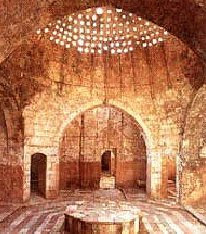 In my guidebook I had seen a picture of a hammam with a striking rooftop : full of particularly intriguing domes. Unfortunately the book didn't mention the name of the bath house. I enquired at a butcher's. The friendly chap spoke English quite well. He had worked in Togo for ten years and had only recently returned to Tripoli. So, he didn't remember the name of the place. In the background I noticed a mosque's minaret. "Do you know the name of this mosque ?", I asked. "Yes, he said, I do recognise that one. I also cannot remember the name, but I can direct you to it."
A stroll through the winding and rather dirty souq streets brought me to the al-Muallaq Mosque; the minaret is its best feature. This area had apparently seen some fighting in the war, as many buildings in the neighbourhood were riddled with bullet holes.
I needed to ask where the hammam was situated. I was in luck. Some of the taxi drivers who were waiting for customers there had lived in Germany and therefore spoke the language. I showed them the book and said I wanted to see that place. "Oh, that's the Hammam al-Jadid", the men said. One of them took me by the arm and walked me to the entrance. Unfortunately, it appeared to be locked. "How can I get inside ?", I wanted to know. The man didn't know. He said good-bye and left. Obviously, that wasn't good enough for me. The plain, dusty exterior didn't satisfy me at all; I wanted to see the domes on the roof ! I searched until I found somebody who spoke a little English. A merchant. He too took me by the arm and walked me to the entrance. "How can I get in ? Where's the key ?", I asked. Unfortunately he couldn't tell me either. Would I really have to leave without having seen what I came for ? A shopkeeper who had been sitting in front of his shop had been observing me all the time, probably wondering what I was up to. I walked up to him and made some gestures as if I was turning a key in a door. He understood what I wanted, and pointed towards a policeman who was drinking tea with another shopkeeper.
"Hello sir. Could you please tell me where I can get the key to open that door ?"
He just looked at me. He didn't understand English.
My sign language got the message through to him.
"Two thousand.", was his only answer.
"Excuse me, sir ?"
"Two thousand."
I understood all right. Sigh. I handed him the money.
He walked with me to the door and kicked it with his boot. It just opened. It wasn't locked at all ! They had told me it was locked but I actually never checked.
The policeman smiled and handed the money back to me, and told me to leave it inside. There was a box "for the upkeep of the site". He had taught me an important lesson : to not take everything for granted.
Inside the hammam was splendid. Truly splendid ! It's a big place, and I explored all the rooms. There's a big dome built over the fountain in the entrance. Very beautiful ! I asked a worker how I could get on the roof. He showed me the stairs which lead up to it. Wow ! The domes were very impressive, even more so than on the picture ! They look like ordinary, small cupolas with old bottles sticking out of them. These are thick, conical, specially-made glass objects; inside they make for a diffuse light, though brighter than you'd imagine.
I headed for the Citadel of Raymond de Saint-Gilles, near the Kadisha River. It's an imposing Crusader castle, partly restored. It wasn't very clear where the entrance was to be found, but finally I got in. A ticket was LL 5000. Inside, the place is huge. Huge but plain. There's nothing to do really but to enjoy the fine views from the ramparts. Extensive buildings like this would be ideally suited to house a museum of some sort; it's really too big to be empty. Even better would it be to add furniture and utensils, just like in the time it was actually lived in. An architect responsible for the restoration of the castle, told me in the years before the war there was a fine restaurant in one of the vaulted halls. He showed me, and I think it must have been one hell of a place to dine. No doubt very expensive. He said there were high hopes for the future, but for the moment there were hardly any visitors (especially when compared to 'before').
From the walls, I noticed an attractive spot a short distance from the citadel, near the bridge over the river. I decided to take a look at it after I would leave.
So I did. First I walked across the bridge. From there the view of the castle is stunning. There was a small wooden barrack which was used as a 'leisure shack' by some local men. They chatted, played backgammon and drank coffee. I decided to drop in and 'mingle'. I was given a warm welcome. I had a couple of Pepsi's. The temperature during my whole stay in Lebanon was high; it was downright hot, and a cold drink from time to time was more than welcome. Unfortunately nobody could speak anything but Arabic, and my vocabulary in that language is really much too limited. :-)
After an hour or so I went to see the place I'd seen from the citadel. It was a nice, green spot. Out of the foliage peeked a beautiful minaret. It belonged to the al-Burtasiya Mosque. There's a madrassah in there as well.
Back across the river again, I tried to get a service taxi to stop. There were many of them, but strangely enough, it took me nearly fifteen minutes to get a ride. And then it wasn't even a service, but an ordinary taxi (count on LL 5000 for that ride). I wanted to see the Lion Tower in al-Mina. "To al-Mina", I said. And so that's where Ali, the driver, headed. al-Mina is situated on a headland and consists - among others - of some (very) posh neighbourhoods. There are lovely palm tree-lined boulevards, and nice shops. Unfortunately this was not where I needed to be. The Lion Tower was out of the built-up area. But I didn't know where we were at that very moment, of course, and even the Arabic name of the tower, Bourj es-Sba, didn't mean anything to Ali. It took several stops at different shops to find out where it was. Upon finally approaching it, I noticed the sad remains of a former train station. On the tracks still stood trains and carriages, but they were completely rusting away. Years ago, Lebanon had a reasonable railway network, but the war put an end to that.
The Lion Tower, although it's hardly worth the name IMHO, is a really beautiful monument. Entrance is free. There are a couple of people who will guide you around inside if you want. One of them did that by self-appointment for me, but oddly enough he didn't expect a tip at the end (and I didn't want to start a trend).
From the roof there's a great view towards Tripoli. You are on the headland a couple of kilometres away from the town centre. In between is nothing but some wasteland, and behind the buildings in the distance are mountains. It's a lovely sight.
I decided to walk along the old train tracks towards a big shed where I had seen a collection of locomotives was stored. When I passed some carriages, I noticed that some of the rusted away side panels had been replaced by woven reed, and on the ground under the unit were piles of garbage. I suspected the worst : there were people living in these trains. And yes indeed, inside one carriage I noticed some assorted nudity pictures, and in the next a head carefully peeked outside and retreated as soon as I looked in its direction. I decided it was better to move on. There were several fuel tanks whose thick walls had been shot clear through with heavy artillery.
The most surprising thing, however, was that there, amidst the scrap, was still a small café. Apparently - judging from the cases with empty bottles - it was still functioning; I wonder who on Earth still visits it... It was closed when I passed by though. Close to the train shed, I had to make my way through some bushes. Big was my surprise when I stared into the nozzle of an automatic rifle equipped with a bayonet. It belonged to a Syrian soldier. I smiled and shook hands with him. He was a sentry of the Syrian army battalion who had taken in the shed. Walking any further, let alone taking pictures of the locomotives, was strictly prohibited. I considered it wiser to leave. I walked a couple of hundred metres, and then managed to pick up a service taxi to Tall for LL 1000.
I changed to another taxi (LL 5000) to get to Qubbet al-Beddawi, a town which adjoins Tripoli. The driver wondered what the heck I thought to find in Beddawi. "There", pointing to the city behind us, he said, "city. Qubbet nothing." I explained I wanted to see the Whirling Dervish Monastery and the pool with sacred carp which were supposed to be located there. He didn't understand me at all. I tried to explain that Beddawi was the dervish who brought the 'Whirling' to this region and had given his name to the town, but to no avail. Taxi drivers in Lebanon easily admit that they don't know where a place is located, which is in stark contrast to many drivers in Europe, who will drive until they do (or don't...) find whatever it is you want to go to... We stopped in Qubbet and popped into several shops until we had found some people who could speak a foreign language. A met a bloke who'd lived in Australia before, and another who spoke French perfectly. Neither of them at first got what I was on about, although there was no language barrier anymore. After a while, I found the reason for this : the pool with the carp had dried out. According to M'hammad, the French-speaking man, there hadn't been carp in there since 1986, except for 1992 when there had been extensive rains and the fish 'miraculously' returned in the pool for one year only. No wonder I had to refresh some memories ! 1986, that's twelve years ago !
The monastery is still there, however, but it's not functional anymore. The mosque is. In the presence of M'hammad I was given a warm welcome and was shown around the place. I also got to see the tomb of Beddawi, the Dervish.
The sanctuary is built upon the remains of Crusader buildings, the Priory of St Anthony of Padua. Because I was genuinely interested, several doors which are normally closed for visitors, were unlocked for me. I was taken to the top of the minaret from where there's an excellent view of the former priory buildings; it's quite easy to make the distinction between the Crusader buildings and the newer additions. In the recent civil war, the monastery was used by Palestinian fighters. It'll come as no surprise now that the place could do with a thorough renovation ? Windows have been bricked up, walls have been built inside to make separations, there's 'war graffiti' all over the interior, and several (dead) soldier's clothes and utensils still lie in the dark 'n' dusty corridors and rooms. According to M'hammad it'll be a long time before the government will have any funds available for the restoration of this place; it's not on the priority list (which is perfectly understandable, of course). It was an interesting visit, but it won't appeal to many people, although the left portico is worth mentioning.
Right next door, Syrian workers were involved in the construction of what looked like an apartment block. They were intrigued by this Westerner taking such an interest in the place; after all, I spent at least a full hour there. Being the naturally hospitable people they are, the Syrians invited me and M'hammad over to drink tea. I gladly accepted (see ? that's the reason why I like Syria so much and have such a great respect for their people). I was taken to the underground parking lot for the new building. In this environment the workers actually lived. Several mattresses were lying on the ground, mosquito nets hung over them. There was a corner which was used as a would-be kitchen, judging from the pots, pans and utensils. A gas stove was fired up, and about ten minutes later we were all enjoying a nice cuppa. My hosts spoke only Arabic, but M'hammad could do all the translations for me. They were delighted to hear that I had been to Syria before, and we all revived 'old' memories.
Of course, these guys had to go back to work, so after half an hour or so, we said good-bye. Now it was M'hammad who invited me to lunch at his house, which was nearby. Again, I accepted; actually I hardly ever refuse, 'cause occasions like these are often the greatest memories of a trip, memories you won't have if you join a tour group.
M'Hammad's place was well-furnished and -equipped. I met his wife and little kid. Nice people. M'hammad had been working for the government before, but had now retired. He was a very decent, cultivated man, with good knowledge of many topics. It was fun talking to him.
After the tasty dinner, M'hammad and his wife drove me back to Tall. I went to my hotel to wait for Gamel to show up. At 4.30 there was a knock on my door. Gamel. His friends with the car were waiting 'round the corner. They were sort of dressed up for the occasion, and even made a stop at a roadside stall to buy after-shave. I turned out we were going to Enfe, where supposedly the "best cinema in Lebanon" was located. It's certainly a big complex; it's called Las Salinas, and it's part of the resort of the same name. It has a very modern appearance and four theatres. Big was my friends' disappointment when they found out they had already seen all the films on show. Honestly, they looked like they could cry because they had failed to please me. Or so they thought. In reality I was very pleased. Not because I didn't have to see a film now, but just because these guys were so incredibly nice to me.
It still being early, they suggested to drive me to several nice lookout spots in the mountains to take pictures of the sunset and dusk. Fine by me, and boy, did they know some great spots ! The best most certainly was a small, open forest near the big college above Enfe.
After dark we headed back to Tripoli. The favourite pastime of the youngsters there seems to be parading and cruising. The boulevard(s) of al-Mina is where it all happens. Numerous (Catholic, my pals told me) young girls stand on one side of the street, with the boys opposed to them on the other side. Most of them are dressed up. The girls were extremely nice, often wearing short mini skirts and parading as if they were walking on a catwalk. On the other side several boys took some 'tough' poses to illustrate their masculinity. It was a funny sight. We, like many others who had a car, cruised the boulevard in between, looking at the scene (well, my friends were looking at the chicks only, obviously :-). I think we drove up and down that street at least a dozen times, probably a lot more, taking several hours. Still it wasn't really boring because it gave me an insight in how the local youngsters are trying to meet. In between we also took a Corniche walk, which IMHO is much, much more pleasant than the same thing in Beirut. It's very crowded and dark. Guys selling coffee, sweets, corn cobs, breads, etc are everywhere. My hosts treated me to all of it ! The local beggars see this time of day as the best to try their luck. Often they are handicapped or deformed (there were several sad polio cases; sad, considering the vaccination costs only a couple of bucks), but I was told the locals are reluctant to give because there are a lot of "profiteers". Could be...
We ended the day - not very late, around ten or eleven, I believe - in an ice cream parlour which belonged to a brother of one of my hosts. The ice cream wasn't particularly good but it had a nice terrace on the upper floor, and the atmosphere was good.
I was driven back to the al-Koura, where we said good-bye but promised to keep in touch. Will be hard if the postal system in Lebanon remains what it is... I sent a dozen or so cards from the post-office in Beirut on the 3rd of October but they still haven't arrived one month later. I doubt they ever will...
I managed to hitch to Tripoli. Arriving there was like arriving in the 'real' Middle East, the Middle East I was used to. The muezzin calling to prayer, dirty streets with road-side stalls crowded with people, many of them Muslim women in long robes, extremely friendly people when asking for directions or just when passing by... God, I loved it !
I asked to be dropped off at Rue Tall, near the clock tower, as that's where the budget hotels are located. I realised that in Lebanon you can actually have that incredible experience, that awesome feeling of moving from a Westernised environment to a much more genuine Oriental one, by only driving a very short distance. Lebanon therefore could be a great introduction to the rest of the Middle East, not only to the people, the sort of sites and the food, but also - and very much so - to the problems of the region. If you like places like Tripoli, the Bekaa Valley and Saida, you'll just love the other countries !
I checked out a couple of places to stay : the Hotel des Cèdres, Palace Hotel and Hotel Koura. The latter was IMHO the best of the three. It's run by a woman and her brother. Both are very friendly; the (unmarried) lady speaks French, her brother can handle both French and English. They're Catholics, which must be rather tough in a city which is 95% Muslim.
The hotel is old and is run-down ("It is a very nice, converted old house off Rue Tall" in the Lonely Planet guide was definitely an overstatement !). Apparently the owners noticed that too, as renovations are in progress. Most of the only handful of rooms that could be had, were occupied by Syrian workers, friendly chaps. My air-conditioned single cost me LL 20,000. There was only a wash-basin. The bathroom was down the hall. The quality of the room was acceptable, but compared to most of the other places I (had to) stay(ed), it was a dump.
When I returned from an early evening walk, I met some youngsters virtually next door to the al-Koura. Gamel, Radwan, Mohammad and Ali; Ali was only sixteen and had lived fifteen years of his life in Germany. He told me that he had stayed in Hotel Koura as well. The asking price for him had been LL 4000, he said, but without A/C ! That shows the price difference for locals and foreigners ! He urged me to complain, but of course there's no way I'd been able to get a room for that price.
Gamel and Mohammad went for another walk with me. They treated me to all kinds of small presents : drinks, sweets,... Gamel, who worked in the gold souq, even gave me a nice tie-pin (although I never wear ties :-) ) !
I wanted to eat something. Gamel immediately suggested the Kentucky Fried Chicken, because they had "the best hamburgers". Clearly American fast-food joints held a big attraction to the Lebanese youth... Still, I must admit that the burgers are better than the ones I later had at Big Bite's. Good Food, a new place, virtually 'round the corner from the al-Koura came recommended by locals, but I didn't eat there. We had a nice conversation, and Gamel said he would arrange a car the next evening, and then he and his friends would take me out. Sounded like fun. We agreed to meet at 5 pm, which is unthinkable nowadays in Western Europe. I suppose the youth over here, within a couple of years, will agree to meet at 5 am (if they don't already :-) )...
I had a good night's sleep. In the (early) morning I went for a walking tour of the city, but first I had breakfast at Paradise Pizza. It's indeed a pizza joint, but they also have lovely croissants and stuff. Delicious, cheap, friendly, the keywords of the place and therefore highly recommended.
The old city is a fascinating area to explore, and that's really what you're doing : exploring ! It's a real maze ! People were friendly and helpful wherever I went. It would lead too far to mention all mosques, hammams and old buildings I came across, so I limit myself to the most interesting/striking. Besides, some interesting ones were under reconstruction to fix the war damage, so they looked more like construction sites (which of course they were) than architectural treasures.
The gate of the Grand Mosque was closed when I arrived. I asked a cigarettes vendor near the entrance if I could have a peek. "No Problem", he said, and opened the door for me. The mosques better looking from the inner courtyard than it does from the street, although it's not baffling. Adjacent is the al-Qartawiya Madrassah. Its façade is nice but again not baffling. Just past the mosque and inside the souq is the Hammam en-Nouri. It can be seen from the street from 'round the corner. The entrance is a bit tricky to find, as you have to walk right through a small shop. The hammam is rather dilapidated but one can still visualise how it once must have looked; rather grand that is.
 In my guidebook I had seen a picture of a hammam with a striking rooftop : full of particularly intriguing domes. Unfortunately the book didn't mention the name of the bath house. I enquired at a butcher's. The friendly chap spoke English quite well. He had worked in Togo for ten years and had only recently returned to Tripoli. So, he didn't remember the name of the place. In the background I noticed a mosque's minaret. "Do you know the name of this mosque ?", I asked. "Yes, he said, I do recognise that one. I also cannot remember the name, but I can direct you to it."
A stroll through the winding and rather dirty souq streets brought me to the al-Muallaq Mosque; the minaret is its best feature. This area had apparently seen some fighting in the war, as many buildings in the neighbourhood were riddled with bullet holes.
I needed to ask where the hammam was situated. I was in luck. Some of the taxi drivers who were waiting for customers there had lived in Germany and therefore spoke the language. I showed them the book and said I wanted to see that place. "Oh, that's the Hammam al-Jadid", the men said. One of them took me by the arm and walked me to the entrance. Unfortunately, it appeared to be locked. "How can I get inside ?", I wanted to know. The man didn't know. He said good-bye and left. Obviously, that wasn't good enough for me. The plain, dusty exterior didn't satisfy me at all; I wanted to see the domes on the roof ! I searched until I found somebody who spoke a little English. A merchant. He too took me by the arm and walked me to the entrance. "How can I get in ? Where's the key ?", I asked. Unfortunately he couldn't tell me either. Would I really have to leave without having seen what I came for ? A shopkeeper who had been sitting in front of his shop had been observing me all the time, probably wondering what I was up to. I walked up to him and made some gestures as if I was turning a key in a door. He understood what I wanted, and pointed towards a policeman who was drinking tea with another shopkeeper.
"Hello sir. Could you please tell me where I can get the key to open that door ?"
He just looked at me. He didn't understand English.
My sign language got the message through to him.
"Two thousand.", was his only answer.
"Excuse me, sir ?"
"Two thousand."
I understood all right. Sigh. I handed him the money.
He walked with me to the door and kicked it with his boot. It just opened. It wasn't locked at all ! They had told me it was locked but I actually never checked.
The policeman smiled and handed the money back to me, and told me to leave it inside. There was a box "for the upkeep of the site". He had taught me an important lesson : to not take everything for granted.
Inside the hammam was splendid. Truly splendid ! It's a big place, and I explored all the rooms. There's a big dome built over the fountain in the entrance. Very beautiful ! I asked a worker how I could get on the roof. He showed me the stairs which lead up to it. Wow ! The domes were very impressive, even more so than on the picture ! They look like ordinary, small cupolas with old bottles sticking out of them. These are thick, conical, specially-made glass objects; inside they make for a diffuse light, though brighter than you'd imagine.
I headed for the Citadel of Raymond de Saint-Gilles, near the Kadisha River. It's an imposing Crusader castle, partly restored. It wasn't very clear where the entrance was to be found, but finally I got in. A ticket was LL 5000. Inside, the place is huge. Huge but plain. There's nothing to do really but to enjoy the fine views from the ramparts. Extensive buildings like this would be ideally suited to house a museum of some sort; it's really too big to be empty. Even better would it be to add furniture and utensils, just like in the time it was actually lived in. An architect responsible for the restoration of the castle, told me in the years before the war there was a fine restaurant in one of the vaulted halls. He showed me, and I think it must have been one hell of a place to dine. No doubt very expensive. He said there were high hopes for the future, but for the moment there were hardly any visitors (especially when compared to 'before').
From the walls, I noticed an attractive spot a short distance from the citadel, near the bridge over the river. I decided to take a look at it after I would leave.
So I did. First I walked across the bridge. From there the view of the castle is stunning. There was a small wooden barrack which was used as a 'leisure shack' by some local men. They chatted, played backgammon and drank coffee. I decided to drop in and 'mingle'. I was given a warm welcome. I had a couple of Pepsi's. The temperature during my whole stay in Lebanon was high; it was downright hot, and a cold drink from time to time was more than welcome. Unfortunately nobody could speak anything but Arabic, and my vocabulary in that language is really much too limited. :-)
After an hour or so I went to see the place I'd seen from the citadel. It was a nice, green spot. Out of the foliage peeked a beautiful minaret. It belonged to the al-Burtasiya Mosque. There's a madrassah in there as well.
Back across the river again, I tried to get a service taxi to stop. There were many of them, but strangely enough, it took me nearly fifteen minutes to get a ride. And then it wasn't even a service, but an ordinary taxi (count on LL 5000 for that ride). I wanted to see the Lion Tower in al-Mina. "To al-Mina", I said. And so that's where Ali, the driver, headed. al-Mina is situated on a headland and consists - among others - of some (very) posh neighbourhoods. There are lovely palm tree-lined boulevards, and nice shops. Unfortunately this was not where I needed to be. The Lion Tower was out of the built-up area. But I didn't know where we were at that very moment, of course, and even the Arabic name of the tower, Bourj es-Sba, didn't mean anything to Ali. It took several stops at different shops to find out where it was. Upon finally approaching it, I noticed the sad remains of a former train station. On the tracks still stood trains and carriages, but they were completely rusting away. Years ago, Lebanon had a reasonable railway network, but the war put an end to that.
The Lion Tower, although it's hardly worth the name IMHO, is a really beautiful monument. Entrance is free. There are a couple of people who will guide you around inside if you want. One of them did that by self-appointment for me, but oddly enough he didn't expect a tip at the end (and I didn't want to start a trend).
From the roof there's a great view towards Tripoli. You are on the headland a couple of kilometres away from the town centre. In between is nothing but some wasteland, and behind the buildings in the distance are mountains. It's a lovely sight.
I decided to walk along the old train tracks towards a big shed where I had seen a collection of locomotives was stored. When I passed some carriages, I noticed that some of the rusted away side panels had been replaced by woven reed, and on the ground under the unit were piles of garbage. I suspected the worst : there were people living in these trains. And yes indeed, inside one carriage I noticed some assorted nudity pictures, and in the next a head carefully peeked outside and retreated as soon as I looked in its direction. I decided it was better to move on. There were several fuel tanks whose thick walls had been shot clear through with heavy artillery.
The most surprising thing, however, was that there, amidst the scrap, was still a small café. Apparently - judging from the cases with empty bottles - it was still functioning; I wonder who on Earth still visits it... It was closed when I passed by though. Close to the train shed, I had to make my way through some bushes. Big was my surprise when I stared into the nozzle of an automatic rifle equipped with a bayonet. It belonged to a Syrian soldier. I smiled and shook hands with him. He was a sentry of the Syrian army battalion who had taken in the shed. Walking any further, let alone taking pictures of the locomotives, was strictly prohibited. I considered it wiser to leave. I walked a couple of hundred metres, and then managed to pick up a service taxi to Tall for LL 1000.
I changed to another taxi (LL 5000) to get to Qubbet al-Beddawi, a town which adjoins Tripoli. The driver wondered what the heck I thought to find in Beddawi. "There", pointing to the city behind us, he said, "city. Qubbet nothing." I explained I wanted to see the Whirling Dervish Monastery and the pool with sacred carp which were supposed to be located there. He didn't understand me at all. I tried to explain that Beddawi was the dervish who brought the 'Whirling' to this region and had given his name to the town, but to no avail. Taxi drivers in Lebanon easily admit that they don't know where a place is located, which is in stark contrast to many drivers in Europe, who will drive until they do (or don't...) find whatever it is you want to go to... We stopped in Qubbet and popped into several shops until we had found some people who could speak a foreign language. A met a bloke who'd lived in Australia before, and another who spoke French perfectly. Neither of them at first got what I was on about, although there was no language barrier anymore. After a while, I found the reason for this : the pool with the carp had dried out. According to M'hammad, the French-speaking man, there hadn't been carp in there since 1986, except for 1992 when there had been extensive rains and the fish 'miraculously' returned in the pool for one year only. No wonder I had to refresh some memories ! 1986, that's twelve years ago !
The monastery is still there, however, but it's not functional anymore. The mosque is. In the presence of M'hammad I was given a warm welcome and was shown around the place. I also got to see the tomb of Beddawi, the Dervish.
The sanctuary is built upon the remains of Crusader buildings, the Priory of St Anthony of Padua. Because I was genuinely interested, several doors which are normally closed for visitors, were unlocked for me. I was taken to the top of the minaret from where there's an excellent view of the former priory buildings; it's quite easy to make the distinction between the Crusader buildings and the newer additions. In the recent civil war, the monastery was used by Palestinian fighters. It'll come as no surprise now that the place could do with a thorough renovation ? Windows have been bricked up, walls have been built inside to make separations, there's 'war graffiti' all over the interior, and several (dead) soldier's clothes and utensils still lie in the dark 'n' dusty corridors and rooms. According to M'hammad it'll be a long time before the government will have any funds available for the restoration of this place; it's not on the priority list (which is perfectly understandable, of course). It was an interesting visit, but it won't appeal to many people, although the left portico is worth mentioning.
Right next door, Syrian workers were involved in the construction of what looked like an apartment block. They were intrigued by this Westerner taking such an interest in the place; after all, I spent at least a full hour there. Being the naturally hospitable people they are, the Syrians invited me and M'hammad over to drink tea. I gladly accepted (see ? that's the reason why I like Syria so much and have such a great respect for their people). I was taken to the underground parking lot for the new building. In this environment the workers actually lived. Several mattresses were lying on the ground, mosquito nets hung over them. There was a corner which was used as a would-be kitchen, judging from the pots, pans and utensils. A gas stove was fired up, and about ten minutes later we were all enjoying a nice cuppa. My hosts spoke only Arabic, but M'hammad could do all the translations for me. They were delighted to hear that I had been to Syria before, and we all revived 'old' memories.
Of course, these guys had to go back to work, so after half an hour or so, we said good-bye. Now it was M'hammad who invited me to lunch at his house, which was nearby. Again, I accepted; actually I hardly ever refuse, 'cause occasions like these are often the greatest memories of a trip, memories you won't have if you join a tour group.
M'Hammad's place was well-furnished and -equipped. I met his wife and little kid. Nice people. M'hammad had been working for the government before, but had now retired. He was a very decent, cultivated man, with good knowledge of many topics. It was fun talking to him.
After the tasty dinner, M'hammad and his wife drove me back to Tall. I went to my hotel to wait for Gamel to show up. At 4.30 there was a knock on my door. Gamel. His friends with the car were waiting 'round the corner. They were sort of dressed up for the occasion, and even made a stop at a roadside stall to buy after-shave. I turned out we were going to Enfe, where supposedly the "best cinema in Lebanon" was located. It's certainly a big complex; it's called Las Salinas, and it's part of the resort of the same name. It has a very modern appearance and four theatres. Big was my friends' disappointment when they found out they had already seen all the films on show. Honestly, they looked like they could cry because they had failed to please me. Or so they thought. In reality I was very pleased. Not because I didn't have to see a film now, but just because these guys were so incredibly nice to me.
It still being early, they suggested to drive me to several nice lookout spots in the mountains to take pictures of the sunset and dusk. Fine by me, and boy, did they know some great spots ! The best most certainly was a small, open forest near the big college above Enfe.
After dark we headed back to Tripoli. The favourite pastime of the youngsters there seems to be parading and cruising. The boulevard(s) of al-Mina is where it all happens. Numerous (Catholic, my pals told me) young girls stand on one side of the street, with the boys opposed to them on the other side. Most of them are dressed up. The girls were extremely nice, often wearing short mini skirts and parading as if they were walking on a catwalk. On the other side several boys took some 'tough' poses to illustrate their masculinity. It was a funny sight. We, like many others who had a car, cruised the boulevard in between, looking at the scene (well, my friends were looking at the chicks only, obviously :-). I think we drove up and down that street at least a dozen times, probably a lot more, taking several hours. Still it wasn't really boring because it gave me an insight in how the local youngsters are trying to meet. In between we also took a Corniche walk, which IMHO is much, much more pleasant than the same thing in Beirut. It's very crowded and dark. Guys selling coffee, sweets, corn cobs, breads, etc are everywhere. My hosts treated me to all of it ! The local beggars see this time of day as the best to try their luck. Often they are handicapped or deformed (there were several sad polio cases; sad, considering the vaccination costs only a couple of bucks), but I was told the locals are reluctant to give because there are a lot of "profiteers". Could be...
We ended the day - not very late, around ten or eleven, I believe - in an ice cream parlour which belonged to a brother of one of my hosts. The ice cream wasn't particularly good but it had a nice terrace on the upper floor, and the atmosphere was good.
I was driven back to the al-Koura, where we said good-bye but promised to keep in touch. Will be hard if the postal system in Lebanon remains what it is... I sent a dozen or so cards from the post-office in Beirut on the 3rd of October but they still haven't arrived one month later. I doubt they ever will...
Lebanon: Byblos and its surroundings
Chapter Three - Byblos and its surroundings
Whilst looking for Hotel Ahiram, one of the only two hotels in town, I noticed what a nice city this was : lovely houses and churches, cosy narrow streets, a delightful seafront and everything very clean. I loved it on first sight, and I didn't regret it one bit having to say good-bye to the Faraya landlady.
A (single) room in Hotel Ahiram was $45 plus $2.5 tax, but including breakfast. It's a friendly place. Granted, the rooms are a bit small, but they're immaculately clean and look really good. There's TV, A/C and a nice bathroom. I loved the place, just as much as I liked the town it was in. This town is famous for being the longest continuously inhabited in the world. A town with a past that goes back such a long way, just has to have its share of ruins. And it has.
It was only a short walk to them. I took a small detour through the old, but very renovated, souqs. They're a feast on the eye, but the merchandising is touristy.
 I paid the LL 6000 entrance fee to the friendly ticket office clerk and first headed to the rather imposing Frankish Castle. The castle is not very interesting but is worth a little exploring, and the views from the top over the rest of the site are great.
From the castle I walked to the Obelisk Temple, the Temple of Resheph, past the King's Well and many dwellings and settlements, to the adorable little Roman amphitheatre, and finally the Roman Colonnade and Necropolis. The visit took two or two and a half hours. There were only a few other people.
I walked to the waterfront. On my right when I exited the small street leading there, was the Fishing Club, a posh - or at least it was very posh - restaurant/bar where the crème de la crème of the international celebrity scene came to dine in the years before the war. It looks out over the small harbour where small fishing boats gently bob. Across the water are the scarce remnants of the old Phoenician port. If you want, you can make a short boat ride, but the local fishermen will ask as much as $10 !
I headed back into town, to the Church of St John the Baptist. But first, I wanted to see the Wax museum, which is almost opposite. It costs LL 5000 to enter. The cashier's a friendly bloke; he's also very informative. I found it a fun place to spend some time. It's not very big, but the scenes are well-presented. It depicts the history of Lebanon, from the Stone Age until the Second World War. Apparently the more recent history is too touchy or too difficult to add... Never mind, it's still nice as at is, and sometimes it's easier to learn a country's history through something which is at least more visual than the broken pots and beheaded statues one always sees in the more serious museums. I love those too, of course; they're an important part of the culture and history of a country. The sculptor apparently found that he had to add some figures which have not so much to do with Lebanon's history, for instance a mermaid. Perhaps he just wanted to show his creative talents, or just a pair of bare titties, I don't know. For those who want to see the exhibition again at home, there's a good guidebook available with pictures of all the scenes. It costs LL 3000.
The Church of St John the Baptist was locked. It was beautiful on the outside, but still I wanted to see the interior. A man was standing in the churchyard. I enquired about the opening hours. He was a nice bloke, but couldn't really help me. According to him, it was only possible to visit the church - which he said had one of the most beautiful interiors in the country - during mass. Next to the church is a big building. It belongs to an administrative section of the Maronite Church of Lebanon. I walked in and asked the first person I saw about the opening times of the church. Seemingly I had picked the right person. He asked me if I was alone. I was. Promptly he handed me the key to the church. "Return it when you've finished", he said. Was that nice or what ? I looked around inside for a fair while. I was not at all impressed by the looks of the interior, but nevertheless it was worth the visit; it had something serene, calming...
I returned the key and went for a bite. When I passed a joint called Safety Food, a guy tried to 'lure' me inside. I was easily convinced, especially when I found at that the place is run by three or four Egyptians... I like the people and their country very much ! As most Egyptians, they were friendly and very talkative. They had excellent, filling burgers, which cost LL 3000 each. Soft drinks are LL 1000. After my meal I wanted to make a telephone call. I soon found a very reliable and cheap private telephone office in a small alley to the right of the Kentucky Fried Chicken : only $1 per minute for a call to Europe. Most places in Lebanon charge $2 or even $3.
I returned to Hotel Ahiram, took a nice bath, grabbed a Pepsi and sat down on the terrace of my room, overlooking the sea and beach and waited for the sunset. The sunsets in Lebanon are almost always fantastic !
The next day I arranged a taxi for the day. Another $70, I know, but IMHO it was worth it. My chauffeur was Elie Daou, a really nice fellow and a good driver (03/464716) . He speaks a bit French and English. We headed for the Afqa Grotto. En route, we passed Elie's snack bar, Snack Daou (although in front of foreigners he likes to call it Restaurant Daou). Making delicious bread A friendly woman, who turned out to be his cousin, was outside and rolling out dough of which she made a big, triangular bread, which she stuffed with a salsa-like filling and baked on a hot plate. Of course we stopped and I had some of the breads. They were delicious. Delicious but expensive at $1.5 each. The restaurant's located at the Route de St. Charbel, opposite Hotel Marval. The best thing about the restaurant is not the food, but the two rooms (spacey, clean and with en-suite bathroom). Such a room can be had for $25-30 (even $20 if you bargain or tell him you know me... hehe).
The road towards the Afqa Grotto goes through some nice mountain scenery, which I found rather reminiscent of Greece. Before I even realised, we were in front of the rock which contains the grotto, on the new bridge. The rock made a pretty sight, but I wasn't incredibly impressed. My attention was drawn by Elie, who got out of the car like lightning and seemed to be jumping up and down for some unnecessary reason. Weird. I got out to, and saw he was killing a small snake, a viper. "There are many of those around here", he said. Cool...
We decided to descend from the road to the small Roman bridge, where we were greeted by an old lady who asked if I wanted to eat or drink something. Elie advised me not to have any food there, as it was not good, he said. I had a Seven-Up, which cost $1. Not cheap ! The view from the bridge was lovely : the water which runs down from the grotto reaches the bridge and there, from right underneath you, tumbles down in a azure blue and green small lake. Beautiful. The old lady showed me the way to a spot where you can have a spectacular view of the whole thing. Amazing; I was much more impressed than when I first arrived at the place !
After having taken sufficient time to marvel at the scenery, I decided it was time to hike up to the cave itself. The Lonely Planet guide I was carrying, stated that "you can walk up a flight of steps on the left bank of the river (steep but not too difficult)". Well, I can tell you, forget that ! There are no steps (anymore). Getting to the grotto involves a rather difficult climb over big boulders and over a narrow, slippery irrigation pipe. It's not at all easy, I can tell you, and you will inevitably get dirty, perhaps even wet. The first part can be walked, but then the path suddenly ends and you have to climb. Once inside, the cave is very big. It was October, so there wasn't much water inside. It was quite impressive, but for most people the difficulties involved in reaching it, will certainly outweigh the rewards.
Nearby are the remains of a Roman temple dedicated to Venus. It could not be visited, as it is completely fenced off and the gates are locked. Not a great loss, as it's primarily a pile of rubble.
On to Laklouk. This is a pleasant area to drive around in. Looking for the Bala Gorge, we passed the Bishop's House, which as the name would suggest is not the residence of a chief pastor, but a small collection of houses carved from the living rock, which in its own right is very distinct, slightly reminiscent of Cappadocia in Turkey. There are several spots in the mountains of Lebanon which, if you've been to Cappadocia, immediately look familiar.
Finding Bala Gorge was a big problem for my driver. No matter how I tried, I couldn't get him to understand what I was on about. We both asked some people, but nobody caught my drift. I think I saw the gorge, but couldn't confirm it.
Elie told me he still had family living in a small mountain village nearby. At a certain point, we left the main road and drove up a very narrow track. I noticed a very beautiful, young woman making her way up as well. We only briefly had eye contact, but I noticed something friendly, fascinating in her look. The track was a dead end, and we arrived at a simple house, beautifully located, overlooking a valley below. A woman in her mid-40s welcomed us. She was overwhelmingly friendly. I also met some other people. In the meantime, the woman we had passed, had made her way up too. She told me her name was Claudine and that the woman who had welcomed was called Madeleine. She was the aunt of Claudine. Madeleine only spoke Arabic, but that was no problem since Claudine spoke French quite well. Much better than me for sure... These two women were so friendly, and we talked about life in Belgium, and in Europe as a whole, who I was, if I was married, what job I did, etc. This and that. I must admit I was quite fascinated, both by the extraordinary welcoming, and by Claudine; she was kind, calm, very beautiful, sexy and intelligent. I'd never thought finding someone like her in this tiny mountain village...
I enjoyed my visit very much, and I gladly accepted the invitation to lunch, especially since this meant a nice walk to the grocery store with Claudine. She truly was interesting and told me about her life, hopes and dreams.
Madeleine really went out of her way. In no time a table was set up with a whole assortment of foodstuffs : stuffed aubergines, tabouleh, chips, chicken and rice, tomatoes, different salads, hummus,... Really too much to name it all. Everything - literally everything - was delicious. I was full after such an extensive meal, but Madeleine treated me to melons, grapes, apples, bananas, and many other fruits. After that we enjoyed a nice cup of tea.
Time flies if you're enjoying yourself, and it was only by the arrival of Madeleine's son and his mate that I realised it was already late afternoon. I stayed another twenty minutes or so, but then I had to say the inevitable good-bye, although under different circumstances I could've easily stayed a whole week with this tremendous family.
We took a final snap in front of the tiny local church. Madeleine embraced me and gave me lots of kisses; she had tears in her eyes because I was leaving. Honestly, these folks' hospitality was unbelievable. I shook hands with all the others, also Claudine. We both felt pity this had to end so soon.
I thanked the family for everything, and then we left. Madeleine and Claudine were waving to us until we were out of sight. But not out of heart, that's for sure !
We now headed for Douma, a traditional village which is allegedly famous for being built in the shape of a scorpion. I was quite fascinated by that story, but somewhat disappointed by reality. Not that the place itself is disappointing. It's beautiful and quiet, but I just couldn't make out a scorpion shape. Probably more and more houses had been built outside the original shape, destroying the original plan.
We returned to Byblos, but made a stop at Anaya, where the convent, tombs, church and hermitage of St Charbel can be visited. The place is full of pilgrims, but everything's peaceful. I heard every Sunday (tens of) thousands of people flock here ! Yes indeed, St Charbel is very revered by the Maronites of Lebanon.
The place is pretty and well-kept. The convent has a serene atmosphere. It contains the tomb of Charbel, as well as the caskets in which he rested in peace before, including one he clearly, err, disintegrated in, to use a civilised term; this can clearly be judged by the big stains. There are also some relics of the saint, like some of his garments, and there's some sort of tableau vivant which shows the man as a child. The convent church as well as the bigger church outside are more than worth a visit. Photography is allowed everywhere inside and out. A short ride away, on top of a nearby hill, is St Charbel's former hermitage, which is also worth a look.
 Once back in Byblos, Elie invited me over at his house. I met his wife, two daughters and three sons, and was again offered coffee and fruits. His house was up on a hill and offered nice views of the town by night. I had happy memories of a great day when I said good-bye to Elie and his family !
The next couple of days I used Byblos as a base to explore some places in the vicinity, some interesting, some not so interesting.
Qubba is only a short trip away. The Crusader Church of the Saviour is set on a hilltop and is down a back road which dead-ends at a barrier. It's only a short walk from there. The church cannot be visited and is rather plain on the outside. Therefore I think it can easily be skipped.
Much better is Moussalayha Castle, set in a quite romantic setting only just off the main Beirut-Tripoli highway, from which it can be seen. I had seen the pictures of this place on postcards and in guidebooks, and was somewhat disappointed by the real thing. The reason for this is that I visited in October and not in spring. In spring the whole place - and the whole Lebanon as a matter of fact - is much greener and more beautiful. I recommend everyone to visit in spring; if you can't right now, postpone your trip until later ! Anyway, back to the castle... it's an impressive construction, built atop a rocky outcrop which stands in the middle of a small plain. The approach is by an old stone bridge which spans a small river, dry in this case.
Steps cut in the rock lead up to the castle. It's only small, but there are quite a few rooms for such a tiny place. There's not a great lot to see inside, and there are some dangerous drops.
Subscribe to:
Posts (Atom)
