Trek Day 5
Now that it was morning we could see what the campsite looked like, Q'ente was at a height of 2,500m (8,125ft). Very nice, with toilets, a shower block and washbasins with running water. In fact it was a bit too civilised!
Having said that I did have a wash that morning so as to not be a really smelly mountain man. After we packed up our stuff all our main packs went in a pile, not for the muels, the bags would go from here by train to Aguas Calientes. This is the nearest town to Machu Picchu and where we would be sleeping tonight, or not as it turned out. The plan for us was to catch the train from Km 88 to Chachabamba (Km 104), from there we would trek to the Sun Gate and Machu Picchu.
After breakfast we hung around a) for a briefing and b) for the train. As you will have noticed briefings are very regular occurrences on this trip, not a bad thing. We had at least two a day, sometimes three. Some people would not be walking with us today as they were still sick, they would not get off the train at Km 104 but would travel with Libby to Aguas Calientes and meet us at Intipunku or The Sun Gate.
The journey to Km 104 was not very long, about 16 Km really! As the cooks were no longer with us we were all provided with a pack lunch, these were handed out on the train. It was more of a journey of anticipation, this was our final day of trekking and Machu Picchu was our destination, so this train ride was just a necessity rather then an experience to be treasured. Before long it was over and we arrived at Km 104. We all got off the train and made our way to the hut where our passports were checked against the records that the guards had. Unlike the previous day we were on our way after just a short interval, enough time for a pee and to apply lots of sun cream. We were now on the final stretch of our trek to Machu Picchu.
The environment we started trekking through today was similar to some parts of previous days. A steadily uphill trail along the side of a mountain with some vegetation and a river down below. It was quite narrow so the fact that there were over seventy of us plus the guides, meant that quite often we were either moving slowly or we actually came to a halt. Today's theme would be steps, you will probably have never experienced steps like you do on the final part of the Inca trail. Today was hot and the trail was getting steeper, within the first hour there was a nice thatched shelter where we stopped for a rest and some food. Before long the surroundings changed and we were walking through a jungle with deep, rich green leaves everywhere.
The contrasts which we experienced during our trek really were amazing. We now walking through what can best be described as rain forest. Technically it is known as cloud forest. When the weather closes in you can find yourself walking through clouds but not today, as for the rest of our trip the weather was warm and dry. This was certainly very uncomfortable at times but it was better than walking through the pouring rain. We had been told that today's weather could change in a instant as we got nearer Machu Picchu but we were lucky as it didn't.
Our first target today were the Inca ruins at Wiñaywayna at a height of 2,650m (8,613ft). In the Andean language of Quechua it means 'forever young' and is named after a pink orchid which grows here. It is thought that it was a religous centre for the Incas and their worship of water. In the photograph it looks a long way away but before long we were there, well at the bottom of it anyway! As you may be able to make out from the photo the Incas, as is their trademark, made large terraces so as to utilise the steep slopes of the mountains for growing crops. Our problem was that we entered the ruins at the bottom of the terracing, we then had walk (read climb and struggle!) up the steps which went up the middle of the ruins. These weren't steps as you have in your house these were big steps each one being twelve to twenty four inches high, at the time I can assure you they felt a lot higher.
These steps are a killer but if you take your time and don't try to rush it, climbing them is achievable, you haven't actually got an option! Once you have completed this last day of the trek, steps back home will never seem daunting again. Once we had got to the top we had a chance to look around the ruins and get our breath back. Before long we were off again, within half an hour we got to our lunch stop, a beautiful shaded area complete with natural air conditioning, a large waterfall. Sitting in the shade with the spray from the waterfall hitting your face was so nice! I actually took my shirt off and went and stood at the base of the waterfall soaking my head and hat in the process. I got some water in my boots but I didn't care, after about an half an hour's break we started climbing again.
It wasn't long before we stopped, this time at the Wiñaywayna visitors centre. Here we found a large building with a shop, toilets and tables and chairs so we could sit inside out of the sun. The drink of the moment was Inca Cola, which tasted just like Irn Bru (the unofficial national drink of Scotland). It was straight from the fridge and very refreshing. We sat around here for a while, most people chose to sit outside. Then we started the last leg to Machu Picchu. The start of the walk from the visitors centre was very gentle and flat. We passed some tents so this must also be a trekker's campsite too. From here to Machu Picchu is six kilometres as shown in the sign in the photograph (look at the large version in the Image Gallery).
Although the start was gentle we were soon going up more than we were walking on level ground. In between Wiñaywayna and the Sun Gate there are a lot of very steep and big steps. The last half fifteen minute's climb was near vertical then all of a sudden we were at the Sun Gate or Intipunku. The sense of relief was amazing and to actually see Machu Picchu was fantastic. Again this was an emotional moment, there tears in a lot of people's eyes. We had heard a rumour that it was possible to get a signal on mobile 'phones at the Sun Gate so I turned my 'phone on to see. It was true, I had a good signal, I 'phoned my wife and other members of my family to let them know I was OK and that I had reached my target. Between Cusco and here I had not had a mobile signal, not that I was bothered, I had my 'phonme turned off anyway. This is also where we met up with Libby and those people who had stayed on the train at Km 104.
On arrival at Intipunku I was a bit disappointed with the view of Machu Picchu. The weather was clear but what I saw was not like the photos I had seen before. After we had rested and taken everything in at Intipunku we made our way down the mountain towards the bus stop where would catch the bus down the narrow, winding road to Aguas Calientes. Jez, the cameraman, had gone on ahead to film us we walked past. This film would be used in the closing credits of the official Scope video. A bit further on we came to a smaller Inca terraced area which gave us the more conventional postcard view of Machu Picchu. This is the view of Machu Picchu I recognised and now that I had seen it, the realisation that I was nearing the end of my journey became apparent.
Once everyone had taken lots of photos we started our decent to the bus station. The buses stop very near to the Machu Picchu Sanctuary Lodge, a very expensive hotel which shouldn't be there. It is the nearest hotel to these sacred ruins and when you see this having just seen the splendour of Machu Picchu you realise how stupid capitalism can be. The buses leave regularly during the day and make their way slowly down the windy road to Aguas Calientes.
So that was it, all the hard work was done and in a couple of days we would be home again. Tonight we would be sleeping in real beds in a real hotel in Aguas Calientes, The Machu Picchu Inn. There was also a gala dinner arranged for the whole group to celebrate our achievement and afterwards we were going to a 'disco' nearby as that was the nearest thing they had to a night club.
On first impressions Aguas Calientes seemed a nice town, part flat and part built on a steep hill, with an obvious Spanish influence. It was late afternoon by the time we got there so tomorrow would be a good day to explore and also if you wanted you could go back up to Machu Picchu and have a proper look around the ruins. So after Alex and I had found our room in the hotel, had a shower and I had written some notes for a speech which Lucy from Scope had asked me to make after tonight's dinner, we made our way to the bar across the road where everyone had arranged to meet.
The dinner was good, yes you guessed it, a buffet! It was good, although I didn't each much. After four night's camping and the excellent meals we had on the way I knew it was possible to survive on less food than I was used too at home. Lucy made a speech, I think it was her final one, there had been so many.... (Only joking Lucy! :-) I made my speech after her about my son and how cerebral palsy affects him. Another member of the group whose daughter has cerebral palsy had her speech read out by her good friend. After the formal stuff some people did funny sketches, one of a weird talent competition, Owen did a brilliant impersonation of our Doctor who was one of the stars of our trip and Tamzin did a hilarious impersonation of Libby. Once all this was out of the way it was disco time, we made our way to the bar/disco and it seemed pleasant enough. It had a big dance floor, music and a bar selling drinks. What more did we need? We drank, we danced and we had good fun.
So anyway, the bar staff asked us to leave at a half past four the next morning as they wanted to go to bed! A group of us made our way back to the hotel as a girl called Amy had a room by herself and we could all go back there and carry on drinking. I fell asleep pretty soon, it must have been around five o'clock when I did so.
Showing posts with label Peru. Show all posts
Showing posts with label Peru. Show all posts
Friday, May 30, 2008

Trekking The Inca Trail: Lima, Cusco, Pisaq, Saqsaywaman, Aguas Calientes (Part IV)
Trek Day 4
Surreal, unbelievable, amazing and the phrase "money couldn't buy this" where some of things said about day four of our trek. It all began quite innocently, we got up and had breakfast as normal. The campsite was being packed away again when we left camp in a westerly direction following the Urubamba river along a fairly flat, dusty and hot trail to our lunch stop. We passed through a varied environment again, there was forest, narrow paths alongside the edge of the mountains and sun parched fields.
We had lunch near to the train station known as Kilometer 82 (82 Kilometres from Cusco). The Inca trail to Machu Picchu has a few of these kilometre markers, in essence they are railway stations marking the route used by rich tourists from Cusco who can't be bothered to walk to Machu Picchu. Some of the stations do have towns attached so of course they also fulfil the needs of the local townsfolk and transporting goods to Aguas Calientes which is the nearest town to Machu Picchu. Our lunch was at a purpose built campsite near to Km 82, the nice thing about it was that we could eat lunch in a nice cool hall out of the blazing sunshine.
After lunch and a sit down we walked the short distance to the bridge over the Urubamba river at Km 82. The bridge was typical of the area, wobbly! The plan was that we were going to cross the bridge, sort out our paperwork as we were now entering the Machu Picchu National Park, walk a short distance along the railway line then join a trail to our last night's camping at Km 88. Well, that was the plan anyway. It started OK, we walked to the bridge crossed it and then waited by the railway line for Libby to sort out all the paperwork. After a while Libby came up and said there was a problem but it should be sorted out soon.
The Inca trail was on the other side of the bridge, the side where we'd had lunch. The staff at the crossing couldn't understand why we wanted come the other way over the bridge and walk into the National Park along the railway line. All our paperwork was in order and the crossing had prior notification of our intention to cross on this day. Libby had taken groups on this planned route many times before and this was the first time she'd had a problem. Apparently the rules affecting entry to the Machu Picchu National Park had changed within the last few days, so therefore our paperwork was out of date. Libby was great at trying to resolve it, desperate 'phone calls to her boss in Lima didn't help though, we needed a contingency plan.
Between them, Libby and Explorandes came up with a plan that involved one group of us getting on a train and going straight from Km 82 to Km 88, the site of night four's camp. The rest of us, which included me, would walk for two miles back along the river to the town of Chillca. Explorandes were only able to reserve so many seats in the train going to Km 88, that is why some us had to walk the other way. Once at Chillca we would wait until evening and catch the train from there to Km 88. Again we had reserved seats on that later train. All this took three hours to sort out but going by train towards Machu Picchu or walking the other way were the only ways we would get out. It was roughly half and half were travelling by each method. The walkers waited for the train the others were catching just to make sure that a) it arrived and b) they got on it. There was spontaneous cheering and applause when it did arrive as after such a long delay we were moving again!
Once the train had gone we, the group that was left, began walking to Chillca. Most of the walk was up a long hill, not to steep but steeper than we would like at this point of time. Being part of this group did seem the best option because at least we would get a bit of walking in this afternoon. The route we were following was a road so we didn't have worries about narrow mountain passes or anything like that. At one point we passed a cemetery, in contrast to how cemeteries normally look this one was very colourful. The gravestones were decorated with bright flower arrangements. It was interesting to see how other people deal with death.
After about an hour of quite tough walking we arrived in the town of Chilca. There were two small shops in the town, for some reason, the local exchange rate I think, we went for the one on the left and I went straight in and bought six bottles of beer.
After about half an hour of lazing around outside drinking beer and chatting to people I made my way inside the shop. Quite a few people were already in there, sitting on whatever they could find. The man who owned the shop, I suppose realising he was on to a winner, was working frantically with his wife to get as many chairs and stools made available as possible. To the side of the shop there was a small courtyard, no roof but tables and chairs and what was turning into a beautiful night sky. There must have been thirty to forty people crammed into this shop which was no bigger than most people's sitting room. We'd drunk all his small bottles of beer so we were now onto the familiar one litre bottles.
After an hour of drinking, chatting and generally having a bloody good laugh Libby decided that rather than waiting for the train here in Chillca and hoping it stopped, it would be easier for us to get a bus a bit further down the railway line so that we could catch the train at the major station of Ollantaytambo (78 Km from Cusco).
We waited for the bus and drank a bit more, after about another hour it arrived and we all piled onto it. What a journey, all the seats were full and the rest were in the aisle. In the good old British tradition we had a sing song all the way. Most of us had brought beer with us from the shop so people sang (shouted), drank and just continued having one hell of a party. Libby did tell us that when we left the shop in Chillca the owner came after us asking for his bottles back. He'd just had the best two hours of his shop's trading history and he was worried about a few céntimos for the empties. I'm sure that it was just a natural reaction and with hindsight he would have realised what had just happened to his bank balance!
The driver of the bus to Ollantaytambo must have wondered what on earth was going on and when he started driving along the railway tracks so did we! Either he knew there would be no trains coming either way or he was just risking it to add more excitement to our lives. After about twenty minutes we were in Ollantaytambo, although it was now dark the town looked very nice. We got to the train station got off the bus and walked through big crowds of passengers and traders. In between the car park and the train there were lots of stalls selling everything. Most of the people seemed like travellers who were just milling around, we had reserved seats on a train though, so we just walked through the middle of them. We were directed to our carriage which turned out to be the Scope carriage with no one else on it. We made ourselves comfortable and then another Scope trekker, Simon and I went to the nearest stall selling beer and bought two crates for our fellow passengers, I think there were twenty four of the small bottles to each case so plenty for us and a few spare. This afternoon we'd had a beer shop, a beer bus and now a beer train!
As well as a beer train, like the bus it turned into a sing song with someone who shall remain anonymous doing a brilliant rendition of Shirley Bassey's song "Big spender". We had seats reserved on the train but we didn't actually have any tickets and one of the funniest moments was when the ticket inspector(s) came round. There was a group of us at the end of the carriage nearest the door who had set up an impromptu bar and smoking area. When the inspectors came round, they couldn't get through so they had a beer instead, we just "held them hostage" at that end of the carriage! I think the main inspector was suitably rewarded at the end of our journey.
It is 10 Kilometres from Ollantaytambo to Km 88 but it seemed like that train ride took us ages. It must have been at least forty five minutes. Then we were there, we were camping at a place called Q'uente at a height of 2,500m (8,125ft) which was right next to Km 88. There was no station, we just got off the train stood beside the railway line and waited to see what the next weird thing to happen would be. Suprisingly, nothing. The campsite and the facilities are owned by a German called Reiner, he doesn't speak a word of English but we had been promised a camp with showers and a barbecue. So although we were camping tonight we had relative luxury.
Anyway, Reiner had come down to the railway line to meet us and he led the way. It was pitch black and a narrow sometimes steep path to the camp. Those of us who had torches used them to light the way for everybody else as there was no lighting on the path. Even though I had a torch it didn't stop me walking straight into a metal pillar in the middle of the far end of a bridge that we had to cross. It didn't hurt me too much but the woman following me, Karen, got a hell of a shock when she walked into my trekking poles which were sticking out of my day pack. After a bit of swearing she said she was OK though.
We made our way up to the campsite. It was quite a substantial site, there were a series of buildings, the main one being our eating area which were all keen to visit. Alex and I dropped our stuff of at the entrance to the three sided room where we would be eating, as did everyone else in our group. After telling people about the afternoon we'd had we learnt that most of the advance party had been on the beer since they arrived. I'm sure we'd had more fun though but they'd had showers and a wash! We'd been promised a really nice barbecue, our cooks had been here a while after they bolted past the guards at Km 82. In the end was what turned out to be what I thought was the worst meal of the entire trip.
We had some nice soup followed by some very tough highly salted steak. I don't know wether the steak was from Reiner's stock or if our cooks had carried it with them all the way from the start of the trek. I suspect it was Reiner's but whichever it really was vile, some people liked it but most people I spoke to did not. Some of the vegetables were OK though, I'm sure it wasn't helped by the fact we were so late in arriving. All this was washed down with some nasty mulled wine. Needless to say, as if by magic, the shopkeeper appeared! Or, bottle keeper, normal service was resumed as we stocked up on beer for the evening.
After supper we had a briefing from Libby about what had happened that day and what the plan was for tomorrow. As soon as Libby had finished telling us what would happen tomorrow, Brod, being very quick witted asked her "What is the chance of any of that happening then?". In context it was a very funny thing to say considering what had happened to Libby's plans so far that day. I'm sure any of my fellow trekkers reading this will get the joke and smile to themselves!
After supper Alex and I went around the corner to the field where the tents were, but this time it was quite hard to find an unoccupied tent but we found one at the back of the site. Alex went to sleep almost as soon as we got inside the tent and slept until morning. I sorted out my sleeping bag and went back to the main building to see what was going on. Not much, as it turned out, a few people were playing cards, I hung around for a bit and then went to bed. Tomorrow was the day we had all been waiting for, Machu Picchu, the goal of the trip!
Surreal, unbelievable, amazing and the phrase "money couldn't buy this" where some of things said about day four of our trek. It all began quite innocently, we got up and had breakfast as normal. The campsite was being packed away again when we left camp in a westerly direction following the Urubamba river along a fairly flat, dusty and hot trail to our lunch stop. We passed through a varied environment again, there was forest, narrow paths alongside the edge of the mountains and sun parched fields.
We had lunch near to the train station known as Kilometer 82 (82 Kilometres from Cusco). The Inca trail to Machu Picchu has a few of these kilometre markers, in essence they are railway stations marking the route used by rich tourists from Cusco who can't be bothered to walk to Machu Picchu. Some of the stations do have towns attached so of course they also fulfil the needs of the local townsfolk and transporting goods to Aguas Calientes which is the nearest town to Machu Picchu. Our lunch was at a purpose built campsite near to Km 82, the nice thing about it was that we could eat lunch in a nice cool hall out of the blazing sunshine.
After lunch and a sit down we walked the short distance to the bridge over the Urubamba river at Km 82. The bridge was typical of the area, wobbly! The plan was that we were going to cross the bridge, sort out our paperwork as we were now entering the Machu Picchu National Park, walk a short distance along the railway line then join a trail to our last night's camping at Km 88. Well, that was the plan anyway. It started OK, we walked to the bridge crossed it and then waited by the railway line for Libby to sort out all the paperwork. After a while Libby came up and said there was a problem but it should be sorted out soon.
The Inca trail was on the other side of the bridge, the side where we'd had lunch. The staff at the crossing couldn't understand why we wanted come the other way over the bridge and walk into the National Park along the railway line. All our paperwork was in order and the crossing had prior notification of our intention to cross on this day. Libby had taken groups on this planned route many times before and this was the first time she'd had a problem. Apparently the rules affecting entry to the Machu Picchu National Park had changed within the last few days, so therefore our paperwork was out of date. Libby was great at trying to resolve it, desperate 'phone calls to her boss in Lima didn't help though, we needed a contingency plan.
Between them, Libby and Explorandes came up with a plan that involved one group of us getting on a train and going straight from Km 82 to Km 88, the site of night four's camp. The rest of us, which included me, would walk for two miles back along the river to the town of Chillca. Explorandes were only able to reserve so many seats in the train going to Km 88, that is why some us had to walk the other way. Once at Chillca we would wait until evening and catch the train from there to Km 88. Again we had reserved seats on that later train. All this took three hours to sort out but going by train towards Machu Picchu or walking the other way were the only ways we would get out. It was roughly half and half were travelling by each method. The walkers waited for the train the others were catching just to make sure that a) it arrived and b) they got on it. There was spontaneous cheering and applause when it did arrive as after such a long delay we were moving again!
Once the train had gone we, the group that was left, began walking to Chillca. Most of the walk was up a long hill, not to steep but steeper than we would like at this point of time. Being part of this group did seem the best option because at least we would get a bit of walking in this afternoon. The route we were following was a road so we didn't have worries about narrow mountain passes or anything like that. At one point we passed a cemetery, in contrast to how cemeteries normally look this one was very colourful. The gravestones were decorated with bright flower arrangements. It was interesting to see how other people deal with death.
After about an hour of quite tough walking we arrived in the town of Chilca. There were two small shops in the town, for some reason, the local exchange rate I think, we went for the one on the left and I went straight in and bought six bottles of beer.
After about half an hour of lazing around outside drinking beer and chatting to people I made my way inside the shop. Quite a few people were already in there, sitting on whatever they could find. The man who owned the shop, I suppose realising he was on to a winner, was working frantically with his wife to get as many chairs and stools made available as possible. To the side of the shop there was a small courtyard, no roof but tables and chairs and what was turning into a beautiful night sky. There must have been thirty to forty people crammed into this shop which was no bigger than most people's sitting room. We'd drunk all his small bottles of beer so we were now onto the familiar one litre bottles.
After an hour of drinking, chatting and generally having a bloody good laugh Libby decided that rather than waiting for the train here in Chillca and hoping it stopped, it would be easier for us to get a bus a bit further down the railway line so that we could catch the train at the major station of Ollantaytambo (78 Km from Cusco).
We waited for the bus and drank a bit more, after about another hour it arrived and we all piled onto it. What a journey, all the seats were full and the rest were in the aisle. In the good old British tradition we had a sing song all the way. Most of us had brought beer with us from the shop so people sang (shouted), drank and just continued having one hell of a party. Libby did tell us that when we left the shop in Chillca the owner came after us asking for his bottles back. He'd just had the best two hours of his shop's trading history and he was worried about a few céntimos for the empties. I'm sure that it was just a natural reaction and with hindsight he would have realised what had just happened to his bank balance!
The driver of the bus to Ollantaytambo must have wondered what on earth was going on and when he started driving along the railway tracks so did we! Either he knew there would be no trains coming either way or he was just risking it to add more excitement to our lives. After about twenty minutes we were in Ollantaytambo, although it was now dark the town looked very nice. We got to the train station got off the bus and walked through big crowds of passengers and traders. In between the car park and the train there were lots of stalls selling everything. Most of the people seemed like travellers who were just milling around, we had reserved seats on a train though, so we just walked through the middle of them. We were directed to our carriage which turned out to be the Scope carriage with no one else on it. We made ourselves comfortable and then another Scope trekker, Simon and I went to the nearest stall selling beer and bought two crates for our fellow passengers, I think there were twenty four of the small bottles to each case so plenty for us and a few spare. This afternoon we'd had a beer shop, a beer bus and now a beer train!
As well as a beer train, like the bus it turned into a sing song with someone who shall remain anonymous doing a brilliant rendition of Shirley Bassey's song "Big spender". We had seats reserved on the train but we didn't actually have any tickets and one of the funniest moments was when the ticket inspector(s) came round. There was a group of us at the end of the carriage nearest the door who had set up an impromptu bar and smoking area. When the inspectors came round, they couldn't get through so they had a beer instead, we just "held them hostage" at that end of the carriage! I think the main inspector was suitably rewarded at the end of our journey.
It is 10 Kilometres from Ollantaytambo to Km 88 but it seemed like that train ride took us ages. It must have been at least forty five minutes. Then we were there, we were camping at a place called Q'uente at a height of 2,500m (8,125ft) which was right next to Km 88. There was no station, we just got off the train stood beside the railway line and waited to see what the next weird thing to happen would be. Suprisingly, nothing. The campsite and the facilities are owned by a German called Reiner, he doesn't speak a word of English but we had been promised a camp with showers and a barbecue. So although we were camping tonight we had relative luxury.
Anyway, Reiner had come down to the railway line to meet us and he led the way. It was pitch black and a narrow sometimes steep path to the camp. Those of us who had torches used them to light the way for everybody else as there was no lighting on the path. Even though I had a torch it didn't stop me walking straight into a metal pillar in the middle of the far end of a bridge that we had to cross. It didn't hurt me too much but the woman following me, Karen, got a hell of a shock when she walked into my trekking poles which were sticking out of my day pack. After a bit of swearing she said she was OK though.
We made our way up to the campsite. It was quite a substantial site, there were a series of buildings, the main one being our eating area which were all keen to visit. Alex and I dropped our stuff of at the entrance to the three sided room where we would be eating, as did everyone else in our group. After telling people about the afternoon we'd had we learnt that most of the advance party had been on the beer since they arrived. I'm sure we'd had more fun though but they'd had showers and a wash! We'd been promised a really nice barbecue, our cooks had been here a while after they bolted past the guards at Km 82. In the end was what turned out to be what I thought was the worst meal of the entire trip.
We had some nice soup followed by some very tough highly salted steak. I don't know wether the steak was from Reiner's stock or if our cooks had carried it with them all the way from the start of the trek. I suspect it was Reiner's but whichever it really was vile, some people liked it but most people I spoke to did not. Some of the vegetables were OK though, I'm sure it wasn't helped by the fact we were so late in arriving. All this was washed down with some nasty mulled wine. Needless to say, as if by magic, the shopkeeper appeared! Or, bottle keeper, normal service was resumed as we stocked up on beer for the evening.
After supper we had a briefing from Libby about what had happened that day and what the plan was for tomorrow. As soon as Libby had finished telling us what would happen tomorrow, Brod, being very quick witted asked her "What is the chance of any of that happening then?". In context it was a very funny thing to say considering what had happened to Libby's plans so far that day. I'm sure any of my fellow trekkers reading this will get the joke and smile to themselves!
After supper Alex and I went around the corner to the field where the tents were, but this time it was quite hard to find an unoccupied tent but we found one at the back of the site. Alex went to sleep almost as soon as we got inside the tent and slept until morning. I sorted out my sleeping bag and went back to the main building to see what was going on. Not much, as it turned out, a few people were playing cards, I hung around for a bit and then went to bed. Tomorrow was the day we had all been waiting for, Machu Picchu, the goal of the trip!
Trekking The Inca Trail: Lima, Cusco, Pisaq, Saqsaywaman, Aguas Calientes (Part III)
Trek Day 2
We were woken early by the porters bringing us a bowl of hot water to wash in and cups of coca tea. I actually became fond of waking up to coca tea, it was a nice way to start the day.
The porters get up at half past three in the morning to prepare breakfast, feed the mules and start packing things away. By the time we had got up at six, the mess tent had been taken down so there were just the tables and seats left. The tables were already laid up for breakfast. The weather was good for all five days of the trek, so this was the case every morning.
I had a quick wash and brushed my teeth, packed away my sleeping bag and made sure I had all my stuff out of the tent. Everyone had a main rucksack or holdall, which they would put in a pile every morning for loading onto the muels and a smaller day pack which they carried with them on the trek. Once all this was done we sat down to breakfast.

Imagine the scene, more than seventy people sitting on small fold up seats in the cold open air wearing coats and most of us wearing wooly hats, eating porridge! We also had tea, coffee bread, jam, oh and powdered milk! It did the job, when you think that everything we'd need for three nights had to be carried by porters or muels you can see why they didn't want to carry cartons of milk aswell. After breakfast and quick briefing about the day ahead we started walking.
We left our camp at Chilepauwa in a north easterly direction, we started climbing almost immediately. We were at 3,800 metres (12,350 ft) and before we could have lunch we had to climb to 4,750 metres (15,437 ft). This walking lark is harder than you think! I trained for this trek on the South West Coastal Path (see links), which runs from Minehead in Somerset to Poole in Dorset on the South Coast of England. The stretch of the path near me has some big hills and testing terrain but nothing I did there prepared me for the five hours of constant uphill that we endured on day two of the trek.
The terrain was fairly barren with short greeny/brown grass in places. Most of the trail we were walking on was dusty with a few rocks. Either side of the trail was what I call scrub land. Wide open spaces with some gorse type bushes.
The hardest part of that morning's climb was not the flora and fauna but the altitude. I started to find it hard after about an hour. The throbbing pulse in my ears was back and the air was noticeably thinner. I had started the day with the lead group which included Alex, Joe and Brod but during the morning I fell further and further back through the trekkers.
I tried to walk at a pace which meant that I didn't have to stop before our guides stopped for a planned break but it was hard. One minute I'd feel like walking faster and then the next I'd regret it. After what seemed like an eternity of head throbbing and chest pains I made it to a rest stop. I'd been wearing a T-shirt so far this morning but once I stopped for this long rest I started to feel the cold from what I realised was quite a strong wind, the air was cold and fresh aswell.
For the last few hours I'd been wrestling with my conscience. It was telling me to "admit defeat and get on a muel, it would be so much easier" but no, I had trained hard for this and I wasn't going to let lethargy get in my way. There was quite a group of people at the rest stop, which was just a plateau in the hillside. From here we could actually see the top of the pass and it was only a few minutes away. After a rest, a group of us made the last push for the top. What were we rewarded with when we there? It started snowing! Not snowing very heavily but the fact that it was made the morning's efforts seem worthwhile.
It was a relief to be at the top and the sense of achievement was magnificient. It really was quite cold now that there wasn't a mountain in the way to block the wind. We could see that the path down the other side was narrower and it seemed steeper. Some people were ahead of us and we could see them winding away below us like a human train.
I rested a while at the top, took some photos and then started down the other side. There was more than one smaller path making up the trail downwards. Once I was passed a group of people who had started the joutney downward before me I found myself running down. At a number of points I was actually passing muels and their handlers. This was a great feeling as during the morning they had been overtaking me!
After about 10 minutes of running down hill the area opened up into a mass of short brown grass, less steep but still with rocks to catch you out if not careful. It was now a steep downhill walk for about another half an hour to lunch. Lunch was the bottom of the hill next to the river, we were now at 3,800 metres (12,350 ft). Most people were there already when I got there. By this stage I really was knackered, my lunch was much needed. I had a lie down and a good rest, also plenty to eat and drink.
It must have been about an hour before I started what turned out to be a relatively short but entertaining walk to camp. We started out by walking along the bank of the river which was nice and flat, then we started climbing again and the path got much narrower and much rougher. At one point we were walking along a narrow path in the middle of a very steep scree slop with the river and rocks below. I don't suffer from vertigo but this part of the walk did make me consider it!
It didn't seem like it took us long to walk to camp at a place called Anka Skocha and we arrived at about the same time as the day before. After the exersion of the morning it didn't seem like much effot but we must have walked four and we ascended 400 metres, the camp was at 4,200 metres (13,650 ft). It was cooler than camp on day one and it seeemd to get dark within two hours. When it was dark, the temperature plummeted so it was on with my fleece, wooly hat and gloves. To try and keep warm a lot of us sat in the mess tent from about five o'clock and played cards until supper. Afterwards we played cards again and at around nine o'clock I went to bed.
I had emptied my drinking bottle of water earlier and filled it with hot water provided by the kitchen staff. This was my hot water bottle and I put it into my sleeping bag which I had unrolled in my tent. I'd put it there before supper so when I went to bed my bag was nice and warm. Having spoken to some peole during the day about what to wear when sleeping I decided to cut down on the layers tonight. I didn't wear my fleece, troyusers or socks. I did seem to stay a lot warmer even though it turnerd out to be a very cold night.
Trek Day 3
We had a slight lie in this morning. I was used to the early starts now so I woke up quite early. I wasn't alone and when I poked my head out of the tent I saw that there were quite quite a few people who had partial insomnia.
We wandered around the camp site and met up on the far corner. We had a bit of a chat, much to the annoyance of people who were trying to sleep, then we decided to explore the area a bit. We didn't go far, back down the river bank for a few hundred yards and then back to the campsite. One thing that did suprise us was the amount of litter that had been left south of the campsite where we had been walking. The night had been very cold, when I asked one of the guides how cold he thought it was he replied in his best Peruvian that it had been "flipping cold" (not really "flipping" but you can guess what he did say), he reckoned about -6°C!
With hindsight, day three was the easiest of the trek. After what seemed like a very leisurely breakfast we walked north out the camp. We were walking to the east of Mount Wayanay (5,308m) and to the west of the town of Silque. The morning was gentle undulating walk through the Silque Valley. We saw humming birds and went through orchid draped creeks. Apparently we even saw a condor hovering around the top of the mountains but I wasn't certain that the small black dot above was a condor. Before the trek started we were told that "every day will be different" and each day really was.
Having endured a freezing night we were now walking in blazing sunshine. Also this morning we were attacked by mosquitoes as we were now low enough for them to be a problem. I had stopped during the morning to apply some insect repellant to my face, arms and hands. When we arrived at our lunch stop I took my hat off but this was a mistake, the sweat run from forehead down my face and it brought the insect repellant with it. The consequence of this was that it ran in to my eyes and I was in agony. Some people realised I was in difficulty and took me to one of the containers of fresh water with which we washed our hands before every meal. I gave my eyes a good rinse and this solved the problem.
Lunch was at a lovely spot next to the river. A few people went in for a dip which must have been very refreshing. Brod, who had a thermometer built into his watch, told us that it was 40°C in the sun so we had probably had a 30° temperature change in the last twelve hours. Now that is what I call variety!
After a long lunch we just had few hours walk to camp. We meandered down the valley following the river to the village of Kamikancha (3,400m), as normal our campsite was in a natural basin made by the mountains on all sides. It was also quite rocky with a few large boulders in between the tents.
Kamikancha was the scene of a great England victory. We had an England versus Peru football match. A ten minute walk down river from the village was the local school and here they had a pitch but not as we know them. Goalposts yes but rock hard ground, no green grass and very uneven. We'd known this match was going to happen as we were told the night before.
I'd come to the conclusion that I would just spectate but when it came down it and the adrenaline was flowing I couldn't resist taking part. I came on as a substitute for Joe after about 10 minutes. Within a short space of time I realised how hard this was going be. I could cope with walking at altitude but running was a different thing altogether. We were playing the porters plus two of our group to make up the numbers. Peru's most competitive player was Julio Cesar or Julius Caesar as he liked to be known, I kid you not. The end result? England 2 Peru 1, thankfully there was no need for a penalty shootout.
Because the Urubamba river was ahead of us, at the end of the day cold winds were drawn down the Silque valley through our campsite towards the river. They were also very strong as the photo of the bending trees shows.
After the football we walked back to our tents, about 15 minutes, and then after a while the children from Kamikancha came up to our campsite. Some of our group had brought pens and crayons over from the UK which mean the world to a Peruvian child. Just having a red crayon can be such an experience for these kids.
When the children left it was into the mess tent for supper. After supper all the guides and porters were engrossed in an official football match, Peru were playing Uruguay in a World Cup 2006 qualifier. As you can imagine this was a bit of a South American grudge match and all the staff were very excited. In the end Peru triumphed 3 - 1, so at least they had won something that day!
Now we were at a lower altitude it was safer to drink and drink we did. A guy from one of the nearby villages came up to camp with a crate litre bottles of beer. I think he charged us 10 Sol a time. Quite a few of us bought bottles and either hung around outside the mess tent or sat inside drinking them, telling stupid stories and singing silly songs. We had a great time and I eventually went to bed avoiding the rocks on the way to my tent.
We were woken early by the porters bringing us a bowl of hot water to wash in and cups of coca tea. I actually became fond of waking up to coca tea, it was a nice way to start the day.
The porters get up at half past three in the morning to prepare breakfast, feed the mules and start packing things away. By the time we had got up at six, the mess tent had been taken down so there were just the tables and seats left. The tables were already laid up for breakfast. The weather was good for all five days of the trek, so this was the case every morning.
I had a quick wash and brushed my teeth, packed away my sleeping bag and made sure I had all my stuff out of the tent. Everyone had a main rucksack or holdall, which they would put in a pile every morning for loading onto the muels and a smaller day pack which they carried with them on the trek. Once all this was done we sat down to breakfast.

Imagine the scene, more than seventy people sitting on small fold up seats in the cold open air wearing coats and most of us wearing wooly hats, eating porridge! We also had tea, coffee bread, jam, oh and powdered milk! It did the job, when you think that everything we'd need for three nights had to be carried by porters or muels you can see why they didn't want to carry cartons of milk aswell. After breakfast and quick briefing about the day ahead we started walking.
We left our camp at Chilepauwa in a north easterly direction, we started climbing almost immediately. We were at 3,800 metres (12,350 ft) and before we could have lunch we had to climb to 4,750 metres (15,437 ft). This walking lark is harder than you think! I trained for this trek on the South West Coastal Path (see links), which runs from Minehead in Somerset to Poole in Dorset on the South Coast of England. The stretch of the path near me has some big hills and testing terrain but nothing I did there prepared me for the five hours of constant uphill that we endured on day two of the trek.
The terrain was fairly barren with short greeny/brown grass in places. Most of the trail we were walking on was dusty with a few rocks. Either side of the trail was what I call scrub land. Wide open spaces with some gorse type bushes.
The hardest part of that morning's climb was not the flora and fauna but the altitude. I started to find it hard after about an hour. The throbbing pulse in my ears was back and the air was noticeably thinner. I had started the day with the lead group which included Alex, Joe and Brod but during the morning I fell further and further back through the trekkers.
I tried to walk at a pace which meant that I didn't have to stop before our guides stopped for a planned break but it was hard. One minute I'd feel like walking faster and then the next I'd regret it. After what seemed like an eternity of head throbbing and chest pains I made it to a rest stop. I'd been wearing a T-shirt so far this morning but once I stopped for this long rest I started to feel the cold from what I realised was quite a strong wind, the air was cold and fresh aswell.
For the last few hours I'd been wrestling with my conscience. It was telling me to "admit defeat and get on a muel, it would be so much easier" but no, I had trained hard for this and I wasn't going to let lethargy get in my way. There was quite a group of people at the rest stop, which was just a plateau in the hillside. From here we could actually see the top of the pass and it was only a few minutes away. After a rest, a group of us made the last push for the top. What were we rewarded with when we there? It started snowing! Not snowing very heavily but the fact that it was made the morning's efforts seem worthwhile.
It was a relief to be at the top and the sense of achievement was magnificient. It really was quite cold now that there wasn't a mountain in the way to block the wind. We could see that the path down the other side was narrower and it seemed steeper. Some people were ahead of us and we could see them winding away below us like a human train.
I rested a while at the top, took some photos and then started down the other side. There was more than one smaller path making up the trail downwards. Once I was passed a group of people who had started the joutney downward before me I found myself running down. At a number of points I was actually passing muels and their handlers. This was a great feeling as during the morning they had been overtaking me!
After about 10 minutes of running down hill the area opened up into a mass of short brown grass, less steep but still with rocks to catch you out if not careful. It was now a steep downhill walk for about another half an hour to lunch. Lunch was the bottom of the hill next to the river, we were now at 3,800 metres (12,350 ft). Most people were there already when I got there. By this stage I really was knackered, my lunch was much needed. I had a lie down and a good rest, also plenty to eat and drink.
It must have been about an hour before I started what turned out to be a relatively short but entertaining walk to camp. We started out by walking along the bank of the river which was nice and flat, then we started climbing again and the path got much narrower and much rougher. At one point we were walking along a narrow path in the middle of a very steep scree slop with the river and rocks below. I don't suffer from vertigo but this part of the walk did make me consider it!
It didn't seem like it took us long to walk to camp at a place called Anka Skocha and we arrived at about the same time as the day before. After the exersion of the morning it didn't seem like much effot but we must have walked four and we ascended 400 metres, the camp was at 4,200 metres (13,650 ft). It was cooler than camp on day one and it seeemd to get dark within two hours. When it was dark, the temperature plummeted so it was on with my fleece, wooly hat and gloves. To try and keep warm a lot of us sat in the mess tent from about five o'clock and played cards until supper. Afterwards we played cards again and at around nine o'clock I went to bed.
I had emptied my drinking bottle of water earlier and filled it with hot water provided by the kitchen staff. This was my hot water bottle and I put it into my sleeping bag which I had unrolled in my tent. I'd put it there before supper so when I went to bed my bag was nice and warm. Having spoken to some peole during the day about what to wear when sleeping I decided to cut down on the layers tonight. I didn't wear my fleece, troyusers or socks. I did seem to stay a lot warmer even though it turnerd out to be a very cold night.
Trek Day 3
We had a slight lie in this morning. I was used to the early starts now so I woke up quite early. I wasn't alone and when I poked my head out of the tent I saw that there were quite quite a few people who had partial insomnia.
We wandered around the camp site and met up on the far corner. We had a bit of a chat, much to the annoyance of people who were trying to sleep, then we decided to explore the area a bit. We didn't go far, back down the river bank for a few hundred yards and then back to the campsite. One thing that did suprise us was the amount of litter that had been left south of the campsite where we had been walking. The night had been very cold, when I asked one of the guides how cold he thought it was he replied in his best Peruvian that it had been "flipping cold" (not really "flipping" but you can guess what he did say), he reckoned about -6°C!
With hindsight, day three was the easiest of the trek. After what seemed like a very leisurely breakfast we walked north out the camp. We were walking to the east of Mount Wayanay (5,308m) and to the west of the town of Silque. The morning was gentle undulating walk through the Silque Valley. We saw humming birds and went through orchid draped creeks. Apparently we even saw a condor hovering around the top of the mountains but I wasn't certain that the small black dot above was a condor. Before the trek started we were told that "every day will be different" and each day really was.
Having endured a freezing night we were now walking in blazing sunshine. Also this morning we were attacked by mosquitoes as we were now low enough for them to be a problem. I had stopped during the morning to apply some insect repellant to my face, arms and hands. When we arrived at our lunch stop I took my hat off but this was a mistake, the sweat run from forehead down my face and it brought the insect repellant with it. The consequence of this was that it ran in to my eyes and I was in agony. Some people realised I was in difficulty and took me to one of the containers of fresh water with which we washed our hands before every meal. I gave my eyes a good rinse and this solved the problem.
Lunch was at a lovely spot next to the river. A few people went in for a dip which must have been very refreshing. Brod, who had a thermometer built into his watch, told us that it was 40°C in the sun so we had probably had a 30° temperature change in the last twelve hours. Now that is what I call variety!
After a long lunch we just had few hours walk to camp. We meandered down the valley following the river to the village of Kamikancha (3,400m), as normal our campsite was in a natural basin made by the mountains on all sides. It was also quite rocky with a few large boulders in between the tents.
Kamikancha was the scene of a great England victory. We had an England versus Peru football match. A ten minute walk down river from the village was the local school and here they had a pitch but not as we know them. Goalposts yes but rock hard ground, no green grass and very uneven. We'd known this match was going to happen as we were told the night before.
I'd come to the conclusion that I would just spectate but when it came down it and the adrenaline was flowing I couldn't resist taking part. I came on as a substitute for Joe after about 10 minutes. Within a short space of time I realised how hard this was going be. I could cope with walking at altitude but running was a different thing altogether. We were playing the porters plus two of our group to make up the numbers. Peru's most competitive player was Julio Cesar or Julius Caesar as he liked to be known, I kid you not. The end result? England 2 Peru 1, thankfully there was no need for a penalty shootout.
Because the Urubamba river was ahead of us, at the end of the day cold winds were drawn down the Silque valley through our campsite towards the river. They were also very strong as the photo of the bending trees shows.
After the football we walked back to our tents, about 15 minutes, and then after a while the children from Kamikancha came up to our campsite. Some of our group had brought pens and crayons over from the UK which mean the world to a Peruvian child. Just having a red crayon can be such an experience for these kids.
When the children left it was into the mess tent for supper. After supper all the guides and porters were engrossed in an official football match, Peru were playing Uruguay in a World Cup 2006 qualifier. As you can imagine this was a bit of a South American grudge match and all the staff were very excited. In the end Peru triumphed 3 - 1, so at least they had won something that day!
Now we were at a lower altitude it was safer to drink and drink we did. A guy from one of the nearby villages came up to camp with a crate litre bottles of beer. I think he charged us 10 Sol a time. Quite a few of us bought bottles and either hung around outside the mess tent or sat inside drinking them, telling stupid stories and singing silly songs. We had a great time and I eventually went to bed avoiding the rocks on the way to my tent.
Trekking The Inca Trail: Lima, Cusco, Pisaq, Saqsaywaman, Aguas Calientes (Part II)
Pisaq
After breakfast and a briefing we got in the coaches for the 60 minute drive to the market at Pisaq which is 32km north east from Cusco. It was a windy uphill road and the whole journey took us about an hour.We stopped on the way to get our first site of Mount Verónica or Nevado Wakaywilka. This is a glacier which stands at 5,361 metres (17,423 ft) and would be visible to us for much of the time over next few days.

We continued the drive to Pisaq, it was a Saturday which wasn't a main market day but there was still a number of traders filling the town's central square. I spent some time wandering all the stalls. Basically there were woolen goods, Llama and Alpaca wool, hats, pullovers, rugs etc. and jewellery. The hats especially came in a variety of shapes and designs but by far the most popular items were the brightly coloured woolen hats with flaps that came down to cover the wearer's ears. I bought some bracelets for my daughter, a necklace for my wife and a small Peruvian rattle, similar to a castanet for Joshua. For myself I bought a woolen hat to keep me warm during the coming days in the mountains. This would prove to be a wise purchase.
As with all of this trip the weather was perfect. The first restaurant I walked into already had a few trek participants in but not for long. Their was only one member of staff and because of this they wouldn't be doing any hot food only sandwiches, so they wouldn't be getting our custom. A few us left and wandered to a bright yellow building which we had seen earlier. This place was great. It was called Ulrike's Café and it turned out to be run by a German woman who had been to Peru on holiday three times in the past, the third time she decided to stay.
There were quite a few of our group here and I had a wonderful three course meal for 10 Sol (apprx. £2); a thick vegetable soup, chicken pasta and a chocolate brownie. There wasn't a bad word said by any of us about the food although Chris asking for a Shandy (lemonade and beer) did cause our waitress some confusion. That is when we met Ulrike and she sorted the problem out.
After our excellent lunch we wondered around the market a bit more before making our way back to the coaches for the drive to Saqsaywaman, which is just north of Cusco.
Saqsaywaman
This archaeological park covers an area of 3400 acres just north of Cusco at a height of 3,555 metres (11,553 ft), it was our first experience of significant Inca ruins. We only saw a fraction of what is there, the park contains 200 archaeological sites, what we did see was impressive. Saqsaywaman was known to the Incas as the House of the Sun, opinion about it's purpose is divided. Some consider it was used as a temple but the majority of people think that it was a fortress, it probably fulfilled both roles. It's geographical position above Cusco suggests that it was a fortress. What is amazing and what strikes you is the size of the stones used to build the main structures. Each of the large stones apparently weigh 50 tonnes.
I spent about an hour exploring the ruins and then started to walk down the hill into Cusco with a couple of other people from the group. We walked along a steep track out of the park, then along a dusty road to the top of Cusco. As well as filling the basin formed by the mountains all around, the town extends north from Plaza de Armas and covers the hill to the East of Saqsaywaman,see photo.
The road down the hill towards the plaza is very steep and the pavements down either side are made up of long shallow steps most the way down. During heavy rainfall these streets must look like a white water rafting course! Most of the buildings seemed to be single storey and closely packed. The use they were being put to was not just domestic, we passed a small art gallery, shops selling hand printed fabrics, jewelery shops with items hand made on the premises. I do remember walking past a bar, not a common occurrence on this trip I know but it looked quite a grimy local bottle shop, not really a bar at all.
Even though the main plaza is nice the smaller squares off it are equally charming. One of the people I was with needed to visit a camping shop to try and buy some rubber covers for their trekking poles. One of the many rules about trekking in the Machu Picchu National Park is that you cannot use trekking poles if they are not covered. This is to reduce the damage to the trail and the site itself caused by so many visitors. We found a camping shop but their pole rubbers were too expensive ($5 each). Cusco has a number of churches and we passed one on the way which caught my eye, see photo.
At last we had our first proper walk since arriving in Peru, OK it wasn't very far but it was good to get my legs working. We gradually made our way back to the hotel and once we had all recovered we went out to dinner, buffet again in a different restaurant with better entertainment. Lots of colourful dancing with an array of strange masks and a dance routine where two male dancers appeared to whipping each other with pieces of wood on the end of a length of rope. I'm still not certain but I don't think they were making contact!
After dinner I went back to the hotel, tomorrow was the first day of our trek and everyone was really eager to get going, after all the trek was what we had really come for and after 3 days we were feeling more like tourists than adventurers
Trek Day 1
We began with an early morning drive out of Cusco to to the town of Huarocondo, here there were some public toilets (the last we were to see for a few days) and a daily market. Some of us bought last minute provisions such as water and bananas, also brightly coloured and decorated bottles of a Peruvian spirit called Anis, which is very potent. It is similar to Pernod, made with aniseed but without the smoothness.
From here we drove a few miles north along the river (Rio Huarocondo) to the start of our trek at a height of 3,400 metres. There was a big area for our coaches to park and that is where we saw the scale of the operation that would be supporting us. To carry all the equipment we would be using; tents, food, pot and pans, tables, everything but the kitchen sink really! In total there were approximately 50 people who working very hard to ensure that all we had to do was walk. As well as the people there were muels to carry a lot of the equipment and also some spare muels to carry people that got too tired or sick from the altitude.
Everyone was given three self sealing plastic bags, one big and two small. One small bag was filled with nuts and fruit for us to snack on, we were also given a few sweets. The second small plastic bag was for rubbish. Explorandes, the tour company in Peru, are very proud of their ISO1401 accreditation and their environmental policy plays a big part in the award of it. One of the things drilled into us was not to leave any rubbish on the trails, there would be rubbish bags provided in the camp sites but whilst walking we were responsible for our own rubbish.
After about an hour we were on our way! We walked down the road for a hundred metres and made our way over a small bridge to cross the river. As with every day, it was hot, almost everyone, including me, was wearing a sun hat. The moutain sunshine is very strong, even if you don't think it is that hot the rays will still get you!
The terrain we started in was dusty, rocky and quite steep. There were numerous breaks when we cam across a suitably large area where we could all sit down. We were told it would be about three hours to lunch and as we were walking up the valley towards the mountains our lunch spot was pointed out to us. High up on the ridge ahead near to an ancient wall would be where we stopped, it looked miles away but in less than three hours we were there. Lunch on day 1 was at 3,800 metres.
In actual fact we had walked about 4 miles but the altitude made it hard work for me. I was fine when we started but then after a while I could hear my pulse in my head. This apparently is quite common when at altitude, the secret is just to take it all very slowly. If you find you are walking and then stopping to get your breath back, you are going too fast. Slow and steady is best, the trek wasn't a race and I only had to be as fast as the slowest person.
Some people hiked a bit further up to the next peak to see some ruins, I started to but the pulse in my head came back so I went back to lunch. After a simple but filling lunch of soup, cooked chicken and vegetables. Everyone refilled their water bottles and started walking down the other side of the pass towards our first night's camp. After the exertion of trekking to a height of 3,800 metres walking down hill was a welcome experience.
We walked for about an hour and a half along similar terrain to the morning's walk but this time it was downhill, not all the way but the majority of it. At the top of a ridge we caught sight of our camp site for day 1. While we had been walking the mules, their drivers (mueleteers), the porters and all the equipment had overtaken us and gone on ahead to set up the camp.
The camp was at a place called Chilepauwa, the altitude here was 3,800 metres (12,350 ft). When trekking you don't camp at the highest point you walk to in a day. You go up and then come down to camp so that your body can acclimatise more efficiently. For example, we started the day in Cusco at 3,360m, we trekked up to 4,100m for lunch and were now walking down to 3,800m to camp. It was about 4 o'clock in the afternoon by the time we got there and I was quite tired. This would be around the time we arrived at camp on all the days of the trek, except day 4, more about that later though.
The work that had been done prior to our arrival was amazing. We were a party of 74, two to a tent. Plus the Scope staff, so that would have meant at least 40 tents had to be put up just for people to sleep in. In addition to this there was a tent for the kitchen, one for all the porters and mueleteers and last but very importantly a mess tent for us to all to eat in. This was a long narrow tent with folding tables along its length and about 40 folding seats down either side.
Supper was at six thirty so I had a couple of hours of rest and relaxation which which was filled by chatting to people about how the day went and what lay ahead. Although it was warm at the camp site when we arrived, because the site was in a basin surrounded by mountains, as soon as the sun went behind a mountain and cast the site into shadow it got dark and very cold, very quickly. From now on it was fleece and wooly hat time.
We had a briefing before supper Libby and Lucy told us how well we had done on the first day. Libby said that tomorrow would be a long and hard day and to take it easy. Then we sat down for our food which was simple but filling. As well as the main course we had bread, butter, Marmite, tea and coffee. In fact we were very well provided for. By the time I had eating I was knackered. I was in my sleeping bag, fully clothed and with my wooly hat on by seven thirty.
After breakfast and a briefing we got in the coaches for the 60 minute drive to the market at Pisaq which is 32km north east from Cusco. It was a windy uphill road and the whole journey took us about an hour.We stopped on the way to get our first site of Mount Verónica or Nevado Wakaywilka. This is a glacier which stands at 5,361 metres (17,423 ft) and would be visible to us for much of the time over next few days.

We continued the drive to Pisaq, it was a Saturday which wasn't a main market day but there was still a number of traders filling the town's central square. I spent some time wandering all the stalls. Basically there were woolen goods, Llama and Alpaca wool, hats, pullovers, rugs etc. and jewellery. The hats especially came in a variety of shapes and designs but by far the most popular items were the brightly coloured woolen hats with flaps that came down to cover the wearer's ears. I bought some bracelets for my daughter, a necklace for my wife and a small Peruvian rattle, similar to a castanet for Joshua. For myself I bought a woolen hat to keep me warm during the coming days in the mountains. This would prove to be a wise purchase.
As with all of this trip the weather was perfect. The first restaurant I walked into already had a few trek participants in but not for long. Their was only one member of staff and because of this they wouldn't be doing any hot food only sandwiches, so they wouldn't be getting our custom. A few us left and wandered to a bright yellow building which we had seen earlier. This place was great. It was called Ulrike's Café and it turned out to be run by a German woman who had been to Peru on holiday three times in the past, the third time she decided to stay.
There were quite a few of our group here and I had a wonderful three course meal for 10 Sol (apprx. £2); a thick vegetable soup, chicken pasta and a chocolate brownie. There wasn't a bad word said by any of us about the food although Chris asking for a Shandy (lemonade and beer) did cause our waitress some confusion. That is when we met Ulrike and she sorted the problem out.
After our excellent lunch we wondered around the market a bit more before making our way back to the coaches for the drive to Saqsaywaman, which is just north of Cusco.
Saqsaywaman
This archaeological park covers an area of 3400 acres just north of Cusco at a height of 3,555 metres (11,553 ft), it was our first experience of significant Inca ruins. We only saw a fraction of what is there, the park contains 200 archaeological sites, what we did see was impressive. Saqsaywaman was known to the Incas as the House of the Sun, opinion about it's purpose is divided. Some consider it was used as a temple but the majority of people think that it was a fortress, it probably fulfilled both roles. It's geographical position above Cusco suggests that it was a fortress. What is amazing and what strikes you is the size of the stones used to build the main structures. Each of the large stones apparently weigh 50 tonnes.
I spent about an hour exploring the ruins and then started to walk down the hill into Cusco with a couple of other people from the group. We walked along a steep track out of the park, then along a dusty road to the top of Cusco. As well as filling the basin formed by the mountains all around, the town extends north from Plaza de Armas and covers the hill to the East of Saqsaywaman,see photo.
The road down the hill towards the plaza is very steep and the pavements down either side are made up of long shallow steps most the way down. During heavy rainfall these streets must look like a white water rafting course! Most of the buildings seemed to be single storey and closely packed. The use they were being put to was not just domestic, we passed a small art gallery, shops selling hand printed fabrics, jewelery shops with items hand made on the premises. I do remember walking past a bar, not a common occurrence on this trip I know but it looked quite a grimy local bottle shop, not really a bar at all.
Even though the main plaza is nice the smaller squares off it are equally charming. One of the people I was with needed to visit a camping shop to try and buy some rubber covers for their trekking poles. One of the many rules about trekking in the Machu Picchu National Park is that you cannot use trekking poles if they are not covered. This is to reduce the damage to the trail and the site itself caused by so many visitors. We found a camping shop but their pole rubbers were too expensive ($5 each). Cusco has a number of churches and we passed one on the way which caught my eye, see photo.
At last we had our first proper walk since arriving in Peru, OK it wasn't very far but it was good to get my legs working. We gradually made our way back to the hotel and once we had all recovered we went out to dinner, buffet again in a different restaurant with better entertainment. Lots of colourful dancing with an array of strange masks and a dance routine where two male dancers appeared to whipping each other with pieces of wood on the end of a length of rope. I'm still not certain but I don't think they were making contact!
After dinner I went back to the hotel, tomorrow was the first day of our trek and everyone was really eager to get going, after all the trek was what we had really come for and after 3 days we were feeling more like tourists than adventurers
Trek Day 1
We began with an early morning drive out of Cusco to to the town of Huarocondo, here there were some public toilets (the last we were to see for a few days) and a daily market. Some of us bought last minute provisions such as water and bananas, also brightly coloured and decorated bottles of a Peruvian spirit called Anis, which is very potent. It is similar to Pernod, made with aniseed but without the smoothness.
From here we drove a few miles north along the river (Rio Huarocondo) to the start of our trek at a height of 3,400 metres. There was a big area for our coaches to park and that is where we saw the scale of the operation that would be supporting us. To carry all the equipment we would be using; tents, food, pot and pans, tables, everything but the kitchen sink really! In total there were approximately 50 people who working very hard to ensure that all we had to do was walk. As well as the people there were muels to carry a lot of the equipment and also some spare muels to carry people that got too tired or sick from the altitude.
Everyone was given three self sealing plastic bags, one big and two small. One small bag was filled with nuts and fruit for us to snack on, we were also given a few sweets. The second small plastic bag was for rubbish. Explorandes, the tour company in Peru, are very proud of their ISO1401 accreditation and their environmental policy plays a big part in the award of it. One of the things drilled into us was not to leave any rubbish on the trails, there would be rubbish bags provided in the camp sites but whilst walking we were responsible for our own rubbish.
After about an hour we were on our way! We walked down the road for a hundred metres and made our way over a small bridge to cross the river. As with every day, it was hot, almost everyone, including me, was wearing a sun hat. The moutain sunshine is very strong, even if you don't think it is that hot the rays will still get you!
The terrain we started in was dusty, rocky and quite steep. There were numerous breaks when we cam across a suitably large area where we could all sit down. We were told it would be about three hours to lunch and as we were walking up the valley towards the mountains our lunch spot was pointed out to us. High up on the ridge ahead near to an ancient wall would be where we stopped, it looked miles away but in less than three hours we were there. Lunch on day 1 was at 3,800 metres.
In actual fact we had walked about 4 miles but the altitude made it hard work for me. I was fine when we started but then after a while I could hear my pulse in my head. This apparently is quite common when at altitude, the secret is just to take it all very slowly. If you find you are walking and then stopping to get your breath back, you are going too fast. Slow and steady is best, the trek wasn't a race and I only had to be as fast as the slowest person.
Some people hiked a bit further up to the next peak to see some ruins, I started to but the pulse in my head came back so I went back to lunch. After a simple but filling lunch of soup, cooked chicken and vegetables. Everyone refilled their water bottles and started walking down the other side of the pass towards our first night's camp. After the exertion of trekking to a height of 3,800 metres walking down hill was a welcome experience.
We walked for about an hour and a half along similar terrain to the morning's walk but this time it was downhill, not all the way but the majority of it. At the top of a ridge we caught sight of our camp site for day 1. While we had been walking the mules, their drivers (mueleteers), the porters and all the equipment had overtaken us and gone on ahead to set up the camp.
The camp was at a place called Chilepauwa, the altitude here was 3,800 metres (12,350 ft). When trekking you don't camp at the highest point you walk to in a day. You go up and then come down to camp so that your body can acclimatise more efficiently. For example, we started the day in Cusco at 3,360m, we trekked up to 4,100m for lunch and were now walking down to 3,800m to camp. It was about 4 o'clock in the afternoon by the time we got there and I was quite tired. This would be around the time we arrived at camp on all the days of the trek, except day 4, more about that later though.
The work that had been done prior to our arrival was amazing. We were a party of 74, two to a tent. Plus the Scope staff, so that would have meant at least 40 tents had to be put up just for people to sleep in. In addition to this there was a tent for the kitchen, one for all the porters and mueleteers and last but very importantly a mess tent for us to all to eat in. This was a long narrow tent with folding tables along its length and about 40 folding seats down either side.
Supper was at six thirty so I had a couple of hours of rest and relaxation which which was filled by chatting to people about how the day went and what lay ahead. Although it was warm at the camp site when we arrived, because the site was in a basin surrounded by mountains, as soon as the sun went behind a mountain and cast the site into shadow it got dark and very cold, very quickly. From now on it was fleece and wooly hat time.
We had a briefing before supper Libby and Lucy told us how well we had done on the first day. Libby said that tomorrow would be a long and hard day and to take it easy. Then we sat down for our food which was simple but filling. As well as the main course we had bread, butter, Marmite, tea and coffee. In fact we were very well provided for. By the time I had eating I was knackered. I was in my sleeping bag, fully clothed and with my wooly hat on by seven thirty.
Trekking The Inca Trail: Lima, Cusco, Pisaq, Saqsaywaman, Aguas Calientes (Part I)
Lima
We flew into Lima's Jorge Chávez airport at around six o'clock on the evening of the 27th May, all quite exhausted. Once we had claimed all of out luggage and regrouped we made our way to the coaches which were going to take us to our hotel.
It was now just after seven o'clock and we started our drive across Lima to our hotel, the Jose Antonio, which was in the Miraflores region of the city.
Upon arrival we all made our way to the bar for our first briefing about what lay ahead. This is where we first met our expedition leader, Libby, of the Ultimate Travel Company and the official cameraman for the trip, Jez.
The other introduction we had was to our unofficial drink of the trip, Pisco Sour. Pisco is the spirit of Peru, it is fermented from grapes and the weak version is 30% proof! I found Pisco Sour to be a bit like Marmite, you either love it or you hate it. I love Marmite but I hated Pisco Sour, there were plenty of people on the trip who loved it though.
It was in the lobby of hotel after the briefing that I first met my room/tent mate Alex Buck. I'd been trying to find out who he was all day but we couldn't seem to meet up on any of our journeys. He seemed like a really nice bloke and after we'd got our stuff and found our room we retired to the hotel bar to soak up some atmosphere and chat to our fellow trekkers.
One thing sticks in my mind about that bar, apart from the cheap beer, and that was the great piano player in the corner. Either he was tone deaf or he knew that his piano was out of tune and he was just having a laugh. Whichever, rather predictably we nicknamed him Sam. For the first night in Peru it was good fun, the beer flowed, the conversation was funny and plentiful but we knew we had to call it a day quite soon as we had an early morning flight to Cusco.
In the morning we packed out bags and put them in reception before having a pleasant breakfast in the hotel. We were going to Cusco, which at 3,360 metres (10,920 ft) above sea level would be mine and most people's first experience of being at altitude. We were told we would have about two thirds of the oxygen normally available at sea level.
After I had bought some water (Agua) for the journey it was back on the coaches for our trip back to the airport, which took about half an hour. As we were to find out later in the trip Libby and Explorandes are very organised. We were ppre bookedon our flight from Lima to Cusco so Libby checked us and all our luggage in while we were still sitting on the coaches. Once that was done we all decamped to the internal departures area and waited for about an hour for our flight to Cusco.
About Lima
Lima was the capital of Spanish Peru and home to the viceroy of Spanish South America. In 1821 Lima was liberated from the Spanish by San Martin.
The city lies on the Pacific coast of Peru and is almost always engulfed in a thick grey sea fog (garúa), aalthoughwe saw just a fraction of the city what we saw did not strike me as attractive. It now has a population of over 8,000,000 although in 1920 this was just 120,000. Most of the population live in shanty towns (pueblos jóvenes) on the outskirts of the city.
Cusco
The flight from Lima was an hour. On the way we marvelled at our first proper glimpse of the Andes below and some snow peaks in the distance. It seems a stupid thing to say but one of the first things I felt once we were over the mountains was how big it all was.
The flight was uneventful and I left the plane in Cusco with trepidation thinking that now we were at 3,360 metres (10,920 ft) my heart would jumping out of my chest trying to find some air but it wasn't. I can't say I was disappointed but taking into account what I had read I was quite suprised. I didn't feel any different, yet.
Outside the airport it was a completely different scene from Lima, firstly it wasn't dark! Blue skies, early morning sunshine and a colourful market all in an area which was surrounded by mountains.
We were surrounded by people trying to sell us packets of coca leaves. Chewing these helps alleviate the symptoms of altitude sickness. They definitely take some getting used to but they do help. Coca leaves are very important to the Peruvians and they have many ties to the deep Andean religion. When the Spanish invaded Peru they considered banning the growing and use of coca leaves but realising how much money they would lose they only enforced the ban in Lima.
We learnt that the best way to chew them was to put a few leaves into your mouth, chew them until they were mushy and then rest what was left at the bottom of your mouth next to your gums. Every so often you just sucked on the coca leaves to get a bit of the juice. They were definitely a help, especially on day 2 of the trek.
Once we had loaded our bags onto the coaches which were waiting for us we drove the short distance to our hotel in Cusco, again called the Jose Antonio.
When we had checked in and freshened up we made our way downstairs to sunny courtyard just off the main hotel reception. Here we found complimentary coffee and what became a favourite, coca tea. The tea was definitely a more subtle way of getting the benefits of coca leaves.
Everyone assembled for our main trek briefing given by Libby and another of the senior guides, Ian from Explorandes. All the guides for our trek worked for Explorandes, a local company with ISO 14001 accreditation. They are the first tour operator in the region, and apparently in the world that has been certified at this level.
We were told what to expect and what to not take with us on the trek. Just the bare essentials, no hairdryers, electric razors or electrical equipment etc. We were just to take the clothes we would need for the trek. I was lucky because I had packed very light in the first place but I still managed to strip some weight out of my main pack. The hotel would look after the stuff we were leaving behind until we returned in about six days time.

The next day was to be our acclimatisation day, so we could get used to being at altitude before starting the trek proper the following day. For the acclimatisation day we were going to a Peruvian market in a town called Pisaq and then on the way back we would be dropped off at some Inca ruins to the north of Cusco, these were called Saqsaywaman. We would then be free to explore the ruins and then walk back into Cusco.
Another tip we were given about coping with the altitude was not to over eat and to drink plenty of water. The body uses oxygen to power the digestive system, so the more food you have eaten the less oxygen there is for the rest of your body. So chew coca leaves or drink coca tea, drink plenty of water, don't overeat and don't drink alcohol and you should be fine!
After a light lunch in the hotel we all walked to the Plaza de Armas (main square) which Cusco revolves around. This was a very vibrant place and our first impressions of Cusco were very good. The city was the capital of the Inca empire and it must have been a magnificent sight in the days of Inca, the god-king.
As soon as we got there we were pestered by kids trying to sell us colourful finger puppets or postcards. This afternoon was the afternoon when everyone learnt to say "No Gracias"! In fact, wherever we went in Peru there were always kids trying to sell us homemade finger puppets!
We entered the Plaza de Armas by the south corner. The first thing you when entering the square from this direction is the cathedral (built 1556 - 1669) and to the right of that is a church, El Triunfo (built 1536), the site of Cusco's first church. In the centre of the plaza is a fountain, if you are standing at the fountain facing the cathedral and look right you will see La Compañía or Jesus's Church (built 1578 - 1668).
We spent some time looking around the plaza and all the little shops, we stopped to watch some street entertainers and then decided to find a bar and have a beer. We found a place right on the plaza called the Cross Keys. This is actually as near to an English pub as you will find in Cusco. It is owned by the British Honary Consul in Cusco, Barry Walker MBE. He is a keen Manchester United fan and his pub is a shrine to the team and the sport. We were told that the consulate office is actually a back room in the pub!
This turned out to be a popular place with the Scope trekkers as quite a few of us met in here. After a few beers it was late afternoon so one group of us made our way back to the hotel while two girls from London who were on the trek, Sarah and Fiona, went to find some photographic equipment in one of the many shops dotted around the Plaza.
I was in a group which included Alex, my room mate and Adam yet another nice guy, this time from Scotland. We wandered back down Avenida El Sol to the hotel, between the Plaza and the hotel the two girls caught up with us. We all just hung around the hotel chatting and drinking coca tea or popping across the road to the indoor market or perhaps buying water in one of the local shops.
At around seven o'clock, before we all went out for dinner the group had a briefing in the hotel bar. After the briefing, we all left the hotel in coaches back up the Avenida El Sol to Plaza de Armas for out first experience of eating out Peruvian style, the buffet. The buffets we had in Peru were all very good and the nice was that as it was a buffet you could have as much or as little as you wanted. They were typically made up of; bread, rice, pasta, salad, chicken, beef, pork and sometimes guinea pig, yes guinea pig! Guinea pigs in Peru are not the small cuddly rodents we have as pets in the UK. Guinea pigs are bred domestically for consumption and a well fattened up one can feed up to six people. As well as Peru they are also eaten in parts of Bolivia, Colombia and Ecuador. See the Links section for information about dining on guinea pig.
Our meal was in a restaurant called the Inka Wall, on the north East corner of the Plaza de Armas. As an introduction to Peruvian buffets it really was good. We had live stereotypical Peruvian pan pipe music with some dancers which was entertaining but monotonous. It had a definite feel of being laid on for the tourists. All the food and one Pisco Sour was pre-paid for any other drinks we had we had to pay for. Although we were driven to the restaurant we were up to our own devices to make our way back to the hotel. People started making their way back after about an hour, either walking;king or by taxi. The taxis in Cusco are good and should charge a flat rate of s/.2 (2 Solos or Sol) which is about 40 pence. This should be a flat rate for anywhere in Cusco but not to the airport. I say should be but the taxi driver will realise that you are a foreigner and try and charge what he thinks he can get away with.
By around a quarter to nine everyone except for me, Chris and one of the senior guides with Explorandes, Ian had left. It was now that the place livened up, almost all the tourists had left and the restaurant filled up with locals. The band changed aswell, it was now a lot more lively group of musicians and dancers. We had music and dancing as the Peruvians like to see it not as they like us to see it. Peruvian culture has a lot of caribbean influences and this was evident from the dancing. There was a dance which reminded Chris, who used to be in the Navy, of an event on board called "the dance of the flaming assholes" which involved naked men and rolled up newspapers. There was nothing that extreme in the restaurant but what we saw had similarities!
It was just after 10 o'clock now and we had a busy day ahead so the three of us left the Inka Wall, Ian got a taxi to where he was staying while Chris and myself made our way back to the hotel. Along the way we inevitably discussed the day's events and enjoyed Cusco's night time sights and sounds. At no time while we were walking down the Avenida el Sol did we feel at all threatened or intimidated. Cusco really is a lovely place, I'm sure it has a bad side but from what I saw it is a beautiful town. When we got back to the hotel we found Libby and Lucy in the reception still working hard arranging the next day of the trip. We told them to try and get some sleep and then we went to our rooms.
We flew into Lima's Jorge Chávez airport at around six o'clock on the evening of the 27th May, all quite exhausted. Once we had claimed all of out luggage and regrouped we made our way to the coaches which were going to take us to our hotel.
It was now just after seven o'clock and we started our drive across Lima to our hotel, the Jose Antonio, which was in the Miraflores region of the city.
Upon arrival we all made our way to the bar for our first briefing about what lay ahead. This is where we first met our expedition leader, Libby, of the Ultimate Travel Company and the official cameraman for the trip, Jez.
The other introduction we had was to our unofficial drink of the trip, Pisco Sour. Pisco is the spirit of Peru, it is fermented from grapes and the weak version is 30% proof! I found Pisco Sour to be a bit like Marmite, you either love it or you hate it. I love Marmite but I hated Pisco Sour, there were plenty of people on the trip who loved it though.
It was in the lobby of hotel after the briefing that I first met my room/tent mate Alex Buck. I'd been trying to find out who he was all day but we couldn't seem to meet up on any of our journeys. He seemed like a really nice bloke and after we'd got our stuff and found our room we retired to the hotel bar to soak up some atmosphere and chat to our fellow trekkers.
One thing sticks in my mind about that bar, apart from the cheap beer, and that was the great piano player in the corner. Either he was tone deaf or he knew that his piano was out of tune and he was just having a laugh. Whichever, rather predictably we nicknamed him Sam. For the first night in Peru it was good fun, the beer flowed, the conversation was funny and plentiful but we knew we had to call it a day quite soon as we had an early morning flight to Cusco.
In the morning we packed out bags and put them in reception before having a pleasant breakfast in the hotel. We were going to Cusco, which at 3,360 metres (10,920 ft) above sea level would be mine and most people's first experience of being at altitude. We were told we would have about two thirds of the oxygen normally available at sea level.
After I had bought some water (Agua) for the journey it was back on the coaches for our trip back to the airport, which took about half an hour. As we were to find out later in the trip Libby and Explorandes are very organised. We were ppre bookedon our flight from Lima to Cusco so Libby checked us and all our luggage in while we were still sitting on the coaches. Once that was done we all decamped to the internal departures area and waited for about an hour for our flight to Cusco.
About Lima
Lima was the capital of Spanish Peru and home to the viceroy of Spanish South America. In 1821 Lima was liberated from the Spanish by San Martin.
The city lies on the Pacific coast of Peru and is almost always engulfed in a thick grey sea fog (garúa), aalthoughwe saw just a fraction of the city what we saw did not strike me as attractive. It now has a population of over 8,000,000 although in 1920 this was just 120,000. Most of the population live in shanty towns (pueblos jóvenes) on the outskirts of the city.
Cusco
The flight from Lima was an hour. On the way we marvelled at our first proper glimpse of the Andes below and some snow peaks in the distance. It seems a stupid thing to say but one of the first things I felt once we were over the mountains was how big it all was.
The flight was uneventful and I left the plane in Cusco with trepidation thinking that now we were at 3,360 metres (10,920 ft) my heart would jumping out of my chest trying to find some air but it wasn't. I can't say I was disappointed but taking into account what I had read I was quite suprised. I didn't feel any different, yet.
Outside the airport it was a completely different scene from Lima, firstly it wasn't dark! Blue skies, early morning sunshine and a colourful market all in an area which was surrounded by mountains.
We were surrounded by people trying to sell us packets of coca leaves. Chewing these helps alleviate the symptoms of altitude sickness. They definitely take some getting used to but they do help. Coca leaves are very important to the Peruvians and they have many ties to the deep Andean religion. When the Spanish invaded Peru they considered banning the growing and use of coca leaves but realising how much money they would lose they only enforced the ban in Lima.
We learnt that the best way to chew them was to put a few leaves into your mouth, chew them until they were mushy and then rest what was left at the bottom of your mouth next to your gums. Every so often you just sucked on the coca leaves to get a bit of the juice. They were definitely a help, especially on day 2 of the trek.
Once we had loaded our bags onto the coaches which were waiting for us we drove the short distance to our hotel in Cusco, again called the Jose Antonio.
When we had checked in and freshened up we made our way downstairs to sunny courtyard just off the main hotel reception. Here we found complimentary coffee and what became a favourite, coca tea. The tea was definitely a more subtle way of getting the benefits of coca leaves.
Everyone assembled for our main trek briefing given by Libby and another of the senior guides, Ian from Explorandes. All the guides for our trek worked for Explorandes, a local company with ISO 14001 accreditation. They are the first tour operator in the region, and apparently in the world that has been certified at this level.
We were told what to expect and what to not take with us on the trek. Just the bare essentials, no hairdryers, electric razors or electrical equipment etc. We were just to take the clothes we would need for the trek. I was lucky because I had packed very light in the first place but I still managed to strip some weight out of my main pack. The hotel would look after the stuff we were leaving behind until we returned in about six days time.

The next day was to be our acclimatisation day, so we could get used to being at altitude before starting the trek proper the following day. For the acclimatisation day we were going to a Peruvian market in a town called Pisaq and then on the way back we would be dropped off at some Inca ruins to the north of Cusco, these were called Saqsaywaman. We would then be free to explore the ruins and then walk back into Cusco.
Another tip we were given about coping with the altitude was not to over eat and to drink plenty of water. The body uses oxygen to power the digestive system, so the more food you have eaten the less oxygen there is for the rest of your body. So chew coca leaves or drink coca tea, drink plenty of water, don't overeat and don't drink alcohol and you should be fine!
After a light lunch in the hotel we all walked to the Plaza de Armas (main square) which Cusco revolves around. This was a very vibrant place and our first impressions of Cusco were very good. The city was the capital of the Inca empire and it must have been a magnificent sight in the days of Inca, the god-king.
As soon as we got there we were pestered by kids trying to sell us colourful finger puppets or postcards. This afternoon was the afternoon when everyone learnt to say "No Gracias"! In fact, wherever we went in Peru there were always kids trying to sell us homemade finger puppets!
We entered the Plaza de Armas by the south corner. The first thing you when entering the square from this direction is the cathedral (built 1556 - 1669) and to the right of that is a church, El Triunfo (built 1536), the site of Cusco's first church. In the centre of the plaza is a fountain, if you are standing at the fountain facing the cathedral and look right you will see La Compañía or Jesus's Church (built 1578 - 1668).
We spent some time looking around the plaza and all the little shops, we stopped to watch some street entertainers and then decided to find a bar and have a beer. We found a place right on the plaza called the Cross Keys. This is actually as near to an English pub as you will find in Cusco. It is owned by the British Honary Consul in Cusco, Barry Walker MBE. He is a keen Manchester United fan and his pub is a shrine to the team and the sport. We were told that the consulate office is actually a back room in the pub!
This turned out to be a popular place with the Scope trekkers as quite a few of us met in here. After a few beers it was late afternoon so one group of us made our way back to the hotel while two girls from London who were on the trek, Sarah and Fiona, went to find some photographic equipment in one of the many shops dotted around the Plaza.
I was in a group which included Alex, my room mate and Adam yet another nice guy, this time from Scotland. We wandered back down Avenida El Sol to the hotel, between the Plaza and the hotel the two girls caught up with us. We all just hung around the hotel chatting and drinking coca tea or popping across the road to the indoor market or perhaps buying water in one of the local shops.
At around seven o'clock, before we all went out for dinner the group had a briefing in the hotel bar. After the briefing, we all left the hotel in coaches back up the Avenida El Sol to Plaza de Armas for out first experience of eating out Peruvian style, the buffet. The buffets we had in Peru were all very good and the nice was that as it was a buffet you could have as much or as little as you wanted. They were typically made up of; bread, rice, pasta, salad, chicken, beef, pork and sometimes guinea pig, yes guinea pig! Guinea pigs in Peru are not the small cuddly rodents we have as pets in the UK. Guinea pigs are bred domestically for consumption and a well fattened up one can feed up to six people. As well as Peru they are also eaten in parts of Bolivia, Colombia and Ecuador. See the Links section for information about dining on guinea pig.
Our meal was in a restaurant called the Inka Wall, on the north East corner of the Plaza de Armas. As an introduction to Peruvian buffets it really was good. We had live stereotypical Peruvian pan pipe music with some dancers which was entertaining but monotonous. It had a definite feel of being laid on for the tourists. All the food and one Pisco Sour was pre-paid for any other drinks we had we had to pay for. Although we were driven to the restaurant we were up to our own devices to make our way back to the hotel. People started making their way back after about an hour, either walking;king or by taxi. The taxis in Cusco are good and should charge a flat rate of s/.2 (2 Solos or Sol) which is about 40 pence. This should be a flat rate for anywhere in Cusco but not to the airport. I say should be but the taxi driver will realise that you are a foreigner and try and charge what he thinks he can get away with.
By around a quarter to nine everyone except for me, Chris and one of the senior guides with Explorandes, Ian had left. It was now that the place livened up, almost all the tourists had left and the restaurant filled up with locals. The band changed aswell, it was now a lot more lively group of musicians and dancers. We had music and dancing as the Peruvians like to see it not as they like us to see it. Peruvian culture has a lot of caribbean influences and this was evident from the dancing. There was a dance which reminded Chris, who used to be in the Navy, of an event on board called "the dance of the flaming assholes" which involved naked men and rolled up newspapers. There was nothing that extreme in the restaurant but what we saw had similarities!
It was just after 10 o'clock now and we had a busy day ahead so the three of us left the Inka Wall, Ian got a taxi to where he was staying while Chris and myself made our way back to the hotel. Along the way we inevitably discussed the day's events and enjoyed Cusco's night time sights and sounds. At no time while we were walking down the Avenida el Sol did we feel at all threatened or intimidated. Cusco really is a lovely place, I'm sure it has a bad side but from what I saw it is a beautiful town. When we got back to the hotel we found Libby and Lucy in the reception still working hard arranging the next day of the trip. We told them to try and get some sleep and then we went to our rooms.
Trekking The Inca Trail: Lima, Cusco, Pisaq, Saqsaywaman, Aguas Calientes (Part VI)
Aguas Calientes
I woke up after about an hour, some people had gone to get ready to go back up to the ruins and there was just me and Amy left. We decided to go and wake up Alex, we did this by climbing into bed with him, Amy on one side and me on the other. He got the fright of his life but it woke him up! Alex went off to visit the ruins while Amy and me went to the hotel restaurant for breakfast. Afterwards we joined up with Stevie to explore the town.
Aguas Calientes or Pueblo Machu Picchu as it is also known is the end of track as far as the train from Cusco goes. Although it is obvious that it wouldn't amount to much without all the visitors to the ruins it still has some charm. Definitely very Spanish in feel it lies across the Urubamba river, about half an hour's drive from the bus station near Machu Picchu.
Once you get away from the area around the river and the railway line you have to walk steeply uphill to get anywhere. There seemed to be one main street leading up from the river, half way up was our hotel and some bars, then you get to a market selling all manner of everything. This is where I chose to buy some Inca Kola T-Shirts, this is actually where a lot of our group chose to buy T-Shirts and at approximately a pound each who can blame us.
As you walk further up this street it gets more run down just before what appeared to be a building site you come across the reason for the town's name. In Spanish Aguas Calientes means hot water, and here you'll find some hot springs, not as picturesque as it sounds though. Here you'll find some rickety old corrugated iron changing cubicles and a big swimming pool full of green water. Yes it was warm and it did seem to be natural water but it wasn't clear where it came from. Stevie and me sampled the natural water while Amy made her back to the hotel. For all the cheap tackiness of the 'hot springs' it was very relaxing and whiled away at least half an hour in the water. We then made our back to the town and the bar across from our hotel.
We were all meeting up for lunch at a restaurant called Toto's House for lunch before we caught a train back towards Cusco. The train was due at a half past two and we could get into Toto's any time after one o'clock. A few of us bumped into each other and made our way down for Lunch at around one. The food was really good, it was already paid for as part of our trip, if we wanted beer it was extra.
After lunch we seemed to be waiting a long time for our train, probably a couple of hours. It wasn't a tedious wait because I just lay in the sun chatting to my fellow trekkers and watching the goings on around the station. Eventually the train arrived and we all piled on we would be travelling back to Ollantaytambo where we had been a few days earlier. From there we were catching a bus back to Cusco and the Jose Antonio hotel. You can go by train all the way from Aguas Calientes to Cusco but it is quicker to go by train and bus.
The train journey was quite quiet really. Essentially we were on our way home now so most people were in a reflective mood. The train track is on the other side of the Urubamba river from where we walked on days four and five and we could see a lot of the trail which we had covered. From this side of the river it was quite a feeling of achievement to see the distance that we had covered. The sun was setting as we made our way to Ollantaytambo and the Andes looked especially beautiful in the late evening sunshine.
By the time we got to Ollantaytambo it was dark, from the train we made our way through the crowds to the buses which were waiting for us. As we now had all our luggage this had to be loaded on to the tops of the buses. Once Libby was sure that everyone in the party was on a bus we started the relatively short but sometimes hair raising journey to Cusco. These bus drivers do this every day but for the unitiated the windy mountain roads coming down into Cusco were quite an experience! We all arrived in one piece and so we were back at the Jose Antonio for one night before our twenty four hours of travelling back to the UK.
Cusco 2
Once we had freshened up after our journey from Aguas Calientes we were out the door of the hotel quite quickly. There was one more buffet meal to go to and this time it was in a restaurant next door to the Cross Keys pub on Plaza de Armas (see Cusco page). This was by and away the best meal of the whole trip. The range of food from many different countries was magnificent. There was live music and some of us, not me, were dragged up to dance with members of the group.
After the meal most of us went across the corridor to the Cross Keys. It all started pretty tamely but I do remember a Pisco drinking competition or two. A good while later a group of us hit some of Cusco's clubs which were small, hot and sweaty but that didn't stop me staying in them until just before five o'clock in the morning. Myself and one person that I was with got a taxi back to the hotel and I fell onto my bed for about one hour's sleep.
Up at six, pack, breakfast and wait in the hotel lobby for our buses to the airport. We flying back to Lima, where we would spend the day before flying back to the UK via Madrid in the evening. We weren't pre-checked in to the flight from Cusco so we all had to check in individually. Once that was out of the way it was quite a wait in Cusco airport, which does not have many/any facilities to kill time with. Then we were on the plane for our short flight to Lima. The flight, about an hour, was uneventful.
Lima 2
As usual it was overcast in Lima. To fill the day we had two options, go to a seafood restaurant next to the ocean for some Peruvian seafood or go to a shopping centre with cafes and a chance to buy some last souvenirs. I chose the seafood option as I love seafood and it is a speciality of the Pacific coast of Peru. It was only a short drive from the airport to the restaurant, La Rosa Nautica (see links), which was at the end of a walkway with the ocean on all sides.
We had drinks in the bar while we waited for the staff to prepare our food. Plates of everything seafood is how I can best describe it. After a leisurely lunch we sat outside in the sunshine drinking wine and relaxing. The buses with the shoppers came back and we got on for the short journey to the airport.
At the airport we checked in and made our way through to departures. We had a couple of hour's wait here so after looking around the duty free shops I made our my to the bar. It was nice to see that I was the first of our group to have this idea. A few beers later it was time to get on our flight to Madrid, this was an eleven hour flight and I slept for the first ten of those. In the last hour Libby, who was travelling back to the UK with us, very kindly drew on a map where we had been trekking. The area we covered was not shown on everyday maps of Peru but Libby had managed to find a supply of maps which did shopw the right places. Once my map was complete I lent it to a few others to copy onto their maps. On schedule, we arrived in Madrid.
Transferring from arrivals, once we had got through passport control, to our next plane was about a five minute walk. I had a small penknife confiscated at the security checks, it was in my hand luggage. The suprising thing was that I'd travelled from Cusco with it in the same place and nobody noticed it. After two hours wait at Madrid we boarded our flight to London Heathrow, the final leg of our journey home.
We arrived at Heathrow just after five o'clock in the afternoon. To avoid emotional scenes and the fact that I'm not very comfortable with goodbyes I collected my luggage and mad my exit straight away. I was keen to get to the airport's coach station to try and get on an earlier coach to the one that I had booked. Luckily I got an earlier coach so it was just a matter of waiting for that. Just after nine o'clock in the evening of Sunday 6th June 2004 I arrived back in Exeter. I was met by my wife and children who all very glad to see me. So that was it, back to reality.
I woke up after about an hour, some people had gone to get ready to go back up to the ruins and there was just me and Amy left. We decided to go and wake up Alex, we did this by climbing into bed with him, Amy on one side and me on the other. He got the fright of his life but it woke him up! Alex went off to visit the ruins while Amy and me went to the hotel restaurant for breakfast. Afterwards we joined up with Stevie to explore the town.
Aguas Calientes or Pueblo Machu Picchu as it is also known is the end of track as far as the train from Cusco goes. Although it is obvious that it wouldn't amount to much without all the visitors to the ruins it still has some charm. Definitely very Spanish in feel it lies across the Urubamba river, about half an hour's drive from the bus station near Machu Picchu.
Once you get away from the area around the river and the railway line you have to walk steeply uphill to get anywhere. There seemed to be one main street leading up from the river, half way up was our hotel and some bars, then you get to a market selling all manner of everything. This is where I chose to buy some Inca Kola T-Shirts, this is actually where a lot of our group chose to buy T-Shirts and at approximately a pound each who can blame us.
As you walk further up this street it gets more run down just before what appeared to be a building site you come across the reason for the town's name. In Spanish Aguas Calientes means hot water, and here you'll find some hot springs, not as picturesque as it sounds though. Here you'll find some rickety old corrugated iron changing cubicles and a big swimming pool full of green water. Yes it was warm and it did seem to be natural water but it wasn't clear where it came from. Stevie and me sampled the natural water while Amy made her back to the hotel. For all the cheap tackiness of the 'hot springs' it was very relaxing and whiled away at least half an hour in the water. We then made our back to the town and the bar across from our hotel.
We were all meeting up for lunch at a restaurant called Toto's House for lunch before we caught a train back towards Cusco. The train was due at a half past two and we could get into Toto's any time after one o'clock. A few of us bumped into each other and made our way down for Lunch at around one. The food was really good, it was already paid for as part of our trip, if we wanted beer it was extra.
After lunch we seemed to be waiting a long time for our train, probably a couple of hours. It wasn't a tedious wait because I just lay in the sun chatting to my fellow trekkers and watching the goings on around the station. Eventually the train arrived and we all piled on we would be travelling back to Ollantaytambo where we had been a few days earlier. From there we were catching a bus back to Cusco and the Jose Antonio hotel. You can go by train all the way from Aguas Calientes to Cusco but it is quicker to go by train and bus.
The train journey was quite quiet really. Essentially we were on our way home now so most people were in a reflective mood. The train track is on the other side of the Urubamba river from where we walked on days four and five and we could see a lot of the trail which we had covered. From this side of the river it was quite a feeling of achievement to see the distance that we had covered. The sun was setting as we made our way to Ollantaytambo and the Andes looked especially beautiful in the late evening sunshine.
By the time we got to Ollantaytambo it was dark, from the train we made our way through the crowds to the buses which were waiting for us. As we now had all our luggage this had to be loaded on to the tops of the buses. Once Libby was sure that everyone in the party was on a bus we started the relatively short but sometimes hair raising journey to Cusco. These bus drivers do this every day but for the unitiated the windy mountain roads coming down into Cusco were quite an experience! We all arrived in one piece and so we were back at the Jose Antonio for one night before our twenty four hours of travelling back to the UK.
Cusco 2
Once we had freshened up after our journey from Aguas Calientes we were out the door of the hotel quite quickly. There was one more buffet meal to go to and this time it was in a restaurant next door to the Cross Keys pub on Plaza de Armas (see Cusco page). This was by and away the best meal of the whole trip. The range of food from many different countries was magnificent. There was live music and some of us, not me, were dragged up to dance with members of the group.
After the meal most of us went across the corridor to the Cross Keys. It all started pretty tamely but I do remember a Pisco drinking competition or two. A good while later a group of us hit some of Cusco's clubs which were small, hot and sweaty but that didn't stop me staying in them until just before five o'clock in the morning. Myself and one person that I was with got a taxi back to the hotel and I fell onto my bed for about one hour's sleep.
Up at six, pack, breakfast and wait in the hotel lobby for our buses to the airport. We flying back to Lima, where we would spend the day before flying back to the UK via Madrid in the evening. We weren't pre-checked in to the flight from Cusco so we all had to check in individually. Once that was out of the way it was quite a wait in Cusco airport, which does not have many/any facilities to kill time with. Then we were on the plane for our short flight to Lima. The flight, about an hour, was uneventful.
Lima 2
As usual it was overcast in Lima. To fill the day we had two options, go to a seafood restaurant next to the ocean for some Peruvian seafood or go to a shopping centre with cafes and a chance to buy some last souvenirs. I chose the seafood option as I love seafood and it is a speciality of the Pacific coast of Peru. It was only a short drive from the airport to the restaurant, La Rosa Nautica (see links), which was at the end of a walkway with the ocean on all sides.
We had drinks in the bar while we waited for the staff to prepare our food. Plates of everything seafood is how I can best describe it. After a leisurely lunch we sat outside in the sunshine drinking wine and relaxing. The buses with the shoppers came back and we got on for the short journey to the airport.
At the airport we checked in and made our way through to departures. We had a couple of hour's wait here so after looking around the duty free shops I made our my to the bar. It was nice to see that I was the first of our group to have this idea. A few beers later it was time to get on our flight to Madrid, this was an eleven hour flight and I slept for the first ten of those. In the last hour Libby, who was travelling back to the UK with us, very kindly drew on a map where we had been trekking. The area we covered was not shown on everyday maps of Peru but Libby had managed to find a supply of maps which did shopw the right places. Once my map was complete I lent it to a few others to copy onto their maps. On schedule, we arrived in Madrid.
Transferring from arrivals, once we had got through passport control, to our next plane was about a five minute walk. I had a small penknife confiscated at the security checks, it was in my hand luggage. The suprising thing was that I'd travelled from Cusco with it in the same place and nobody noticed it. After two hours wait at Madrid we boarded our flight to London Heathrow, the final leg of our journey home.
We arrived at Heathrow just after five o'clock in the afternoon. To avoid emotional scenes and the fact that I'm not very comfortable with goodbyes I collected my luggage and mad my exit straight away. I was keen to get to the airport's coach station to try and get on an earlier coach to the one that I had booked. Luckily I got an earlier coach so it was just a matter of waiting for that. Just after nine o'clock in the evening of Sunday 6th June 2004 I arrived back in Exeter. I was met by my wife and children who all very glad to see me. So that was it, back to reality.
Thursday, May 29, 2008
Trip to Peru: Lima, Nazca
In summer of 2007 a friend and myself ventured off on a trip to Peru for a month or so. We had heard much about this exciting South American country mainly through Pooh Bear and various children's adventure novels. It was wonderful although not containing the dangers one might expect.
Go to Brazil for that!
 Like most normal people I arrived into the dusty capital city, Lima and unlike most people didn't leave straight away. I had to wait for my friend who had a stricter work schedule back in Ireland. After five days I went to meet him at the airport and had never been more pleased to see anyone in my life.
My hostel had a tendency to be rented out more by the hour than the night, with the consequence that it was sometimes hard to get to sleep at night. I had been conned by this very friendly Peruvian who got about $20 off me. If he had only asked I'd probably have given it to him. And just before arriving in the airport some local youths had smilingly attempted to coerce me into handing over valuable on the bus through the use of a broken bottle. It was one of the two most pleasant experiences I have had being mugged. The other time was in Madrid. The Spanish psyche seems to be awfully willing to please. Their smiles sometimes turn to frustration when you can only keep repeating "No entiende!" to them.
I didn't wear glasses much after that and did my best not to look like a gringo. Which is impossible but at least I may look as if I wasn't a tourist. Yeah, right!
To this aim I hadn't been carrying a camera around Lima with me and the only photo I have is of leaving Lima. Of the shantytown we passed while leaving Lima in fact. Don't worry, you're not missing much.
"Thank God I've left that hell-hole behind!", I exclaimed and we moved onto Nazca.
Nazca is in the middle of the coastal Peruvian desert; the driest in the world apparently. This desert is also very dirty. Thoughts of vast sandy wildernesses were spoilt by ancient buses and not so ancient orange peels rotting into the ground. But we didn't complain. We just sneered at the toilet facilities in roadside cafes and looked forward to our next destination.
This was Nazca and was pleasant enough.
We had been recommended a particular hostel by a travel agent in Lima, lovely girl. Siduith was her name. However, as soon as we stepped off the bus in Nazca felons, young and old accosted us, each regaling us of the wonders of their particular hostel. We stuck to our guns and made our way to our recommended.
First impressions of Nazca were excellent. It seemed a very romantic town as they forfeited all use of electric light for the softer glow of candles and gas. How quaint! If only I could find someone to be romantic with. Apart form this we couldn't see much of the town as it was rather dark.
It was plain and functional and an ideal place to collapse for the night. We dumped our luggage, met an Australian called Craig and took off into town for some food. In the restaurant we encountered our first water shortage. On entering the bathroom my nose grew alert and I dared not look in the toilet bowl. After a week or two in Peru my resistance had hardened somewhat and I would challenge anyone to a bowl staring contest. but in Nazca I was yet tender. There was a barrel of water rather than a basin and I was happy.
Food was a served by a long haired hippy type who was polite if not chatty. The food itself was similar. It served its purpose without bothering to be particularly tasty. But then again I'm awful fussy at times.
We went home to our temporary home and duly collapsed.
The next morning we woke to a beautiful day and some shouting. I can't remember what the shouting was about but it was good to be awake. Had some cold showers and then got ready for this trip which we had arranged the night before. We were to go on a tour of the town and then take to the skies so we could waste lots of film on photographing the famous Nazca lines. No, really, they are famous!
I made a new friend on the trip as you can see below. He lived in an ancient graveyard where they had perfected the mummifying technique, we assume independently of Egypt. The human hair was braided with horsehair and is the last part of the body to decay. The decay apparently only set in when these graves were opened up for ogling by tourists. On the mentioning of this by the townspeople to the authorities the authorities replied that they would open another grave when the bodies in the first had decayed.
We met his pal later on who was taking something of a rest from the noonday sun.
On to the Lines!
My eyesight isn't the best. I couldn't see a single design from the plane but just kept snapping my camera in the general direction of where our pilot was pointing. Every so often while I would be relaxing and enjoying the scenery, while pretending not to get sick, he would scream some nonsensical word in my ear. Like "Hummingbird" or "Spaceman" or "Whale". I think he showed an unhealthy fascination with animals. Maybe it was just the language barrier but I found it difficult to communicate.
I was quite pleased with my shots and could make out the various giant shapes etched into the rock quite clearly. Not clear enough to put up on the web unfortunately so here's a plane instead.
Again these shapes or rather how they were constructed are something of a mystery. They were not discovered in modern times until the early years of this century when aeroplanes first began to fly over this barren desert. There are various theories as to their origin, including water divination, homage to the Gods and markers for a landing site by extra terrestrials. I like the latter idea myself.
Go to Brazil for that!
 Like most normal people I arrived into the dusty capital city, Lima and unlike most people didn't leave straight away. I had to wait for my friend who had a stricter work schedule back in Ireland. After five days I went to meet him at the airport and had never been more pleased to see anyone in my life.
My hostel had a tendency to be rented out more by the hour than the night, with the consequence that it was sometimes hard to get to sleep at night. I had been conned by this very friendly Peruvian who got about $20 off me. If he had only asked I'd probably have given it to him. And just before arriving in the airport some local youths had smilingly attempted to coerce me into handing over valuable on the bus through the use of a broken bottle. It was one of the two most pleasant experiences I have had being mugged. The other time was in Madrid. The Spanish psyche seems to be awfully willing to please. Their smiles sometimes turn to frustration when you can only keep repeating "No entiende!" to them.
I didn't wear glasses much after that and did my best not to look like a gringo. Which is impossible but at least I may look as if I wasn't a tourist. Yeah, right!
To this aim I hadn't been carrying a camera around Lima with me and the only photo I have is of leaving Lima. Of the shantytown we passed while leaving Lima in fact. Don't worry, you're not missing much.
"Thank God I've left that hell-hole behind!", I exclaimed and we moved onto Nazca.
Nazca is in the middle of the coastal Peruvian desert; the driest in the world apparently. This desert is also very dirty. Thoughts of vast sandy wildernesses were spoilt by ancient buses and not so ancient orange peels rotting into the ground. But we didn't complain. We just sneered at the toilet facilities in roadside cafes and looked forward to our next destination.
This was Nazca and was pleasant enough.
We had been recommended a particular hostel by a travel agent in Lima, lovely girl. Siduith was her name. However, as soon as we stepped off the bus in Nazca felons, young and old accosted us, each regaling us of the wonders of their particular hostel. We stuck to our guns and made our way to our recommended.
First impressions of Nazca were excellent. It seemed a very romantic town as they forfeited all use of electric light for the softer glow of candles and gas. How quaint! If only I could find someone to be romantic with. Apart form this we couldn't see much of the town as it was rather dark.
It was plain and functional and an ideal place to collapse for the night. We dumped our luggage, met an Australian called Craig and took off into town for some food. In the restaurant we encountered our first water shortage. On entering the bathroom my nose grew alert and I dared not look in the toilet bowl. After a week or two in Peru my resistance had hardened somewhat and I would challenge anyone to a bowl staring contest. but in Nazca I was yet tender. There was a barrel of water rather than a basin and I was happy.
Food was a served by a long haired hippy type who was polite if not chatty. The food itself was similar. It served its purpose without bothering to be particularly tasty. But then again I'm awful fussy at times.
We went home to our temporary home and duly collapsed.
The next morning we woke to a beautiful day and some shouting. I can't remember what the shouting was about but it was good to be awake. Had some cold showers and then got ready for this trip which we had arranged the night before. We were to go on a tour of the town and then take to the skies so we could waste lots of film on photographing the famous Nazca lines. No, really, they are famous!
I made a new friend on the trip as you can see below. He lived in an ancient graveyard where they had perfected the mummifying technique, we assume independently of Egypt. The human hair was braided with horsehair and is the last part of the body to decay. The decay apparently only set in when these graves were opened up for ogling by tourists. On the mentioning of this by the townspeople to the authorities the authorities replied that they would open another grave when the bodies in the first had decayed.
We met his pal later on who was taking something of a rest from the noonday sun.
On to the Lines!
My eyesight isn't the best. I couldn't see a single design from the plane but just kept snapping my camera in the general direction of where our pilot was pointing. Every so often while I would be relaxing and enjoying the scenery, while pretending not to get sick, he would scream some nonsensical word in my ear. Like "Hummingbird" or "Spaceman" or "Whale". I think he showed an unhealthy fascination with animals. Maybe it was just the language barrier but I found it difficult to communicate.
I was quite pleased with my shots and could make out the various giant shapes etched into the rock quite clearly. Not clear enough to put up on the web unfortunately so here's a plane instead.
Again these shapes or rather how they were constructed are something of a mystery. They were not discovered in modern times until the early years of this century when aeroplanes first began to fly over this barren desert. There are various theories as to their origin, including water divination, homage to the Gods and markers for a landing site by extra terrestrials. I like the latter idea myself.
Backpacking South America: Peru, Bolivia and Ecuador (Part III)
From: Quito, Ecuador
Posted on: Tuesday, January 11
We have just spent a week in the Amazon Jungle in north eastern Ecuador. Took a long bus trip (8 hrs) to a hot oil town called Lago Agrio near the Colombian border ($3). Trevor was sick and puked at an army checkpoint. On the way we passed the wreck of the previous days bus which was about 100m down a cliff. From Lago Agrio it was a 2 hr drive to the Cuyabeno reserve entrance. Then a 6 hr trip on a motorised canoe to the camp. It took so long because the river was very low and we had to get out and push the canoe over logs and off sandbanks. It was dark by the time we reached camp. It rained very hard that night and the next which was fortunate for us because the river had risen by the time we returned and it only took 2 hrs back.
We slept under mosquito nets which were under a thatch canopy. We went walking in the jungle with rubber boots and a guide showed us all the medicinal plants used by the local Indians. We also visited a Shaman who is a traditional healer and he had a feather through his nose. We saw birds including parrots and toucans and we fished for piranha but didn't catch any. We even swam in the river but they didn't show up. One of the local little boys caught a baby Caiman, the South American version of a crocodile. We didn't see any Anacondas but we did find a nest with the discarded skin of one. Apparently Anacondas are the main danger to humans and they swim in the rivers. The 5 day jungle trip cost $175 each, all inclusive from Lago Agrio. It is also possible to fly from Quito to Lago Agrio for about $55.
From: Quito, Ecuador
Posted on: Friday, January 14
Took a longer than expected bus trip from Quito to Aldea Salamandra, an organic farm with rustic cabanas on a river. We expected the bus to take 2 to 3 hours but it took 4. It dropped us off at the turnoff, 2km before the town of Puerto Quito, in the dark and pouring rain. We couldn't see the sign (later saw it was hidden in the bushes) and thought maybe they'd dropped us off in the middle of nowhere. There were no lights and no moon, so we fumbled around for our torch. Some dogs barking woke a woman in the nearest house and she confirmed that we were in the right place and pointed us in the right direction - a 5 minute walk. We later found out there was also a power failure that night.
When we woke up the next morning we found our cabana was perched in the trees overlooking the river. We enjoyed the peace from the hammocks on our balcony. We went on a excursion which is included in the cost of accommodation ($17 inc. 3 meals), to a 60m high waterfall set in a tropical forest. We swam in the pool beneath it. Today's excursion was to an organic farm where we were shown and tasted many fruits and shown medicinal plants and their uses. We also saw how chocolate is made from the raw cocoa beans to the finished product. It was very delicious with bananas and bread.
From: Quito - Galapagos
Posted on: Wednesday, January 19

Spent 5 days on a small 16 person cruiser on a trip around the Galapagos Islands. We flew to the islands from Quito and boarded our boat, Gaby. We visited Plazas, Santa Fe, Espa, Floreana and Santa Cruz islands. We saw lots of animals including land and marine iguanas, sea lions, giant tortoises, colourful crabs. We snorkelled everyday and saw sharks, various rays, sea turtles, tropical fish and coral. We also saw lots of different birds including albatross, boobies, flamingos, pelicans, finches etc. The cruise cost $350 each, all inclusive. Entry to the islands is $100 each. Flights are very expensive at $329 each but that is the cheapest way to get there. We booked everything through an agency in Quito.
From: Quito, Ecuador
Posted on: Saturday, January 22
Have changed our air tickets to fly out of Quito on 31/1 instead of Caracas on 2/2. This took quite a bit of running around between Iberia and ticket issuers, USIT, and waiting. Tried to go to Otavalo but the roads were closed and no buses running because of Indian protests against the government. Went 2 hrs south to Latacunga, the only place you could get a bus to, with the intention of continuing on to Chugchilan, a small town in the countryside. However could only get as far as Latacunga as the other roads were also closed.
From Latacunga we spent yesterday in the nearby Cotopaxi Mountain Park. The guide took his 4 children with, so it was a bit of a family outing. We went to some hot springs but there was no water in the bath. The children dammed the stream to make their own small bath. Walked to a lake on the paramo, the high plateau (4000m). It was very cold.
On arriving back in Latacunga last night, we thought that all the protests were over as the military had left. Then we saw on TV that there were big problems in Quito and Quayquil. We weren?t sure what was happening but were told that there were 2 presidents. This morning we learnt the full story that Ecuador has a new president, the ex-Vice President, after the old one was forced to flee by a military coup. Everything is slow today but things seem to be more normal - however still no buses except to Quito. So we had no choice but to come back.
From: Otavalo, Ecuador
Posted on: Wednesday, January 26
Spent the weekend in Quito waiting for the roads to open. Saw the new James Bond movie on Sunday and walked around the huge Park Carolina. Left Quito for Otavalo on Monday morning. Otavalo is famous for its Indians and craft markets. On Tuesday we went to Mojando Lakes 18 km away. We climbed Fuya Fuya mountain (4200m) and walked around the lakes. It was very tranquilo. Today we hired mountain bikes and cycled to a waterfall, Cascadas des Peguche, and around Lago San Pablo, a huge lake nearby. Afterwards we bought some hammocks and souvenirs in the market. Have found an excellent fruit pie shop where we have eaten lunch everyday and also a good Sicilian pizzeria.
From: Quito, Ecuador
Posted on: Monday, January 31
On our last day in Otavalo we went horse riding and it was the best riding we?ve done. We went for 5 hours and cantered at least half the time. The horses were very strong and well rested. The scenery was through haciendas (farmland), over hills and through streams. Cost $15 each. Came back to Quito on Thursday night. The next day we went to Iberia to reconfirm our flights and booked 2 mountain biking day trips with the Biking Dutchman.
On Saturday we went mountain biking in Cotopaxi Park. The Biking Dutchman specialises in downhill routes. We drove to 4500m and free wheeled down to 3100m. It was freezing cold at the top and a little snow. The last section was through pine forest. On Sunday we started at a small town called Nono. It was in the cloud forest on the slopes of Guagua Pichincha, the erupting volcano near Quito. It was still raining since the day before. About half way down our route, we realised the significance of the name Nono. The road was blocked by a landslide. There were a couple of other jeeps who had begun to clear it with picks and axes. Eventually we managed to make a passable track over it. It was touch and go driving over but we made it without toppling over.
We thought it was all behind us until we joined the main road back to Quito and discovered it was blocked by 2 landslides. The cranes clearing it had fallen over, so they had given up on trying to clear it. This gave us 3 choices: a 5 hour round trip via Santo Domingo back to Quito; staying the night there waiting for the road to be cleared; or going back the way we came. We decided on the latter. When we reached the landslide it had started raining again and this time the Landcruiser got stuck on the way over. We tried to push it out but it was stuck solid and rocks started falling on us from above. We felt helpless and waited in the rain.
Luckily 2 vehicles came along and one of them was a Unimog! There were more men so they tried again to push the Landcruiser free but it was hopeless. The Unimog had a winch but it was broken. So the other 4x4 went back down and fetched a small rope. This did the trick - the Unimog managed to pull us free. But we were still on the wrong side of the landslide. The Unimog got over first time and in doing so flattened the tracks. The 4x4 took about 5 goes but eventually also got over. We had no choice but to give it another go. Ari, our guide, put his foot flat and got over first time. We were very relieved and everyone was cheering. We only had to brave the rest of the road back to Quito praying that another landslide wouldn?t happen while we were there.
A woman who we gave a lift to said it was rumoured that all the landslides were caused by an earthquake caused by Pichincha volcano. Today is our last day in South America. We fly back to London via Madrid tonight.
From: Redhill, UK
Posted on: Tuesday, February 01
Arrived back in London this evening. It was dark and raining. We can safely say now that we survived the 3 months without getting mugged or having anything stolen. Sadly our journey has come to an end. Adios, hasta luego.
Posted on: Tuesday, January 11
We have just spent a week in the Amazon Jungle in north eastern Ecuador. Took a long bus trip (8 hrs) to a hot oil town called Lago Agrio near the Colombian border ($3). Trevor was sick and puked at an army checkpoint. On the way we passed the wreck of the previous days bus which was about 100m down a cliff. From Lago Agrio it was a 2 hr drive to the Cuyabeno reserve entrance. Then a 6 hr trip on a motorised canoe to the camp. It took so long because the river was very low and we had to get out and push the canoe over logs and off sandbanks. It was dark by the time we reached camp. It rained very hard that night and the next which was fortunate for us because the river had risen by the time we returned and it only took 2 hrs back.
We slept under mosquito nets which were under a thatch canopy. We went walking in the jungle with rubber boots and a guide showed us all the medicinal plants used by the local Indians. We also visited a Shaman who is a traditional healer and he had a feather through his nose. We saw birds including parrots and toucans and we fished for piranha but didn't catch any. We even swam in the river but they didn't show up. One of the local little boys caught a baby Caiman, the South American version of a crocodile. We didn't see any Anacondas but we did find a nest with the discarded skin of one. Apparently Anacondas are the main danger to humans and they swim in the rivers. The 5 day jungle trip cost $175 each, all inclusive from Lago Agrio. It is also possible to fly from Quito to Lago Agrio for about $55.
From: Quito, Ecuador
Posted on: Friday, January 14
Took a longer than expected bus trip from Quito to Aldea Salamandra, an organic farm with rustic cabanas on a river. We expected the bus to take 2 to 3 hours but it took 4. It dropped us off at the turnoff, 2km before the town of Puerto Quito, in the dark and pouring rain. We couldn't see the sign (later saw it was hidden in the bushes) and thought maybe they'd dropped us off in the middle of nowhere. There were no lights and no moon, so we fumbled around for our torch. Some dogs barking woke a woman in the nearest house and she confirmed that we were in the right place and pointed us in the right direction - a 5 minute walk. We later found out there was also a power failure that night.
When we woke up the next morning we found our cabana was perched in the trees overlooking the river. We enjoyed the peace from the hammocks on our balcony. We went on a excursion which is included in the cost of accommodation ($17 inc. 3 meals), to a 60m high waterfall set in a tropical forest. We swam in the pool beneath it. Today's excursion was to an organic farm where we were shown and tasted many fruits and shown medicinal plants and their uses. We also saw how chocolate is made from the raw cocoa beans to the finished product. It was very delicious with bananas and bread.
From: Quito - Galapagos
Posted on: Wednesday, January 19

Spent 5 days on a small 16 person cruiser on a trip around the Galapagos Islands. We flew to the islands from Quito and boarded our boat, Gaby. We visited Plazas, Santa Fe, Espa, Floreana and Santa Cruz islands. We saw lots of animals including land and marine iguanas, sea lions, giant tortoises, colourful crabs. We snorkelled everyday and saw sharks, various rays, sea turtles, tropical fish and coral. We also saw lots of different birds including albatross, boobies, flamingos, pelicans, finches etc. The cruise cost $350 each, all inclusive. Entry to the islands is $100 each. Flights are very expensive at $329 each but that is the cheapest way to get there. We booked everything through an agency in Quito.
From: Quito, Ecuador
Posted on: Saturday, January 22
Have changed our air tickets to fly out of Quito on 31/1 instead of Caracas on 2/2. This took quite a bit of running around between Iberia and ticket issuers, USIT, and waiting. Tried to go to Otavalo but the roads were closed and no buses running because of Indian protests against the government. Went 2 hrs south to Latacunga, the only place you could get a bus to, with the intention of continuing on to Chugchilan, a small town in the countryside. However could only get as far as Latacunga as the other roads were also closed.
From Latacunga we spent yesterday in the nearby Cotopaxi Mountain Park. The guide took his 4 children with, so it was a bit of a family outing. We went to some hot springs but there was no water in the bath. The children dammed the stream to make their own small bath. Walked to a lake on the paramo, the high plateau (4000m). It was very cold.
On arriving back in Latacunga last night, we thought that all the protests were over as the military had left. Then we saw on TV that there were big problems in Quito and Quayquil. We weren?t sure what was happening but were told that there were 2 presidents. This morning we learnt the full story that Ecuador has a new president, the ex-Vice President, after the old one was forced to flee by a military coup. Everything is slow today but things seem to be more normal - however still no buses except to Quito. So we had no choice but to come back.
From: Otavalo, Ecuador
Posted on: Wednesday, January 26
Spent the weekend in Quito waiting for the roads to open. Saw the new James Bond movie on Sunday and walked around the huge Park Carolina. Left Quito for Otavalo on Monday morning. Otavalo is famous for its Indians and craft markets. On Tuesday we went to Mojando Lakes 18 km away. We climbed Fuya Fuya mountain (4200m) and walked around the lakes. It was very tranquilo. Today we hired mountain bikes and cycled to a waterfall, Cascadas des Peguche, and around Lago San Pablo, a huge lake nearby. Afterwards we bought some hammocks and souvenirs in the market. Have found an excellent fruit pie shop where we have eaten lunch everyday and also a good Sicilian pizzeria.
From: Quito, Ecuador
Posted on: Monday, January 31
On our last day in Otavalo we went horse riding and it was the best riding we?ve done. We went for 5 hours and cantered at least half the time. The horses were very strong and well rested. The scenery was through haciendas (farmland), over hills and through streams. Cost $15 each. Came back to Quito on Thursday night. The next day we went to Iberia to reconfirm our flights and booked 2 mountain biking day trips with the Biking Dutchman.
On Saturday we went mountain biking in Cotopaxi Park. The Biking Dutchman specialises in downhill routes. We drove to 4500m and free wheeled down to 3100m. It was freezing cold at the top and a little snow. The last section was through pine forest. On Sunday we started at a small town called Nono. It was in the cloud forest on the slopes of Guagua Pichincha, the erupting volcano near Quito. It was still raining since the day before. About half way down our route, we realised the significance of the name Nono. The road was blocked by a landslide. There were a couple of other jeeps who had begun to clear it with picks and axes. Eventually we managed to make a passable track over it. It was touch and go driving over but we made it without toppling over.
We thought it was all behind us until we joined the main road back to Quito and discovered it was blocked by 2 landslides. The cranes clearing it had fallen over, so they had given up on trying to clear it. This gave us 3 choices: a 5 hour round trip via Santo Domingo back to Quito; staying the night there waiting for the road to be cleared; or going back the way we came. We decided on the latter. When we reached the landslide it had started raining again and this time the Landcruiser got stuck on the way over. We tried to push it out but it was stuck solid and rocks started falling on us from above. We felt helpless and waited in the rain.
Luckily 2 vehicles came along and one of them was a Unimog! There were more men so they tried again to push the Landcruiser free but it was hopeless. The Unimog had a winch but it was broken. So the other 4x4 went back down and fetched a small rope. This did the trick - the Unimog managed to pull us free. But we were still on the wrong side of the landslide. The Unimog got over first time and in doing so flattened the tracks. The 4x4 took about 5 goes but eventually also got over. We had no choice but to give it another go. Ari, our guide, put his foot flat and got over first time. We were very relieved and everyone was cheering. We only had to brave the rest of the road back to Quito praying that another landslide wouldn?t happen while we were there.
A woman who we gave a lift to said it was rumoured that all the landslides were caused by an earthquake caused by Pichincha volcano. Today is our last day in South America. We fly back to London via Madrid tonight.
From: Redhill, UK
Posted on: Tuesday, February 01
Arrived back in London this evening. It was dark and raining. We can safely say now that we survived the 3 months without getting mugged or having anything stolen. Sadly our journey has come to an end. Adios, hasta luego.
Backpacking South America: Peru, Bolivia and Ecuador (Part II)
From: Puno, Peru
Posted on: Saturday, November 28
Went from La Paz to Sorata (4 - 5 hours by bus), a village in a valley below the Cordillera Real mountains in Bolivia. Lots of old Spanish colonial buildings with central courtyards built around the town square. There was no Internet access there. Saw a political rally in progress which was very loud and went on all day. We arranged to do the 7 day Illampu Circuit trek at the Sorata Guides Office, in Spanish, for $10 per day for guide and mule. Food is then bought at the market with the guide.
Our guide was Jaime with his mule, Pancho who carried the food, tents and sleeping bags. Jaime cooked for us and we were well fed - porridge for breakfast; bread, cheese, eggs and jam for lunch; soup, pasta/rice/smash with tinned fish for supper and lots of tea. But we had heartburn after 6 days of purifying our drinking water with iodine tablets. The scenery was awesome - we climbed 5 passes over 4600m and the highest was 5045m. Glacial peaks towered above us - the highest (Illampu) at 6300m. It was good that we had Jaime as on the 5th day the local farmers were not very friendly and wanted money ($50) from us but Jaime talked them out of it. One night it was so cold that our tent zip froze solid and we had to wait till sunrise before we could get out.
After a days rest and doing laundry in Sorata, we caught a combination of three buses from Sorata to Puno which took basically the whole day. In the one bus we both sat in front - Jacqui was perched on a child seat you wouldn?t even know existed between the driver and window and Trevor was on a wooden stool on the other side. Staying in a swish hotel, Manco Capac, in Puno for only $10. Its a new hotel and a special price for us - a promotion, but we musn?t tell anyone. The usual price is $20. En suite bathroom and very clean. Today we went by boat to the floating reed islands of Uros on the lake. Over 400 families live on these islands which are made of woven reeds. The newer ones feel bouncy when you walk on them.
From: Cusco, Peru
Posted on: Sunday, December 05
Caught the train from Puno to Cusco. It took 12 hours during the day and the scenery was good. Cost $19 each which is quite expensive for here but the train is much more comfortable than the bus although a bit slower. Spent a day in Cusco and caught another train to km88 to start the Inca trail the next day. The train left at 7am and took 3 hours to km88.
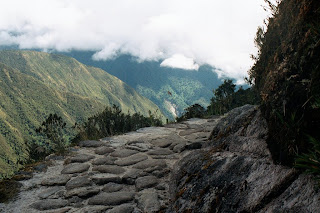
The Inca Trail took 4 days - climbing 3 passes, the highest being 4200m. The first 2 days are more strenuous and longer than the last 2. We saw some impressive Inca ruins on the way and walked through subtropical jungle along the Inca path which has many steps. On the last day we woke up at 4am to walk to the Sun Gate which overlooks the ruined city of Machu Picchu. The idea is to be there at sunrise but it was overcast and misty. It was still special as we got glimpses of Machu Picchu through the mist.
Spent the morning exploring the ruins which are very well preserved and then walked down to the town of Aguas Calientes where we had lunch and a soak in the hot springs before catching the 4.30pm train back to Cusco. It was a scrum just to get on the train and then it was very full for the first hour before many people got off. Trevor had a hot sweaty little boy sleeping with his head on his leg. The rest of the way we were entertained by children playing the panpipes and drums and tourists pulling faces at children.
From: Vilcabamba, Ecuador
Posted on: Thursday, December 16
Flew Cusco - Lima ($59), Lima - Tumbes ($89) on 7/12. Tumbes airport plagued by mosquitos and we got very bitten. Crossed the border to Ecuador at Huaquillas where we were confronted with fraudsters and conmen who wanted to change money at a tenth of the rate using rigged calculators. $1 = 17100 Sucres and they thought we may not notice the missing zero.
Caught bus to Loja ($2,30) in Ecuador?s Southern Sierra and stayed the night there before continuing to Vilcabamba. We are staying at Madre Tierra Health Spa 2 kms from town. Idyllic setting on lush hillside overlooking valley. Lots of trees, colourful birds and hammocks to relax in, as well as a pool and bar. Accommodation in private cabins including delicious breakfasts and dinner, as much as you can eat, $11 each for everything. Jax had spa treatment - jacuzzi, body rub and facial (about $12).
Dragged ourselves away from Madre Tierra for 3 days to do a horse trekking trip to the nearby Podocarpus National Park - $75 each, all inclusive. Rode up the mountain to a refuge on day 1 and walked to nearby waterfalls. On day 2 walked through thick cloud forest, in the rain and mud, to a lake. Dried our clothes by the fire that night. On day 3 rode back down to Vilcabamba. The trail had deteriorated with the rain and we had to get off and walk in places, especially after Jax?s horse slipped and fell with her on it. We also hired bicycles for a couple of hours and explored the back roads of the area.
From: Riobamba, Ecuador
Posted on: Saturday, December 25
Left Vilcabamba 17/12. Caught a lift with Jaime, the owner, to Loja and from there caught the bus to Cuenca - 6hrs. Spent a few days in Cuenca. Went to some hot springs and saw some Christmas parades. Also went to Ingapirca Inca ruins for the day and did some walking. Tried to go to Cajas National Park but the once-a-day, 6am bus didn?t arrive.
Left Cuenca on 21/12 on another 6hr (200km) bus trip to Riobamba in an air-conditioned bus without air conditioning. All we saw was clouds. The road was a branch of the Pan America Highway! The first night in Riobamba we stayed in a terribly depressing hotel called Hostal Segovia ($4 p/rm) - dirty and run by an old hag. Moved very quickly the next morning to Hotel Montecarlo ($8 p/rm) inc. en-suite bathroom and TV. Saw amazing and colourful Christmas parades on 23 and 24/12 - much better than Cuenca. Children dressed up in different costumes doing line dancing behind trucks playing loud music. The themes range from animals to traditional dress and religious. The one was so big we watched for over an hour as it went past.
Went cycling on Christmas Eve to some thermal springs in the surrounding foothills. Over 60km half on tar and half on dirt. Fantastic views of Chimboraza, the highest mountain in Ecuador (6300m) and the smoking volcano. Bathed in the very hot springs which have not finished being built yet. We hired bikes and guide from ProBici, run by a guy who is mountain biking mad and speaks perfect English. It is not his main business but a sideline. Really good quality bicycles - Cannondales, Trek, GT, Klein, Centurion with top of the range components. Had Christmas dinner that night at the hotel restaurant. Had tomales (corn dumplings wrapped in banana leaves), consommé, stuffed turkey with roast potatoes, vegetables, rice and salad, pastry in honey for dessert. Could choose between white wine and champagne. We tried the champagne which was unlike any champagne we?ve ever had - it was not bubbly and tasted more like a dessert wine.
Went Christmas shopping in the traditional markets on Christmas day. Even though it is a holiday, Saturday is still market day and the Indians come from the surrounding countryside to trade. We bought some wall hangings and weavings. Saw cooked pigs heads, racks of ribs getting chopped up by axes, live and dead chickens, live guinea pigs ready to cook, lots of fruit and vegetables. Also tried on a poncho and almost bought a hammock. The Internet cafe is very busy today - lots of people using NetPhone. Thank you for all the Christmas messages - its good to hear from everyone on Christmas day.
From: Riobamba - train ride
Posted on: Friday, December 31
Did the famous 'Nariz del Diablo' rooftop train ride on boxing day. Woke up at 5am (as per the guidebooks suggestion) to buy tickets at 5.30 but ended up waiting till 6.30 before we could buy them. The train was supposed to leave at 7am but the driver never arrived because he was drunk from Christmas festivities. A replacement driver was found but we only left at about 8.30. The 'train' was actually a bus with train wheels and the best views are from the roof rack. We climbed on top after the first stop - it was too cold from the beginning. The train used to go all the way to the coast from Quito but now it only goes from Riobamba to Alausi and then to the Devils Nose and back. This is the most scenic section and the tracks do a couple of switchbacks. However we didn't think it was as exciting as everyone made it out to be. It was expensive too at $15 each.
The next day we went to a nearby carpet weaving town called Guano to go swimming in the first 25m pool we have come across so far. It was filled with spring water and was very cold. We didn't last too long in the water. We have just returned from a 3 day trekking/climbing trip to Carihuairazo mountain (5020m). It is an extinct volcano and lies next to Ecuador's highest mountain, Chimborazo (6300m). We had excellent views of Chimborazo and on the second day walked up to the glacier for acclimatisation. Today we started walking at 4.30am to climb Carihuairazo using crampons and ice axes. We did the trip through Julio Verne - there are pictures on their web site.
From: Quito, Ecuador
Posted on: Saturday, January 01, 2000
Well - the Internet still seems to be working! Spent New Year in Quito. Arrived yesterday afternoon and the streets were packed with people already. They have all these stuffed 'puppets' which represent all the bad things of the past year and they burn them on Old Years Eve. There were also lots of street venders and games and everyone wears masks. On the bus trip from Riobamba to Quito we went through 'road blocks' set up by young guys dressed in drag. It was pretty weird because at about 11pm the party ended - apparently everyone goes home to see the New Year in. So only the Gringos were left in the centre.
From: Quito, Ecuador
Posted on: Saturday, January 01
Well - the Internet still seems to be working! Spent New Year in Quito. Arrived yesterday afternoon and the streets were packed with people already. They have all these stuffed 'puppets' which represent all the bad things of the past year and they burn them on Old Years Eve. There were also lots of street venders and games and everyone wears masks. On the bus trip from Riobamba to Quito we went through 'road blocks' set up by young guys dressed in drag. It was pretty weird because at about 11pm the party ended - apparently everyone goes home to see the New Year in. So only the Gringos were left in the centre.
Posted on: Saturday, November 28
Went from La Paz to Sorata (4 - 5 hours by bus), a village in a valley below the Cordillera Real mountains in Bolivia. Lots of old Spanish colonial buildings with central courtyards built around the town square. There was no Internet access there. Saw a political rally in progress which was very loud and went on all day. We arranged to do the 7 day Illampu Circuit trek at the Sorata Guides Office, in Spanish, for $10 per day for guide and mule. Food is then bought at the market with the guide.
Our guide was Jaime with his mule, Pancho who carried the food, tents and sleeping bags. Jaime cooked for us and we were well fed - porridge for breakfast; bread, cheese, eggs and jam for lunch; soup, pasta/rice/smash with tinned fish for supper and lots of tea. But we had heartburn after 6 days of purifying our drinking water with iodine tablets. The scenery was awesome - we climbed 5 passes over 4600m and the highest was 5045m. Glacial peaks towered above us - the highest (Illampu) at 6300m. It was good that we had Jaime as on the 5th day the local farmers were not very friendly and wanted money ($50) from us but Jaime talked them out of it. One night it was so cold that our tent zip froze solid and we had to wait till sunrise before we could get out.
After a days rest and doing laundry in Sorata, we caught a combination of three buses from Sorata to Puno which took basically the whole day. In the one bus we both sat in front - Jacqui was perched on a child seat you wouldn?t even know existed between the driver and window and Trevor was on a wooden stool on the other side. Staying in a swish hotel, Manco Capac, in Puno for only $10. Its a new hotel and a special price for us - a promotion, but we musn?t tell anyone. The usual price is $20. En suite bathroom and very clean. Today we went by boat to the floating reed islands of Uros on the lake. Over 400 families live on these islands which are made of woven reeds. The newer ones feel bouncy when you walk on them.
From: Cusco, Peru
Posted on: Sunday, December 05
Caught the train from Puno to Cusco. It took 12 hours during the day and the scenery was good. Cost $19 each which is quite expensive for here but the train is much more comfortable than the bus although a bit slower. Spent a day in Cusco and caught another train to km88 to start the Inca trail the next day. The train left at 7am and took 3 hours to km88.

The Inca Trail took 4 days - climbing 3 passes, the highest being 4200m. The first 2 days are more strenuous and longer than the last 2. We saw some impressive Inca ruins on the way and walked through subtropical jungle along the Inca path which has many steps. On the last day we woke up at 4am to walk to the Sun Gate which overlooks the ruined city of Machu Picchu. The idea is to be there at sunrise but it was overcast and misty. It was still special as we got glimpses of Machu Picchu through the mist.
Spent the morning exploring the ruins which are very well preserved and then walked down to the town of Aguas Calientes where we had lunch and a soak in the hot springs before catching the 4.30pm train back to Cusco. It was a scrum just to get on the train and then it was very full for the first hour before many people got off. Trevor had a hot sweaty little boy sleeping with his head on his leg. The rest of the way we were entertained by children playing the panpipes and drums and tourists pulling faces at children.
From: Vilcabamba, Ecuador
Posted on: Thursday, December 16
Flew Cusco - Lima ($59), Lima - Tumbes ($89) on 7/12. Tumbes airport plagued by mosquitos and we got very bitten. Crossed the border to Ecuador at Huaquillas where we were confronted with fraudsters and conmen who wanted to change money at a tenth of the rate using rigged calculators. $1 = 17100 Sucres and they thought we may not notice the missing zero.
Caught bus to Loja ($2,30) in Ecuador?s Southern Sierra and stayed the night there before continuing to Vilcabamba. We are staying at Madre Tierra Health Spa 2 kms from town. Idyllic setting on lush hillside overlooking valley. Lots of trees, colourful birds and hammocks to relax in, as well as a pool and bar. Accommodation in private cabins including delicious breakfasts and dinner, as much as you can eat, $11 each for everything. Jax had spa treatment - jacuzzi, body rub and facial (about $12).
Dragged ourselves away from Madre Tierra for 3 days to do a horse trekking trip to the nearby Podocarpus National Park - $75 each, all inclusive. Rode up the mountain to a refuge on day 1 and walked to nearby waterfalls. On day 2 walked through thick cloud forest, in the rain and mud, to a lake. Dried our clothes by the fire that night. On day 3 rode back down to Vilcabamba. The trail had deteriorated with the rain and we had to get off and walk in places, especially after Jax?s horse slipped and fell with her on it. We also hired bicycles for a couple of hours and explored the back roads of the area.
From: Riobamba, Ecuador
Posted on: Saturday, December 25
Left Vilcabamba 17/12. Caught a lift with Jaime, the owner, to Loja and from there caught the bus to Cuenca - 6hrs. Spent a few days in Cuenca. Went to some hot springs and saw some Christmas parades. Also went to Ingapirca Inca ruins for the day and did some walking. Tried to go to Cajas National Park but the once-a-day, 6am bus didn?t arrive.
Left Cuenca on 21/12 on another 6hr (200km) bus trip to Riobamba in an air-conditioned bus without air conditioning. All we saw was clouds. The road was a branch of the Pan America Highway! The first night in Riobamba we stayed in a terribly depressing hotel called Hostal Segovia ($4 p/rm) - dirty and run by an old hag. Moved very quickly the next morning to Hotel Montecarlo ($8 p/rm) inc. en-suite bathroom and TV. Saw amazing and colourful Christmas parades on 23 and 24/12 - much better than Cuenca. Children dressed up in different costumes doing line dancing behind trucks playing loud music. The themes range from animals to traditional dress and religious. The one was so big we watched for over an hour as it went past.
Went cycling on Christmas Eve to some thermal springs in the surrounding foothills. Over 60km half on tar and half on dirt. Fantastic views of Chimboraza, the highest mountain in Ecuador (6300m) and the smoking volcano. Bathed in the very hot springs which have not finished being built yet. We hired bikes and guide from ProBici, run by a guy who is mountain biking mad and speaks perfect English. It is not his main business but a sideline. Really good quality bicycles - Cannondales, Trek, GT, Klein, Centurion with top of the range components. Had Christmas dinner that night at the hotel restaurant. Had tomales (corn dumplings wrapped in banana leaves), consommé, stuffed turkey with roast potatoes, vegetables, rice and salad, pastry in honey for dessert. Could choose between white wine and champagne. We tried the champagne which was unlike any champagne we?ve ever had - it was not bubbly and tasted more like a dessert wine.
Went Christmas shopping in the traditional markets on Christmas day. Even though it is a holiday, Saturday is still market day and the Indians come from the surrounding countryside to trade. We bought some wall hangings and weavings. Saw cooked pigs heads, racks of ribs getting chopped up by axes, live and dead chickens, live guinea pigs ready to cook, lots of fruit and vegetables. Also tried on a poncho and almost bought a hammock. The Internet cafe is very busy today - lots of people using NetPhone. Thank you for all the Christmas messages - its good to hear from everyone on Christmas day.
From: Riobamba - train ride
Posted on: Friday, December 31
Did the famous 'Nariz del Diablo' rooftop train ride on boxing day. Woke up at 5am (as per the guidebooks suggestion) to buy tickets at 5.30 but ended up waiting till 6.30 before we could buy them. The train was supposed to leave at 7am but the driver never arrived because he was drunk from Christmas festivities. A replacement driver was found but we only left at about 8.30. The 'train' was actually a bus with train wheels and the best views are from the roof rack. We climbed on top after the first stop - it was too cold from the beginning. The train used to go all the way to the coast from Quito but now it only goes from Riobamba to Alausi and then to the Devils Nose and back. This is the most scenic section and the tracks do a couple of switchbacks. However we didn't think it was as exciting as everyone made it out to be. It was expensive too at $15 each.
The next day we went to a nearby carpet weaving town called Guano to go swimming in the first 25m pool we have come across so far. It was filled with spring water and was very cold. We didn't last too long in the water. We have just returned from a 3 day trekking/climbing trip to Carihuairazo mountain (5020m). It is an extinct volcano and lies next to Ecuador's highest mountain, Chimborazo (6300m). We had excellent views of Chimborazo and on the second day walked up to the glacier for acclimatisation. Today we started walking at 4.30am to climb Carihuairazo using crampons and ice axes. We did the trip through Julio Verne - there are pictures on their web site.
From: Quito, Ecuador
Posted on: Saturday, January 01, 2000
Well - the Internet still seems to be working! Spent New Year in Quito. Arrived yesterday afternoon and the streets were packed with people already. They have all these stuffed 'puppets' which represent all the bad things of the past year and they burn them on Old Years Eve. There were also lots of street venders and games and everyone wears masks. On the bus trip from Riobamba to Quito we went through 'road blocks' set up by young guys dressed in drag. It was pretty weird because at about 11pm the party ended - apparently everyone goes home to see the New Year in. So only the Gringos were left in the centre.
From: Quito, Ecuador
Posted on: Saturday, January 01
Well - the Internet still seems to be working! Spent New Year in Quito. Arrived yesterday afternoon and the streets were packed with people already. They have all these stuffed 'puppets' which represent all the bad things of the past year and they burn them on Old Years Eve. There were also lots of street venders and games and everyone wears masks. On the bus trip from Riobamba to Quito we went through 'road blocks' set up by young guys dressed in drag. It was pretty weird because at about 11pm the party ended - apparently everyone goes home to see the New Year in. So only the Gringos were left in the centre.
Backpacking South America: Peru, Bolivia and Ecuador (Part I)
From: At home, Redhill, Surrey, UK
Posted on: Wednesday, September 15
Excitement is building - only 1 month to go. Our tickets arrived today. We still have some preparation to do - we have to get Venezuelan visas and malaria tablets. We haven't decided which sleeping bags to take or whether we need to buy more, nor whether to buy the latest South American handbook or use the 1996 edition lent to us by Richard and Lisa. We met Dave's friend, Paddy, who recommended not using the Lonely Planet, as it leads you to all the tourist traps. He promised to give us some tips which he learned on his recent trip to South America. The Spanish lessons have started but are progressing slowly. Thank you, Paul and Wendy for the LOAN of the 'Learn to Speak Spanish' CD ROM. It's really cool. We speak into the mic and it tells us if we're we're wrong or right. Adios.
From: Cape Town, South Africa
Posted on: Thursday, October 28
Have spent 2 weeks visiting our families and friends in our home town, Cape Town in South Africa, enjoying the sunshine and of course the good ol' Cape Doctor (i.e. the SE wind for non-Capetonians). We spent 3 days in the Cederberg Mountains, visited Robben Island and saw Mandela's cell, climbed Devil's Peak and narrowly escaped being bitten by 2 puffadders, did the wine route and sampled Cape cuisine which seems very cheap after London.
From: Lima, Peru
Posted on: Thursday, November 04
After our short holiday in Cape Town, we flew back to London and then flew to Lima in Peru to start our South American adventure. We arrived last night and are staying at Mochilero's Backpackers ($25 p/rm) in Baranca, a seaside suburb of Lima. The hostel looks very palatial from the outside and the public areas but our room is quite drab and smelt musty although it is clean. Lima is big and busy, very polluted. Taxis everywhere, not as cheap as we expected. Went to the South American Explorers Club to get maps - discovered that they now have a club house in Cusco too so there really is no need to hang around Lima. We are flying to Arequipa tomorrow.
From: Arequipa, Peru
Posted on: Wednesday, November 10

Spent 3 days in the Colca Canyon which is a day's drive from Arequipa. Took a 'tour' on the way there, and went over a pass of 4800m in the bus - we didn't feel too well with headaches and nausea. Stayed in a village called Chivay at the entrance to the canyon, swam in hot springs and were entertained by folk musicians like on Leicester Sq. Woke up early next day to go and see Condors further up the valley. Tour cost $21 each for 2 days inc. transport there and back and to Condor viewpoint, smart accommodation with breakfast in Chivay, folk music evening. Other meals excluded but cheap @ $3 for 3 course meal. Entrance to hotsprings $1. We didn't go back with the tour but instead walked to the furthest village, Cabanaconde, and walked down the canyon to an oasis where we could swim. Camped there for one night ($1 each) and hiked to the villages of Malata and Cosua overlooking the canyon on the other side - good views into the canyon. That evening we walked back up the canyon and spent the night in Cabanaconde at Valle del Fuego hostal, a characterful little shack - $6 p/rm, dinner $1.50, breakfast $1. Took the local bus back to Arequipa the next day ($4 each) - dirt road the whole way. Didn?t feel sick over the pass.
Staying at Hostal Posada de Sancho in Arequipa - not cheap but very nice @ $14 p/rm.
From: La Paz, Bolivia
Posted on: Monday, November 15
Caught the overnight train ($8.50 each) from Arequipa to Puno on the banks of Lake Titicaca (3800m) but still in Peru. It took 13 hours and got very cold during the night. Altitude was 4600m but we felt fine. Crossed the border to Copacabana on the Bolivian side. Saw trucks being blessed and pilgrims using model cars, houses and other material things as symbols of what they are praying for. Paid $3-4 p/rm. Met 2 South Africans who were impressed at how far their Rands were going. 3 course meals for $2. The women wear big bright skirts and small bowler hats and have long plaited hair.
Took a boat to the Isla del Sol on Lake Titicaca, just off the Copacabana and spent 2 nights camping there for free. Walked the whole island and witnessed a local festival with bands and people dressed in bread rolls! Apparently it was the end of the school term. Met quite a few English speaking travellers and picked up some good tips from them. Buying food was difficult as there seemed to be a shortage. Tried to swim in the lake but it was not very warm. It is crystal clear and a deep blue.
Took a bus from Copacabana to La Paz ($2 each) - the city is quite something to see, as it is in a basin surrounded by snow capped peaks. There is a demonstration going on outside. Peasants are protesting for right to grow cocoa. Since being in Bolivia we have had some short bursts of heavy rain and thunder and lightening. There are loads of Internet cafes here and they are full. Accommodation in Hotel Alem is $8 for a room. Had a vegetarian lunch at a Hare Krishna restaurant. We have been eating well e.g. good fish (trout) from Lake Titicaca, normally served with rice and chips.
From: La Paz, Bolivia
Posted on: Wednesday, November 17
Today we climbed a mountain near La Paz called Chacaltaya which was 5600m. It has a glacier which has the worlds highest ski lift (5400m) which is not working at the moment - this means walking to the top of the ski slope! The climb to the peak wasn?t difficult - basically just a walk to the top - but the altitude is the problem and it affected Trevor. It was snowing at the top. At the refuge there was a cute baby llama which belonged to the caretaker. It was fluffy and warm when you put your hand under it?s fur and very affectionate too. It drank milk from a babybottle. We also saw lots of big llamas on the way there and back. We got transport through the Club Andino Boliviana for $10 each.
Posted on: Wednesday, September 15
Excitement is building - only 1 month to go. Our tickets arrived today. We still have some preparation to do - we have to get Venezuelan visas and malaria tablets. We haven't decided which sleeping bags to take or whether we need to buy more, nor whether to buy the latest South American handbook or use the 1996 edition lent to us by Richard and Lisa. We met Dave's friend, Paddy, who recommended not using the Lonely Planet, as it leads you to all the tourist traps. He promised to give us some tips which he learned on his recent trip to South America. The Spanish lessons have started but are progressing slowly. Thank you, Paul and Wendy for the LOAN of the 'Learn to Speak Spanish' CD ROM. It's really cool. We speak into the mic and it tells us if we're we're wrong or right. Adios.
From: Cape Town, South Africa
Posted on: Thursday, October 28
Have spent 2 weeks visiting our families and friends in our home town, Cape Town in South Africa, enjoying the sunshine and of course the good ol' Cape Doctor (i.e. the SE wind for non-Capetonians). We spent 3 days in the Cederberg Mountains, visited Robben Island and saw Mandela's cell, climbed Devil's Peak and narrowly escaped being bitten by 2 puffadders, did the wine route and sampled Cape cuisine which seems very cheap after London.
From: Lima, Peru
Posted on: Thursday, November 04
After our short holiday in Cape Town, we flew back to London and then flew to Lima in Peru to start our South American adventure. We arrived last night and are staying at Mochilero's Backpackers ($25 p/rm) in Baranca, a seaside suburb of Lima. The hostel looks very palatial from the outside and the public areas but our room is quite drab and smelt musty although it is clean. Lima is big and busy, very polluted. Taxis everywhere, not as cheap as we expected. Went to the South American Explorers Club to get maps - discovered that they now have a club house in Cusco too so there really is no need to hang around Lima. We are flying to Arequipa tomorrow.
From: Arequipa, Peru
Posted on: Wednesday, November 10

Spent 3 days in the Colca Canyon which is a day's drive from Arequipa. Took a 'tour' on the way there, and went over a pass of 4800m in the bus - we didn't feel too well with headaches and nausea. Stayed in a village called Chivay at the entrance to the canyon, swam in hot springs and were entertained by folk musicians like on Leicester Sq. Woke up early next day to go and see Condors further up the valley. Tour cost $21 each for 2 days inc. transport there and back and to Condor viewpoint, smart accommodation with breakfast in Chivay, folk music evening. Other meals excluded but cheap @ $3 for 3 course meal. Entrance to hotsprings $1. We didn't go back with the tour but instead walked to the furthest village, Cabanaconde, and walked down the canyon to an oasis where we could swim. Camped there for one night ($1 each) and hiked to the villages of Malata and Cosua overlooking the canyon on the other side - good views into the canyon. That evening we walked back up the canyon and spent the night in Cabanaconde at Valle del Fuego hostal, a characterful little shack - $6 p/rm, dinner $1.50, breakfast $1. Took the local bus back to Arequipa the next day ($4 each) - dirt road the whole way. Didn?t feel sick over the pass.
Staying at Hostal Posada de Sancho in Arequipa - not cheap but very nice @ $14 p/rm.
From: La Paz, Bolivia
Posted on: Monday, November 15
Caught the overnight train ($8.50 each) from Arequipa to Puno on the banks of Lake Titicaca (3800m) but still in Peru. It took 13 hours and got very cold during the night. Altitude was 4600m but we felt fine. Crossed the border to Copacabana on the Bolivian side. Saw trucks being blessed and pilgrims using model cars, houses and other material things as symbols of what they are praying for. Paid $3-4 p/rm. Met 2 South Africans who were impressed at how far their Rands were going. 3 course meals for $2. The women wear big bright skirts and small bowler hats and have long plaited hair.
Took a boat to the Isla del Sol on Lake Titicaca, just off the Copacabana and spent 2 nights camping there for free. Walked the whole island and witnessed a local festival with bands and people dressed in bread rolls! Apparently it was the end of the school term. Met quite a few English speaking travellers and picked up some good tips from them. Buying food was difficult as there seemed to be a shortage. Tried to swim in the lake but it was not very warm. It is crystal clear and a deep blue.
Took a bus from Copacabana to La Paz ($2 each) - the city is quite something to see, as it is in a basin surrounded by snow capped peaks. There is a demonstration going on outside. Peasants are protesting for right to grow cocoa. Since being in Bolivia we have had some short bursts of heavy rain and thunder and lightening. There are loads of Internet cafes here and they are full. Accommodation in Hotel Alem is $8 for a room. Had a vegetarian lunch at a Hare Krishna restaurant. We have been eating well e.g. good fish (trout) from Lake Titicaca, normally served with rice and chips.
From: La Paz, Bolivia
Posted on: Wednesday, November 17
Today we climbed a mountain near La Paz called Chacaltaya which was 5600m. It has a glacier which has the worlds highest ski lift (5400m) which is not working at the moment - this means walking to the top of the ski slope! The climb to the peak wasn?t difficult - basically just a walk to the top - but the altitude is the problem and it affected Trevor. It was snowing at the top. At the refuge there was a cute baby llama which belonged to the caretaker. It was fluffy and warm when you put your hand under it?s fur and very affectionate too. It drank milk from a babybottle. We also saw lots of big llamas on the way there and back. We got transport through the Club Andino Boliviana for $10 each.
Subscribe to:
Posts (Atom)
